
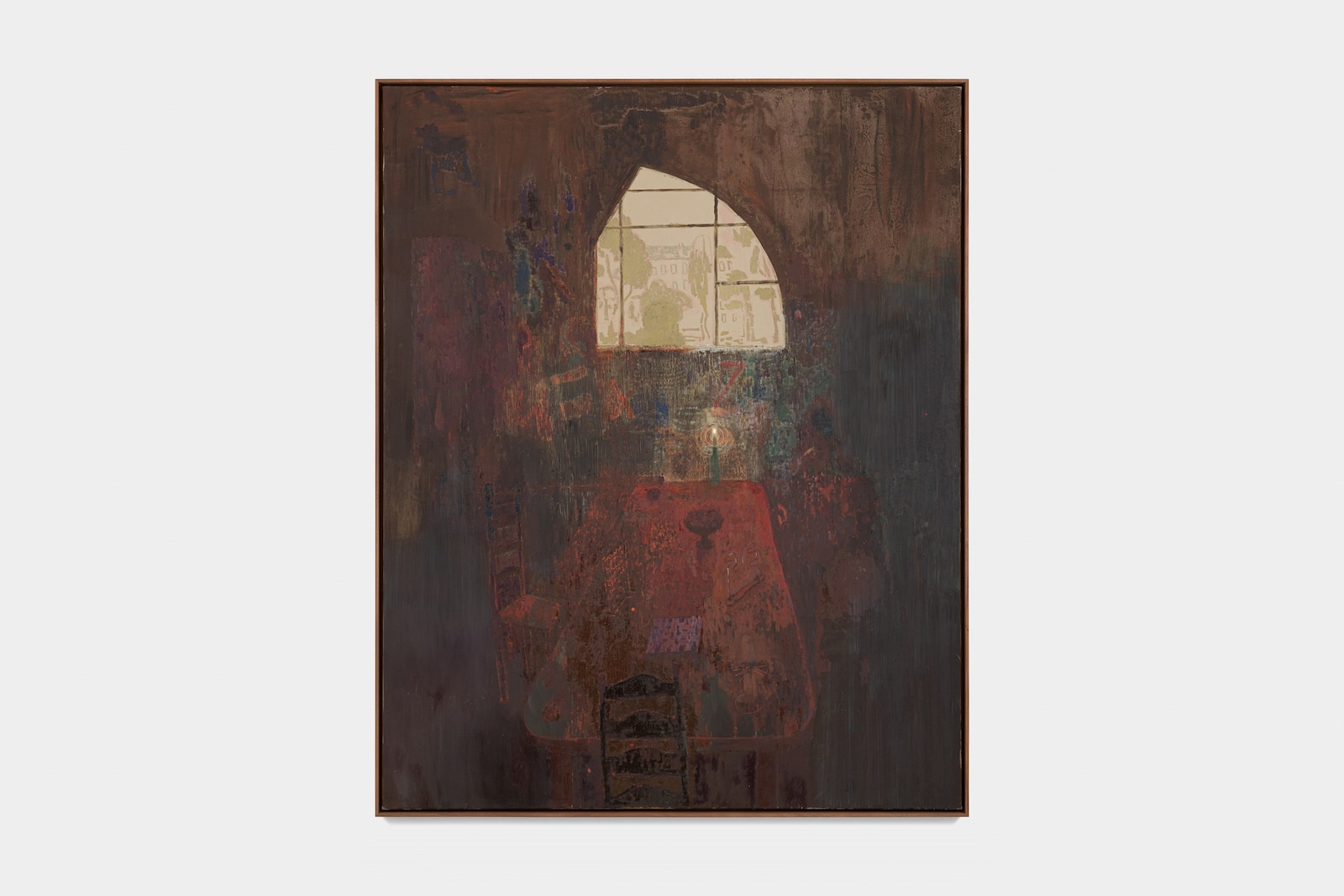
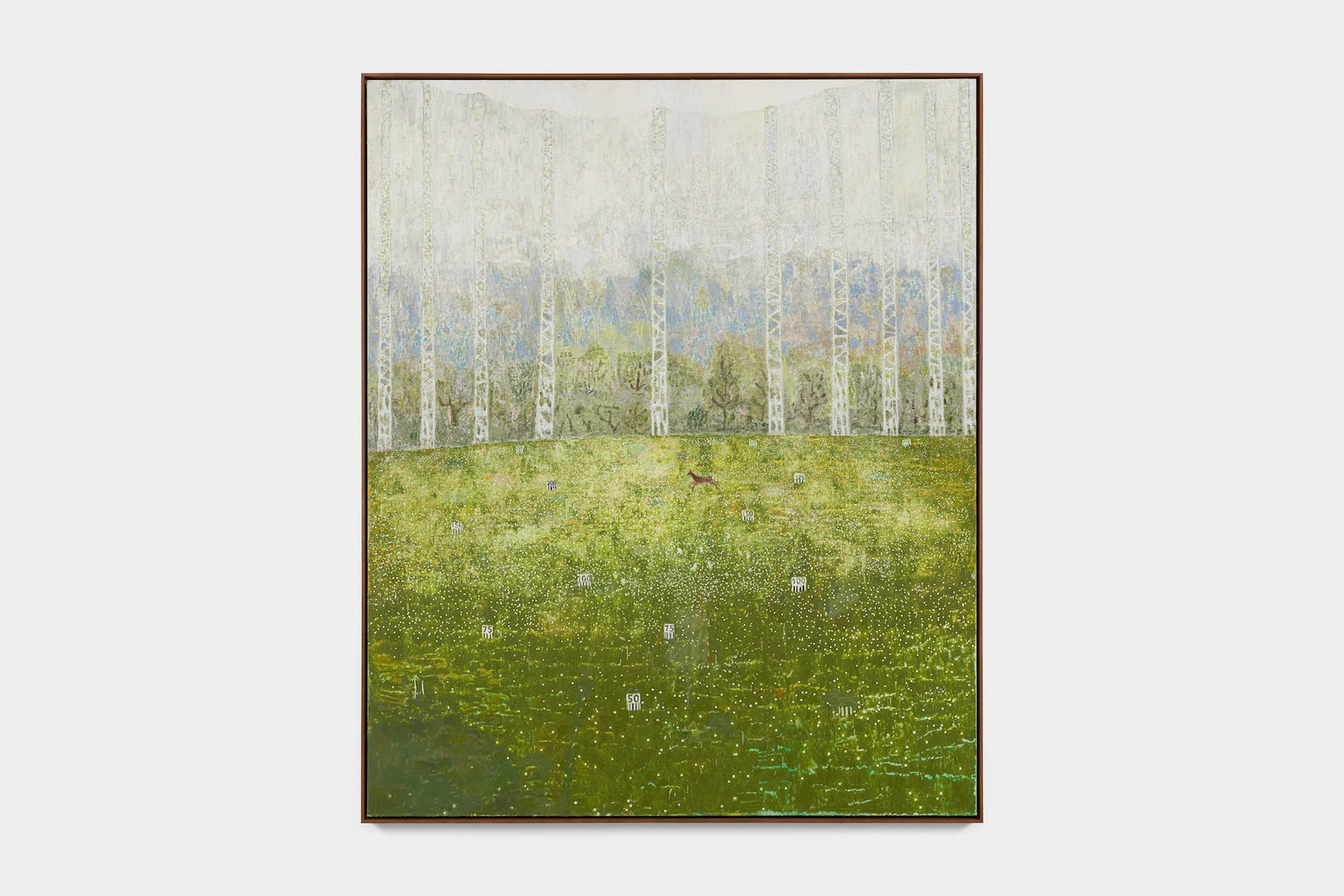
Andrew Cranston was on the golf course thinking about Bruegel. “It’s the curse of being an artist,” he says. “Or a blessing. You never switch off – your antennas are always up.” He was thinking about landscape; how the perfectly cut green dipped and curved, like the sloping, meandering expanses of the Flemish painter’s worlds. “In some ways, golf was the first time I really experienced landscape,” he adds.
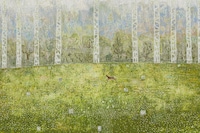
We’re standing in front of I thought I saw an eagle, one of eleven paintings in his latest exhibition, I’m going in a field at Modern Art in London. The painting centres on a view of the 16th hole of a course near Hawick, the town in Scotland where Cranston grew up. Industrial chimneys rise behind, remnants of the town’s textile past, where Lyle & Scott, a clothing brand favoured by many golfers, is based. The golden eagle, lifted from the brand’s logo, flies overhead.
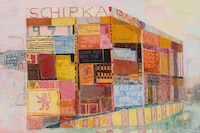
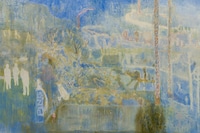
“I realise golf is almost a taboo subject, it’s so uncool,” he says. “But this is more about landscape than it is golf. And besides, this course isn’t posh. It costs £9 a round – no clubhouse.” It’s a detail that feels in keeping. Recognition came later for Cranston, with exhibitions at Ingleby Gallery in Edinburgh in his forties bringing his work wide attention, after more than two decades of painting. Since then, his paintings have taken him to New York and Los Angeles with his US gallery, Karma, and to London and Paris with Modern Art. However, it was a smaller exhibition last summer in Stromness, on Scotland’s Orkney Islands – curated by fashion designer Jonathan Anderson and Richard Ingleby – that he returns to. “The beauty of the place … we were all swimming,” he says. “It didn’t feel much about the art world, more like how art might exist within a community.”
Cranston’s paintings begin with what he calls a kind of “creative misremembering”. Things slip, tilt, or hover slightly out of place – a “kink in reality”, the kind of license he once found troubling in Marc Chagall, and now leans into. From Pierre Bonnard comes that sense of the domestic (he says he thinks about the French painter every time he has a bath); and something of Giorgio Morandi lies in his return to the same subjects – candlelit rooms, snakes, still lifes – again and again. Having studied under Peter Doig, he treats colour as something to be tested, capable of being both seductive and destabilising. And like Paul Cézanne, he struggles to know when a painting is finished, working on multiple paintings at once. Today, his work sits within Modern Art’s particularly strong roster of contemporary painters, alongside Justin Caguiat, Francesca Mollett and Joseph Yaeger.
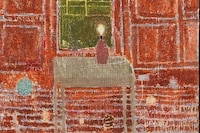
Swimming hasn’t quite made it into this show, but a number of other sports have. A squash court appears in In the white room, where two figures face off beneath stark lighting; elsewhere, No lines allowed shows a candlelit interior set around a chessboard and that childhood game where you guide a metal wand along a twisted wire without letting it buzz. In a smaller room at the back of the gallery hangs Scotland v England, a view of Cranston’s local cricket pitch.
Cranston isn’t shy of colour, and there’s a sense of pleasure in the way he handles it. Skies arrive in a blue one suspects Scotland rarely delivers; interiors draw into a single palette – not far from Matisse’s red studios and Picasso’s blue rooms – their candlelit glow pulling you in, tempting you to take a seat. A cricket pitch takes on that lush felted green of a poker table, its surface pixelated with daubs of oil that flicker between daisies and golf balls. Acrylic and oil are worked into a surface first dyed and then bleached back in places, so that it shifts between matte, gloss, and wash. These are recognisable places – his local cricket ground, his golf course – but they’re reworked, seen through a kind of kaleidoscopic lens, where memory splints and reforms into something brighter, and stranger, and just quite magical.

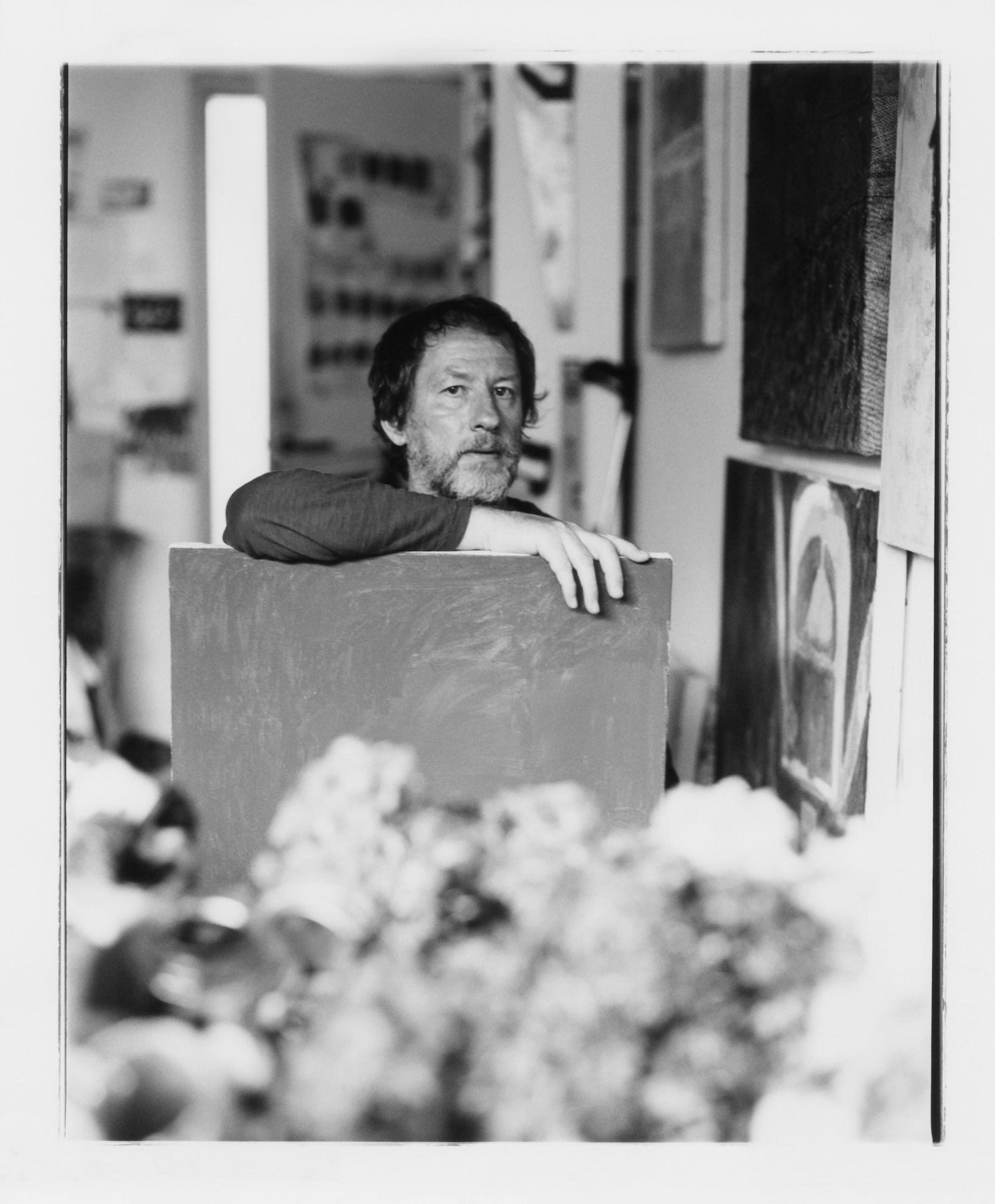
What interests him is not so much the activity of sport, but rather the spaces where the action and emotion play out. “Sport can feel absurd – it’s consuming, and much of the time you’re just trying to get a ball into a hole. But you take it very seriously. It’s like painting: you’re in a room all day, it feels quite absurd, but you care about it.”
For Cranston, that room is in Glasgow, where he has been based for nearly 30 years. He works in a studio next door to his wife, the artist Lorna Robertson; the two come together for tea breaks between stretches of work. His studio, floor to wall with books, newspaper scraps, and paintings past, gives Rose Wylie’s famously upside-down one a run for its money. He works on several paintings at once, allowing them to develop slowly, in parallel.
It’s a method that explains how he’s arrived at eleven paintings – many large, all dated 2026, and all dry in time for the exhibition’s opening. When I remark on being able to smell the paint in Scotland v England – those thick licks of oil worked across the surface – he tells me he had in fact considered adding rosemary from the bushes lining the cricket pitch to the canvas. In Empty Nesting, where two rugby posts are seen through a window, he had also entertained the idea of basting the surface with Deep Heat, a smell he associates with a rugby locker room. Both works are painted onto coffee-bag netting – a recent experiment in his practice, gathered from a coffee shop near his studio – which encourages the paint to sink, pool and catch into its crevices. “I’m interested in creating a surface that slows how it’s read, holding the viewer there – a kind of slow release where you don’t see everything at once,” he says.
His titles give you something else to think through, gathered as fragments: a phrase Cranston overheard on the train, a thought he may have had in the bath, noted in his phone and returned to later. “I almost just title the moment,” he says. Opening up his phone, he scrolls through a list of hundreds, his thumb landing on: “nearly running over an elderly Chinese woman”; “meringues” (his mother used to make great ones); “a man crying in the bath fully clothed.” Some find their way into the paintings; most remain where they are.

“Chay Blyth in the doldrums” found its way through. For a town nearly 60 miles from the sea, it’s perhaps surprising that one of Hawick’s most famous figures was a sailor. Chay Blyth was a yachtsman and adventurer who, in 1971, became the first person to sail single-handed non-stop westward around the world. “He’s a bit of a local hero,” says Cranston, “Many streets in Hawick are named after him.” Cranston paints Blyth sitting in ‘British Steel’, the 59-foot boat that carried him around the world. An albatross passes overhead. The palette is overexposed, depicting how the world might begin to look after too much sun and too little water. Standing in front of the painting, you find yourself squinting. The sails hang open, no wind, no waves, only the flat calm so common (and so feared) to that narrow belt that wraps the equator.
In golf, an albatross is a near-impossible score (three under par on a single shot); at sea, a sign of luck, a carrier of wind. Blyth’s journey, once described in the press as an “impossible voyage,” carries the same sense of improbability. Out there, progress depends on something barely perceptible – a shift in air, a small tension caught in your sail and held just long enough to carry you forward. “I think this image is interesting in relation to painting,” Cranston says, “which is a medium of stillness and silence – of inertia, in a way.” A work may sit in the studio for long stretches, its direction held in suspension. Then something intervenes – a find in the studio, a memory resurfacing, a view from the golf course – introducing a new tension to the image. Something shifts, and the painting begins to set sail.
I’m going in a field by Andrew Cranston is on show at Modern Art in London until 30 May 2026.
