
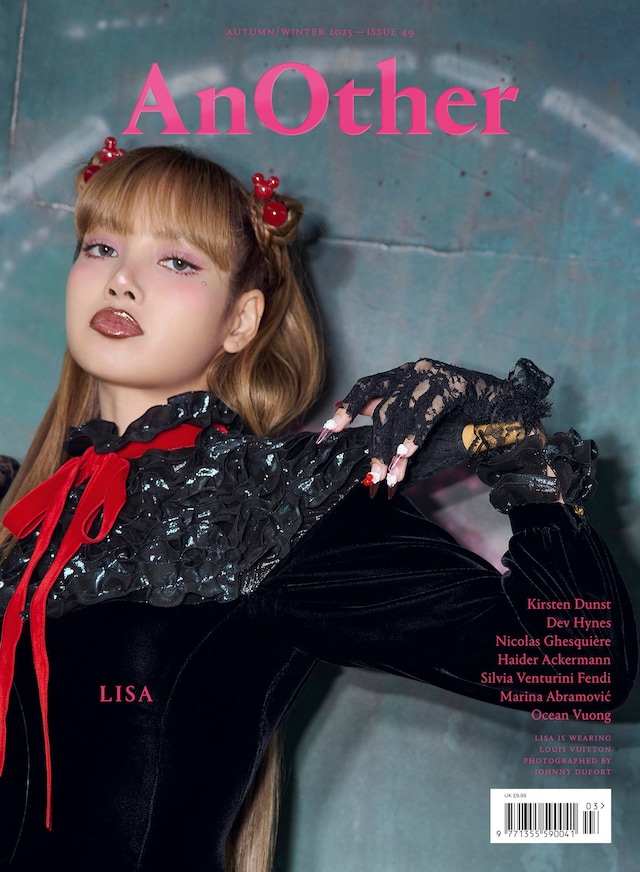
Read Susannah Frankel's introduction to the Autumn/Winter 2025 issue of AnOther Magazine
Read the latest issue of AnOther for free – or buy a copy of the print edition via Boutique Mags.
“Memory takes a lot of poetic licence. It omits some details; others are exaggerated, according to the emotional value of the articles it touches, for memory is seated predominantly in the heart.” Tennessee Williams’s stage directions, The Glass Menagerie, 1944 – in the writer’s own words, “a memory play”.
Each issue of AnOther Magazine is built upon a thematic. It is necessarily universal, allowing for imaginative reach, and is given to contributors to do with what they will – or not. It is not overt, more like a fil rouge to facilitate narrative, to underpin the structure of a title that draws upon a broad range of talent. They are the people who make it their own, transforming it into something specific, as it applies to their disparate thought processes – their universes. Rarely has their response to a single word been so evocative, so seated in the hearts of all who have worked with it. Their memories – deep-rooted, lyrical, selective – populate this issue, shifting the collective memories of our times, defining this moment and creating new memories for the future.
The impact of Lisa, one quarter of the blockbuster cultural phenomenon Blackpink, is shaping a young generation and reshaping those that came before. The singersongwriter, dancer and actor – her performance in The White Lotus snared a whole new audience – talks to Hans Ulrich Obrist about her life and career to date. The seeds for the latter were sown when she was just five years old. “I grew up an only child and my older cousin introduced me to Britney Spears’s music. I also listened to Beyoncé, Rihanna, Justin Bieber ... Then, when I was in my early teen years, I got into K-pop.” Lisa is photographed for this issue by Johnny Dufort and styled by Katie Shillingford.
We all have memories of Kirsten Dunst – we’ve watched her grow up before our eyes. “Her more than 70 roles to date have encompassed springy cheerleaders and catatonically depressed brides, haunted Southern belles and minimum-wage Florida firecrackers, indulged queens and battle-weary photojournalists, the connective tissue between them a bone-deep lived-in quality and her gift for projecting multiplicities with a look,” writes Hannah Lack, who meets the actor in the San Fernando Valley, Los Angeles. Dunst returns to our screens this year in the Swedish provocateur Ruben Östlund’s The Entertainment System Is Down and in the arthouse auteur Derek Cianfrance’s Roofman, based on the true story of escaped convict Jeffrey Manchester. In LA’s leafy Brentwood, Dunst is photographed by Marili Andre.
“The only reason I make music is excavation, you know? To work through things. I’m always thinking about the past,” says Dev Hynes, speaking to Connor Garel, ahead of the release of his latest Blood Orange album, Essex Honey. Hynes has been making music since his early teens, principally in his bedroom, which by no means limits his output: from film scores and TV soundtracks to dance-punk songs and classical symphonies. On Essex Honey he collaborates with, among others, Lorde and Zadie Smith. Hynes is photographed by Martina Hoogland Ivanow and styled by Ellie Grace Cumming in London.
Oscar Wilde wrote: “Memory is the diary that we all carry about with us.” This is especially true in the case of fashion, where memories can be resuscitated and revived with alacrity and ready acceptance. Nicolas Ghesquière has already gone down as one of the truly great designers of our time. His clothes are loaded with memories of his childhood: “It went from Philip K Dick to Blade Runner. I had the Alien poster. There were Flash Gordon comics. Music was more like the Cure. Grace Jones was huge for me, always.” His early obsession with Star Wars and David Lynch’s film adaptation of Dune is well known, as is his translation of that retrofuturistic aesthetic into clothes that speak of the now. “I thought that the big story of my life was going to be Balenciaga,” he says of his time at the head of that maison. “Now I realise that the big, beautiful story is going to be Louis Vuitton.” His Autumn/Winter 2025 collection for that house is photographed by Yorgos Lanthimos and styled by Nell Kalonji.
Haider Ackermann is currently reimagining, among the most potent memories of late-20th and early 21st-century fashion, the legacy of Tom Ford – still warm, considering how his past designs have become a touchstone for new talent. His debut for the house was standout. “We designers, when we take over houses, we are the keepers of memories, but we need to take them somewhere else,” he says. “And what remains in my memory is the importance, the essence. Perhaps it was just words from our conversations, perhaps it was the fantasy or the idea that I have about Mr Ford and his universe. Perhaps it wasn’t the clothes ... I wanted to honour the man because he put his trust in me.” Willy Vanderperre photographs and Olivier Rizzo styles this collection on a new generation – of club kids? – experiencing Tom Ford for the first time.
That same generation may, of course, have seen Juergen Teller’s seminal Nineties image of Kristen McMenamy naked, her body scrawled with lipstick. For this issue, Panos Yiapanis dresses her in layers of recent history, from Ghesquière’s Balenciaga and 90s Comme des Garçons to Raf Simons and Veronique Branquinho, and she is photographed alongside the performance artist Sgàire Teàrlag Wood: past, present and future.
Fendi celebrates its 100th anniversary this year. Silvia Venturini Fendi, its artistic director, still carries the name of the house her grandmother launched. She has designed accessories – including the sensational Baguette – for 31 years, but this season was responsible for a glorious centenary women’s ready-to-wear collection too. Having worked alongside the house’s previous artistic director Kim Jones, and Karl Lagerfeld before him, a relationship that prevailed for all of her working life, she has many a story to tell. “I love the archive, because it reminds me of many things,” she tells Alexander Fury. “Maybe I see a dress and I remember my mother wearing something similar. I see a coat and I remember the day we went out and she was wearing it. I have a very different reaction to our archive than my design team. I remember the emotion.” The new collection is photographed by Sharna Osborne and styled by Bianca Raggi.
This autumn, the artist Marina Abramović revisits her seminal 2005 video work Balkan Erotic Epic, an exploration of ancient folklore, in Manchester and on a scale even she hadn’t imagined possible before now: a four-hour immersive performance with more than 75 participants. “Every single ritual I’ve chosen to show in this work is real – it’s not invented by me,” she tells Sophie Bew for our Art Project. “For centuries we’ve used vaginas and phalluses to connect with the gods. My main statement is it’s not pornography, it’s humanity. This is important.” For her part, she is the most important performance artist of our time, who, with love and compassion, continues to provoke.
Love, compassion and provocation power the work of the writer Ocean Vuong also, who has guest-edited our literary section, which includes work that ranges from the poem Passengers by Denis Johnson to Mourning Diary by Roland Barthes and from The Source of Self-Regard by Toni Morrison to A Confession and Other Religious Writings by Leo Tolstoy. All of these writers have moved and inspired Vuong, as he has moved and inspired us in turn. It remains only to thank Anna Cleveland, photographed by Viviane Sassen in this season’s collections, just weeks before the birth of her first child. A fleeting moment, captured.
Susannah Frankel, editor-in-chief
