
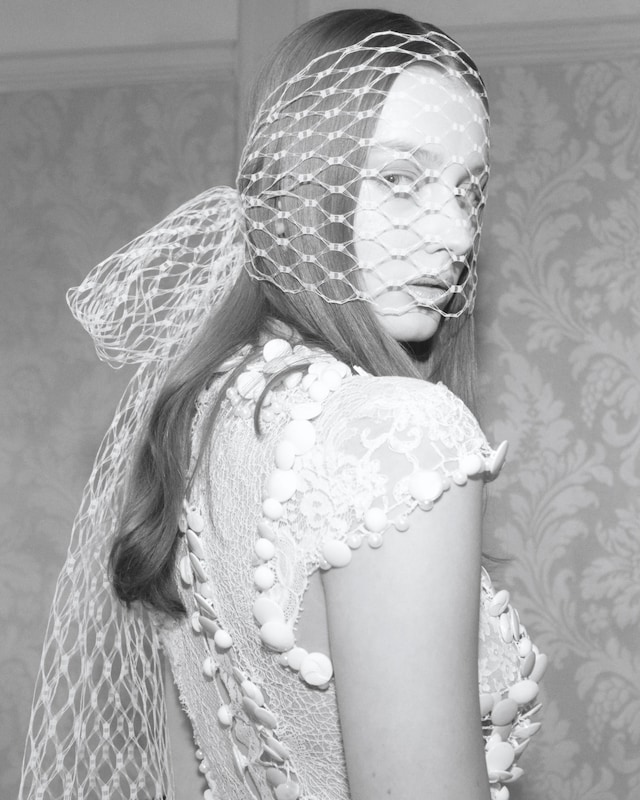
Berlin may have hit –10°C, but the runways kept their temperature up. Here, we list six standout shows from an eclectic fashion week in the city

Lou de Bètoly
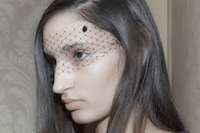
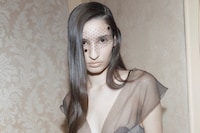
“[Lou de Bètoly]’s an anagram of my birth name,” Odély Teboul, the French designer behind the Berlin-based label, told us. “The ‘de’ is very aristocratic – I wanted to play with that, with the idea that as an artist, I can be whoever I want.” Her Autumn/Winter 2026 collection leaned all the way in on that blue-blooded fiction. The starting point? A box of buttons she bought in the 90s as a child, which came crocheted directly into garments that clinked as they sauntered past. Around them spiral tangled yarns, shredded vintage lingerie, and old purses deconstructed into coats and bustiers, made to look like couture. Push-up bras appear as shoulder pads, or sprout awkwardly and menacingly, from hips. Who knew the bra could be so versatile?
Read our feature on the designer here.

GmbH
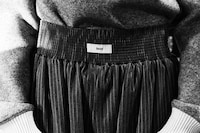
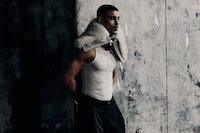
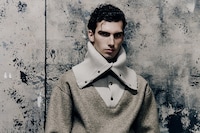
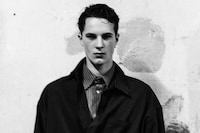
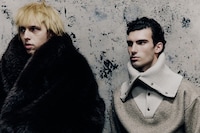
The final show from Reference Studios’ uber-cool Intervention schedule, GmbH landed in the cavernous and industrial Kraftwerk building, an out-of-service power plant, to present their A/W26 collection. Titled Doppelgänger, it circled ideas of repetition and historical rhyme. Each seat held printed poems, including a 1934 line by Bertolt Brecht warning that those who avoid the fight still inherit the defeat. Designers Benjamin Alexander Huseby and Serhat Işık built the collection around the newly circulating term Friedensangst – fear of peace – reportedly coined around arms-industry jitters at the prospect of war ending.
Thigh-high boots come sharpened to a point. Bodies cut close and elastic like a second skin. Tailoring swung between banker severity and nightclub liquidity – long coats flaring behind the body, trousers hugging the hip before breaking wide. Meanwhile, one repeated motif – black and white florals – disrupted the severity. Styled by Another Man’s Ellie Grace Cumming, this was a powerful show with a political purpose that cut through the noise.
Read our feature on the collection here.
Richert Beil
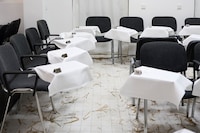
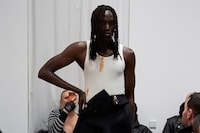
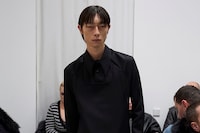
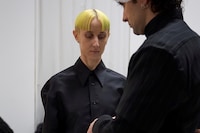
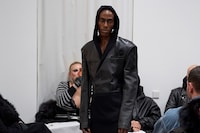
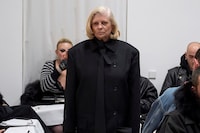
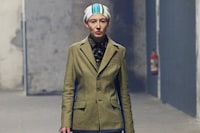
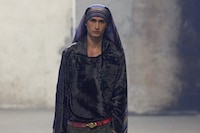
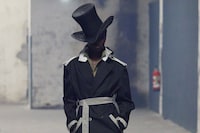
“These kids are crazy,” a seatmate kept uttering throughout Richert Beil’s A/W26 show, Landei, by designers Jale Richert and Michele Beil. They weren’t wrong. The presentation unfolded inside the label’s studio and communal hub – a renovated 135-year-old pharmacy – and took the form of an awkward dinner party. Each guest was installed at a school-style desk fitted with a table dressed in a white tablecloth, like a miniature banquet. Unsmiling waiters in strict Richert Beil uniforms delivered the first course – a seaweed roll with beetroot – while models threaded slowly between the tables, pausing to lock eyes with diners as if checking we were paying sufficient attention. Fashion week rarely offers this level of accountability.
More courses arrived: ‘the pillow’ turned out to be a pastry injected with tomato purée. Then came ‘the shot’, a murky, savoury liquid served in a small brown vial. Shortly after, a model emerged carrying a bottle of what looked suspiciously like poison. By then, of course, we were already committed. Dessert was a large egg, presented with long surgical tweezers. Crack it open, and naturally, retrieve a pair of sheer black lace underwear. Guests left nourished, slightly bewildered, and newly equipped with knickers. Unusual, certainly – but then understatement has never been the Richert Beil brand. It was absurd and oddly fabulous.
Kenneth Ize
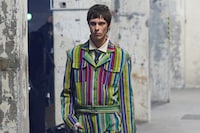
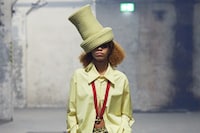
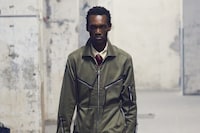
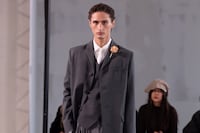
Staged inside Berlin’s cavernous Kraftwerk, Kenneth Ize presented his latest outing for A/W26. Titled Joy, it was “a collection born of a moment marked by fragmentation, introspection, and a world on its knees.” Models emerged one by one, mounted a concrete podium, and were photographed in real time by James Tennessee Briandt – clad neatly in Kenneth Ize – who directed their poses. The audience stood in a tight ring, watching the image-making machine at work. For the finale, the cast lined the platform’s edge and stared back. Joy here was collective and palpable as Ize took his bow.
Marke
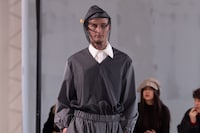
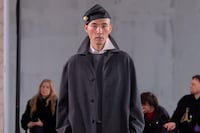
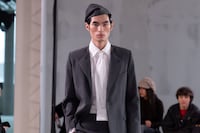
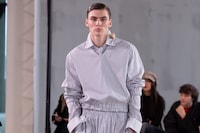
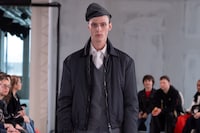
Marke’s A/W26 show, titled The Owl, captured a mood of studied sobriety: Minerva’s bird watching from the rafters while the rest of us doomscroll below. Ever the intellectual, Mario Keine frames the collection as a response to misinformation overload and a culture that mistakes velocity for truth, likening the present to a kind of neo-Rococo – decadent but distracted, edging toward rupture. The clothes followed suit in a disciplined palette of greys, black and eggshell, with flashes of merlot and petrol; slimmed, controlled tailoring; merino and cashmere layered with polka-dot tulle, veils and dried flowers dipped in resin, suggesting beauty mid-wilt. From conversations post-show, it seems like those hats will soon be on everybody’s shopping list, too.
Andrej Gronau
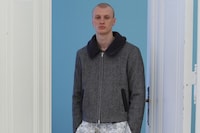
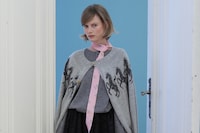
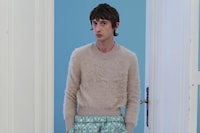
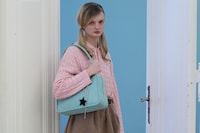
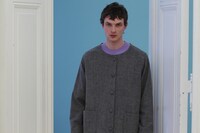
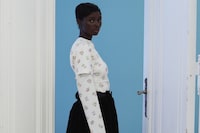
If you believe every Gen-Z night ends on a dancefloor, Andrej Gronau would like a word. His A/W26 collection, Room For Play, staged in Berlin after winning the Berlin Contemporary Prize, made a case for the bedroom as refuge and runway. Drawing on the dollhouse and domestic interior, he sent out velour, French terry and sherpa silhouettes – elasticated, elongated, indulgent – that turned blankets and curtains into dress, while cosy knitwear was styled with fluffy skirts and stockings. Inside Gronau’s house, one’s own pleasure rules.
