
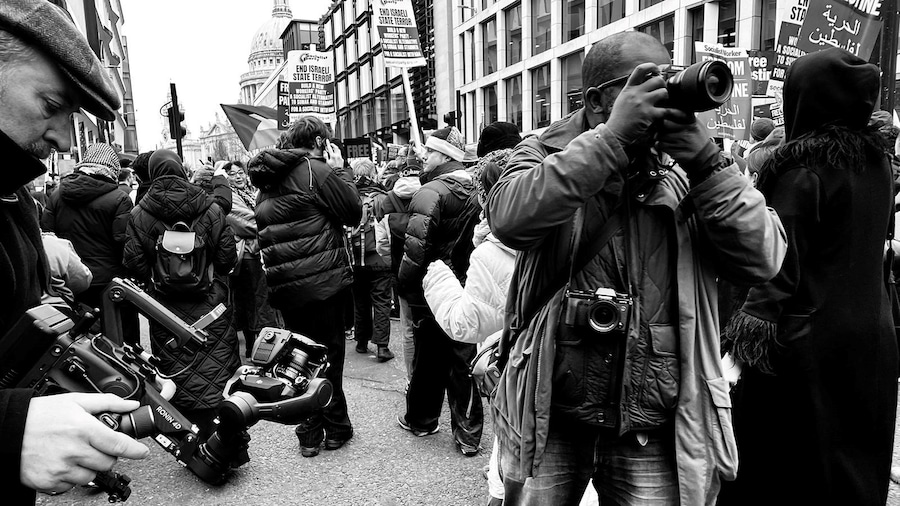
The British-Nigerian artist and activist discusses the enduring power of protest photography as a new doc charts his extraordinary rise
In Shoot the People, director Andy Mundy-Castle’s energising portrait of British-Nigerian photographer and activist Misan Harriman, our subject gives a quote that looks extraordinary in light of the last few months. “I’ve somehow managed to tiptoe around the minefield of being a visible voice and a Black voice in a Britain that usually allows a very specific type of noise to come out of the mouths of someone with the same hue as me,” says Harriman, whose images of the Black Lives Matter protests during Covid landed him on the cover of Vogue just a few years after he first picked up a camera. “Somehow I’ve been quite allowed and able to function in a society that doesn’t usually accept that.”
Talk about dramatic irony. In May, Harriman was branded an antisemite by certain quarters of the press for pointing out that a third victim of the Golders Green attack, in which two Jewish men were fatally assaulted by a Muslim man, was also a Muslim, a fact that was curiously omitted from the headlines of many newspapers. A few days later, he was accused of “comparing Reform voters to Nazis” when talking about the party’s local election gains – here’s the video for context – and a campaign ensued to have him ousted from his role as chair of the Southbank Trust. Finally, at the end of June, a few weeks after our call, he announced his departure from the role – a decision he claimed was unconnected to the controversy.
Perhaps out of respect for the film Mundy-Castle has just made – or perhaps because he’s sick of talking about this stuff – Harriman prefers not to be drawn on how it feels hearing the quote repeated back to him now. “I think the best way for me to answer that is as a humanitarian,” he says. “My job as an artist is to be a voice for those who don’t have voices. I think that all artistic voices right now, especially those who are not going to [remain silent], need to be protected and amplified by the communities that believe that universal human rights matter. So that’s what I’m trying to do, as best as I can.”

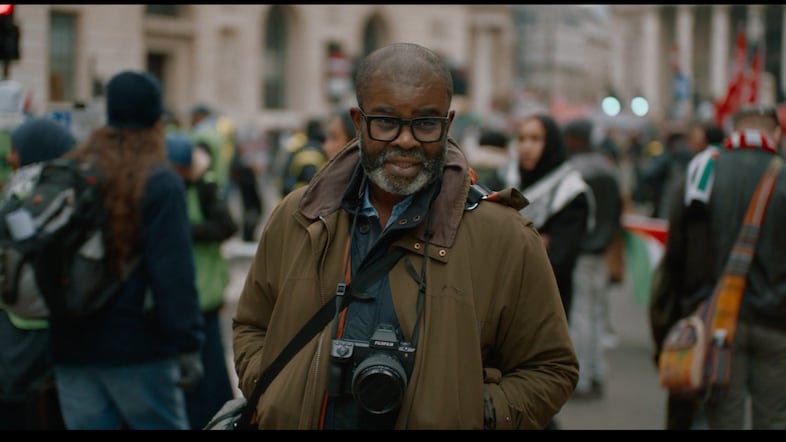
Harriman is the son of a Nigerian real-estate tycoon who came late to photography, after a spell working in the City as a recruiter left him disillusioned with the materialistic lifestyle. “A lot of my friends went into Goldman’s or Deutsche Bank or Lehman’s or whatever and, you know, they wanted to make as much money as quickly as possible to acquire things,” he says. “And I remember when I turned 30 the idea of ‘things’ just felt less important.” Shoot the People weaves his story into a broader narrative about the history of protest, taking him around the world to meet campaigning figures from Martin Luther King III to David Meyer Gollan, friend and archivist to the late anti-Apartheid photographer Peter Magubane, whose extraordinarily moving interview had the whole crew in floods of tears, according to Mundy-Castle.
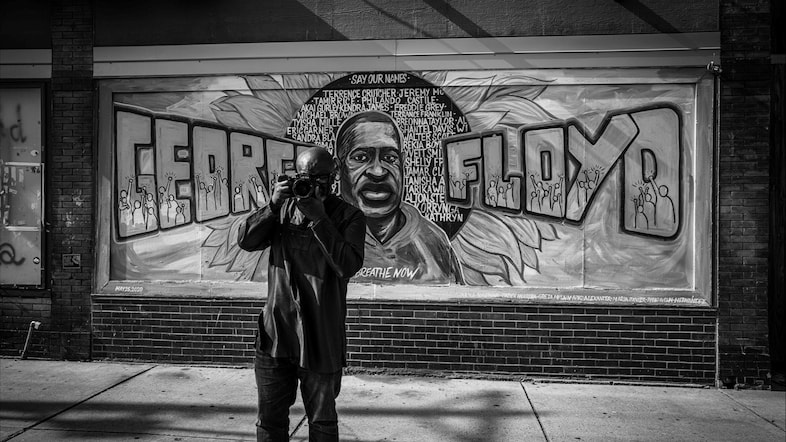
Harriman’s earliest images were of the Covid-19-era lockdowns, but it was the 2020 murder of George Floyd by police in Minneapolis – which he remembers realising with shock was a “modern-day lynching” – that drew him into the world of activism, when his work bearing witness to the global wave of protests that followed went viral online. Since then he’s been on hand to cover political flashpoints from climate marches to the Gaza war protests, while doing high-profile celebrity shoots and a short film, The After, that took him to the Oscars this year.
Mundy-Castle made his film with Harriman after the pair bonded over their shared Nigerian heritage, and was interested in the apparent disjuncture between his public and private selves. “There’s the very well-rounded, articulate, high-energy Misan you see [online] and then there’s the boy that just wants to be seen or be loved, to have himself heard,” says the director. “His reason to communicate is also part of him trying to find out who he is. And so I feel that [the camera] is definitely a kind of therapeutic device for him as well.”

Harriman speaks candidly in the film about the neurodivergence that left him struggling with the weight of academic expectation, and the distance he felt from his father, a formidable figure who was only rarely at home. He credits his wife, who encouraged him to start making photographs in the first place, with helping him to lay some of these ghosts to rest. “I think my wife will say she fell in love with the parts of myself I was ashamed of,” he says, “because when you’re not doing traditionally well at school you are sometimes [made to feel] ashamed of how your mind works. She saw how obsessed I was with film and photography and storytelling, and she was like, ‘Instead of being a fan, maybe you can also have a point of view?’”
Undoubtedly, Harriman has a sharp eye for images that humanise the face of protest. But it’s also his openness and skills as a communicator – he has well over 600k followers on Instagram – that has made him such a compelling voice in the fight for a more equitable future, as well as a lightning-rod for criticism from those seeking to stir up division. The weekend before our call, rioters take to the streets of Southampton, where I live, to protest the murder of teenager Henry Nowak, which prompted Nigel Farage to call for “pure, cold rage” against alleged anti-white bias in UK policing – a frequent rallying point for the far right with no basis in fact. Sickeningly, he invoked the name of George Floyd in his diatribe, an obscene distortion of the facts that must have left a sour taste in the mouth of Harriman, who visits Floyd’s community at the end of the film for the anniversary of his death.
“Look, I live in a place of hope,” says Harriman. “Especially now, when we’re all being told to be on these islands of rage. I want people who are scared and angry to look at someone that looks differently to them and see a human being. I don’t know if that is something that Nigel Farage wakes up and thinks he is trying to do. But that’s the path he’s on and, you know, I can’t control that man. What I can do is work on people who might listen to me or [engage with] my art, and recognise that we can be better.”
Shoot the People is out in UK cinemas now.
