
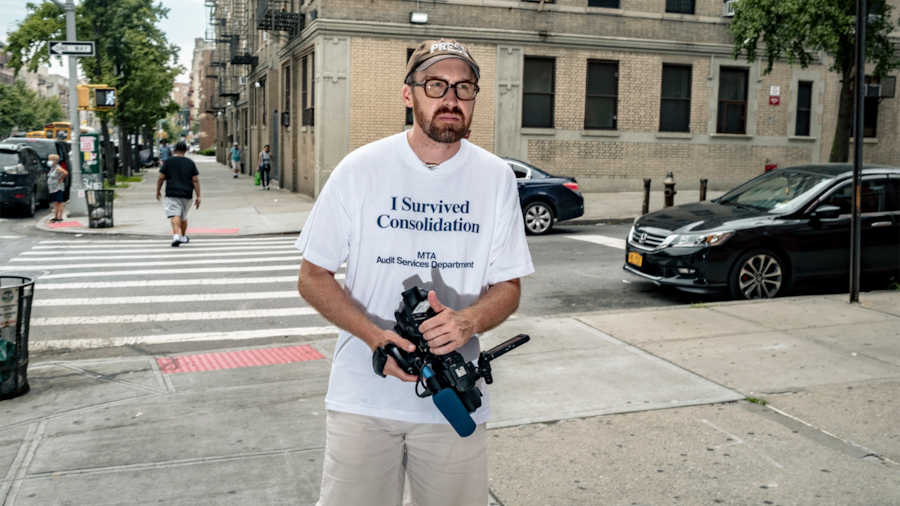
The eccentric genius behind How To with John Wilson set out to make the definitive film about the world’s second-most used material. Did he succeed?
“I knew that it was a very unsexy idea,” says John Wilson. “But I thought it was an ace in the hole. Just because it’s arguably the most relatable subject matter that you could possibly think of. Other than making a movie about water or skin.” Wilson is telling me this sitting in a windowless backstage room in a Copenhagen theatre – “in interview jail”, as he describes it – moments before his debut feature film will screen to a rapturous sellout crowd at the documentary festival CPH:DOX.
He’s initially an anxious figure. The hello is short, somewhat muted, and comes with a slightly awkward and balmy handshake. But once he opens up about his new documentary, he becomes passionate, sharp and funny. “I didn’t think it would ever amount to a coherent narrative but I am in love with it,” he says of the film. The sexless but ubiquitous subject of which? The History of Concrete.

Those already familiar with Wilson’s work will know that few filmmakers can turn everyday humdrum banalities into captivating curiosities as well as he. His superb and singular HBO series How To With John Wilson, which ended its three-season run in 2023, saw him merging glorious, detailed and painstakingly captured footage of day-to-day life in New York with an essay-like voiceover exploring topics such as how to cook the perfect risotto or how to get into sports. “I always like to make the definitive movie about one thing,” says Wilson. “Whether it’s about parking or scaffolding.”
These ruminative, meditative and idiosyncratic explorations usually take a sideways turn or two. When Wilson begins to follow random characters into their own strange worlds along the way, he then connects the dots to his own quest. One episode about how to cover up furniture ends up with Wilson following a foreskin restoration activist back to his home to be shown the process up close.
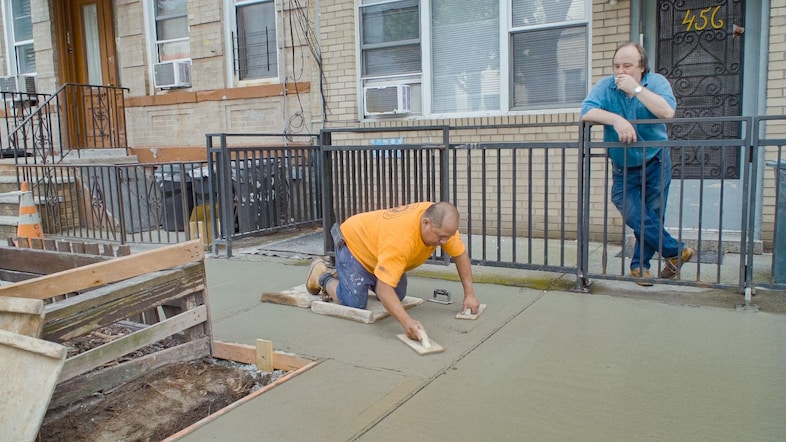
The History of Concrete effectively follows the same approach. What appears on the surface to be a genuine documentary about concrete – the second-most used material on the planet after water – soon veers off on all kinds of tangents about life, death, art, capitalism, impermanence, structure and the creative process.
As with all Wilson projects, the title comes first. But this one was a hard sell. The film contains real-life pitch meetings where he was met with bemused and indifferent stares from film industry people, as nobody came forward to fund it. After the success of his HBO show, with its big budget, dedicated team, writing staff and Nathan Fielder on board as producer, Wilson was humbled, and his ego a little bruised, when nobody was interested in his proposed follow-up. “The struggle was very authentic,” he says. “I even minimised it a lot in the movie. It was actually a lot more emotionally turbulent for me than I really wanted to let on. Just because I didn’t want to feel like you were watching a dog get hit by a car.”

Instead, Wilson’s attempts to finance his film offered a wake-up call for what people want from documentary films in our celeb-heavy era. At one point, he is offered some money on the contractual basis that the film features a musician of notoriety in it. “The fact that the closest I got to getting money was by pretending to want to make a rockumentary where there was a central pop-culture figure is proof people just want the same thing over and over again,” he says. “I do include a lot of pop-culture figures in the film by design, but I like the push-and-pull – the constant tension of playing the game while also trying to subvert it in a certain way.”
He does get some funding in the end – Josh Safdie and Ronald Bronstein’s Central Pictures come on board – but the unexpected musical detour he takes ends up leading the film to its emotional core, when Wilson discovers Jack working in a liquor store giving out free tequila, whom he learns is in a band. Wilson then spent the next year and a half with him, watching his band play dive bar gigs and spending evenings drinking leftover free promotional booze in motel rooms together. “I did try to make the definitive movie about concrete and I still think I did,” he says. “But I was afforded a lot more time in a feature-length format to digress and find these strange tertiary characters that end up illuminating the larger themes.” Jack, as an open-hearted, passionate, dedicated – yet emotionally troubled – figure, ends up becoming a kind of inverse version of Wilson in the film, existing as a symbol for the purity of art for art’s sake.
Wilson also mirrors this idea of people wanting the same stories over and over again by visiting a writer’s workshop for Hallmark movies – the saccharine, holiday-season film outlet that is the most upwardly mobile cable channel going – and applying it playfully to his film. “In the Hallmark class, they say you get bonus points for a dead relative,” he says, of a plot point that becomes unexpectedly pertinent. “But she also said that people don’t like to watch other people struggling financially and that these movies should be a balm. So I was betraying and embracing the tenets of that instruction in equal parts.”


There’s also a surreal and incongruous scene when Wilson is at a GQ event with comedian Tim Robinson, sitting opposite Kim Kardashian, who is being honoured by the publication. He films the event, which ends up becoming a representative microcosm of the alluring yet vacuous nature of celebrity culture in documentary. “It was very strange,” he recalls. “Everyone had to give speeches about one another, but no one seemed to know each other very well. These things are essentially just PR events for the magazine. It’s like, I don’t know any of these people. I felt no emotion.”
It’s easy to think that Wilson has a natural tendency for embracing awkward situations or zooming in on eccentric characters but in reality, that’s not what he’s looking for. “I tend to naturally gravitate towards people that are a lot more confident than I am,” he says. “That’s what I really liked about Jack. I’m constantly filled with self-doubt and questioning [in] every single decision that I make. So that’s why I like when people who are really self-assured come up with something, as there is no ambiguity there. I like to be a piece of driftwood and be shaped by the decisions of other people, because I’m always afraid that I’m making the wrong call and it’s paralysing sometimes.”
Even after he’s successfully made three series of an HBO show and a feature-length film about concrete that appears to be a festival hit? “The project of doubting yourself is a lifelong commitment,” he laughs. “It never goes away.”
