
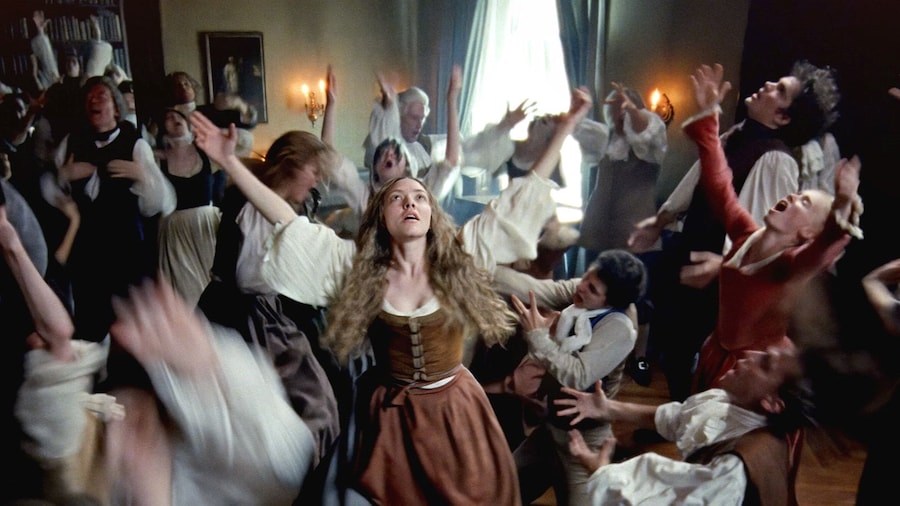
In less than a decade, Celia Rowlson-Hall has become cinema’s go-to choreographer for contemporary dance. Here, she talks about making herself a receiver for God in Mona Fastvold’s wild period musical
“It’s funny, I had a mother like that; I grew up with a very unwavering female leader in my life.” Celia Rowlson-Hall is speaking to me from upstate New York, reflecting on her choreography for director Mona Fastvold’s new film, The Testament of Ann Lee, about the life of the eponymous – and unwavering – Ann Lee (Amanda Seyfried). Lee was a member of the 18th-century Shaker movement, an offshoot of Quakerism with music and dance at the heart of their worship. A musical odyssey, the film traces Lee’s journey from birth in Manchester to her death in the Shaker colony she founded in the US.
Born in Virginia, Rowlson-Hall moved to New York City after college to pursue contemporary dance, and went on to build a broad creative practice. Choreographing for a 2008 MGMT music video sparked a love of film, and alongside choreography, she has been writing and directing her own shorts and music videos ever since (most recently for Cameron Winter). Over two decades in TV and film, Rowlson-Hall has crafted movement for everything from indie favourites like Girls and After Yang to horror blockbuster Smile 2. She even turned in a small role in Charlotte Wells’ Aftersun, choreographing its pulsating final scene. Having met her on the set of Gossip Girl when the two were both modelling on the side, Rowlson-Hall has enjoyed a long creative dialogue with Fastvold that included working with her partner, director Brady Corbet, on Vox Lux in 2018.
In conversation, Rowlson-Hall is bursting with a propulsive creative energy, and it’s unsurprising that she seems poised to have the kind of starry moment that Hollywood hasn’t lavished on choreographers since the heyday of the studio musical. Upcoming projects include Kristoffer Borgli’s buzzy A24 vehicle The Drama, with Robert Pattinson and Zendaya, and Charlie Polinger’s psychological horror The Plague. While blockbuster musicals might be sticking to a Broadway style of dance that melds pop and pantomime, contemporary dance is far more in tune with the modern idiom, and seeing it get more of a spotlight is something Rowlson-Hall is celebrating with her peers: “It’s exciting to see what we love to do be given more than just two seconds.”

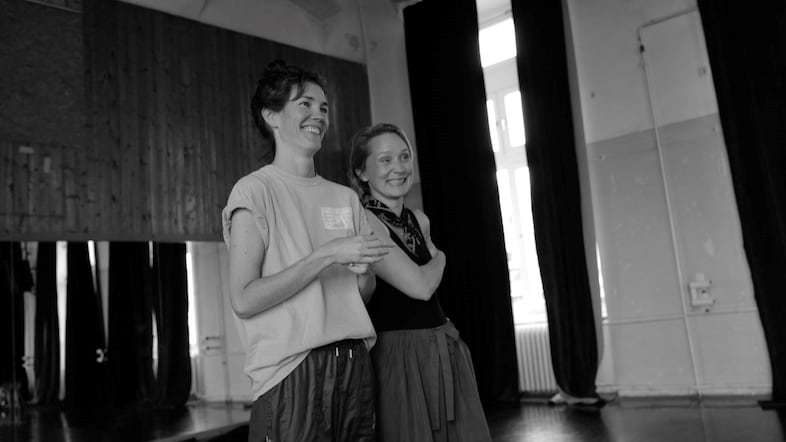
After so many years in the industry, working on this film was more personal than Rowlson-Hall expected, and she developed a deep understanding of Lee’s physical and spiritual reality over the course of the project. “I really always loved praying,” she reflects, despite having left the church she grew up in. Rowlson-Hall was raised Christian Scientist, a dogmatic sect also founded by a woman that believes in spiritual healing and, like the Shakers, has no pastors. “To be able to go into a place that is a religion and a prayer that is not mine, and to have creative expression and freedom inside of it … I got to decide what prayer looks like for this moment in time.”
For the Shakers, what prayer looked like was ecstatic song and movement. Rowlson-Hall knew her choreography needed to tell not just “the trajectory of [Lee’s] life”, but “the trajectory of her body, what it endured through her lifetime, and then how that can be seen and felt through movement and dance”. Lee’s body is the heart of the film; it suffers, strives, praises, breaks, heals and endures. Following the loss of four children during childbirth and infancy, Lee is imprisoned and institutionalised.
These trials give rise to a series of revelations, anointing her as the second coming of Christ, and convincing her that all sex (even in marriage) is spiritually corrupt. Worshipped as “Mother Ann”, she ascends to the head of the Shakers, preaching total abstinence to her followers. Despite this strict celibacy, the Shakers were provocatively radical for their time; extreme pacifists who lived communally, they firmly upheld the equality of sex and race. This elevation of the female sex empowered Lee to position herself as a leader, and ultimately fuelled most of the outside persecution towards her and the Shakers.
Transcending the burdens of the flesh with the flesh is a central tension at the heart of the film. How can the body be denied when it is the engine driving your prayer? In early scenes, the Shakers’ worship sees them writhe in a spontaneous, orgiastic frenzy, a sublimation of sexual desire into the ecstasy of collective devotion, exhaustion as a means of cleansing. These scenes were based on historical accounts of “raves through the night”, leaving Rowlson-Hall to wonder, “How would my body be? Could I even still be standing after ten hours of dancing?”

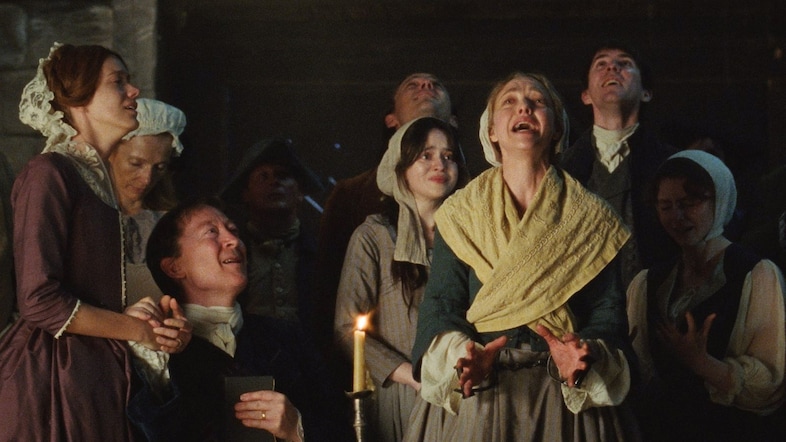
The breathing of bodies in motion punctuate the film, worked into the score by composer Daniel Blumberg. Rowlson-Hall says hearing Blumberg’s early sketches was instructive to her own work: “I heard this breathing, and realised I needed to choreograph breathing into the dance.” Working her classical dance background – which obliges you to “pretend that what you’re doing is not physically strenuous” – Rowlson-Hall embraced the flesh-and-blood fallibility of the worshippers. “It really helped shake up how I was thinking about the choreography and the body.”
Seyfried’s own body informed much of what made it into the final dance sequences. “Amanda happens to have these beautiful, very expressive hands, [so we] tell so much story just through her hands alone,” says Rowlson-Hall. Hands then became key in unlocking the movement of all the Shakers: “These people were not professional dancers. They worked with their hands. And so, they were these little transmitters to God.” For Lee, who was illiterate, worship becomes its own form of mass communication.
“Are you receiving or are you giving?” This is the intention Rowlson-Hall encouraged the cast to consider with each transmission. A throwing of hands from chest to sky, or sometimes the reverse, a clutching of the heavens to the body, recurs throughout. Both a supplication and an exhortation, this system of signs and gestures becomes its own kind of language: “Take this pain from me, take this guilt, I want it off,” or, conversely: “Oh God, I have so much love for you.”
By the film’s closing scenes, the Shakers’ worship has evolved into something more ordered. Concentric wreaths of men and women come together in a harmonious devotion of bodies in sync. These later dances were inspired by illustrations Fastvold found, as well as by filming in historic Shaker buildings in Massachusetts, including a spherical barn. “The energy was really beautiful,” Rowlson-Hall remembers. “I was thinking to myself, ‘Of course a woman designs a round barn …’ I wanted the choreography at the end to have this assuredness and this roundedness – ‘I have gone out and now I’m folding back into myself.’ There’s no loss or lack of power; the power has shifted in the body.”

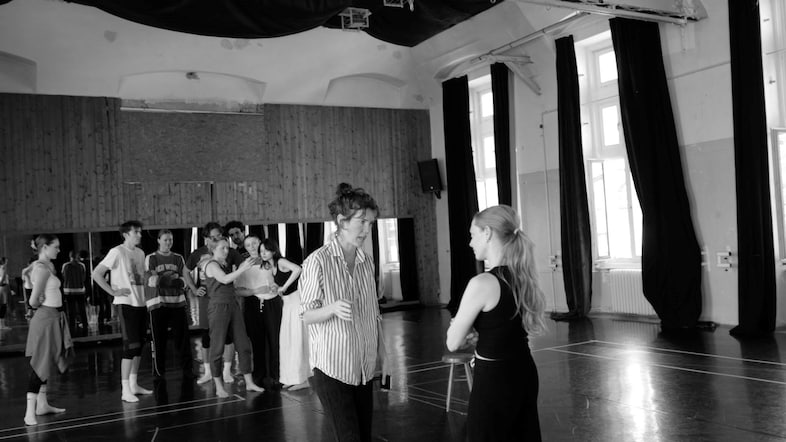
With all these bodies and feelings in motion, The Testament of Ann Lee does a remarkable job of showcasing the dance itself, and Rowlson-Hall is almost evangelical about the success of the holistic approach the team took, compared to past projects: “I will shout it from the rooftops!” she declares. Fastvold and cinematographer William Rexer attended all the early dance rehearsals, blocking scenes, adjusting camera movements and choreographing in tandem. “It’s very hard to film dance. It really is like the camera and the [bodies] have to dance together. They have to be aligned.”
Ultimately, Rowlson-Hall was most moved by Lee’s unwavering commitment: “She was this woman who just was giving, giving. And then goes into near oblivion because there wasn’t this ego.” It’s something I pause over, that idea of ego – it’s hard not to read some degree of knowing performance in Lee’s zeal. Rowlson-Hall disagrees, but does admit a certain disposition may have been necessary for Lee to survive – “a little delusion”, as she puts it, “but I feel like she really was just a determined woman inside of this world that offered her nothing.”
Thinking back to reimagining prayer, Rowlson-Hall muses on what was most surprising about choreographing this project. In general, dancing for hours in the studio just leaves you tired, she says, but this time it was different. “With something in this movement, the energy recycled itself and we could go again. And I think that’s what you would want prayer to be – that you are getting energy from it, you are not drained.”
The Testament of Ann Lee is out in UK cinemas 27 February.
