
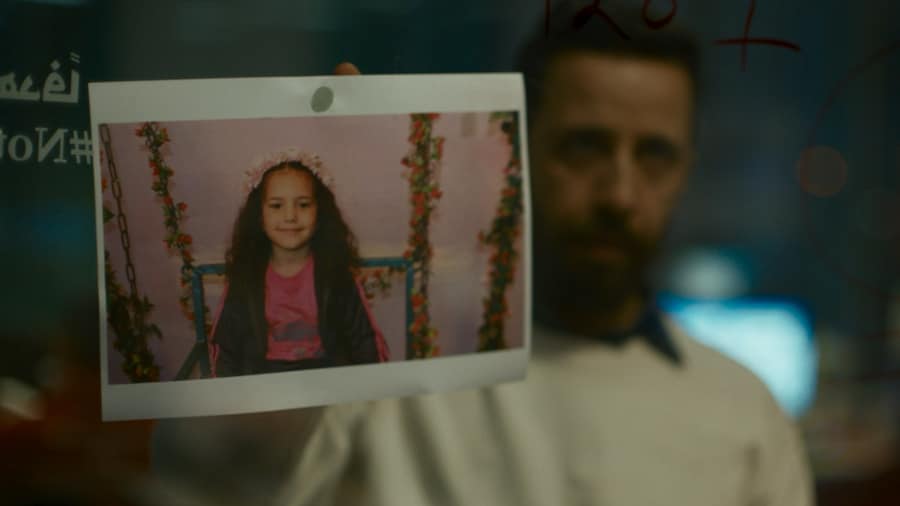
When Kaouther Ben Hania heard the call made by a five-year-old Palestinian girl fired upon by Israeli forces, she “couldn’t go on” with her daily life. The Voice of Hind Rajab tells her story
Filmmakers have myriad tools at their disposal to elicit emotions, but no cinematic technique could ever hope to match the shattering power of the voice of young Hind Rajab. On 29 January 2024, over a crackling mobile phone line, this five-year-old girl pleaded with Palestinian Red Crescent emergency response coordinators to rescue her from Gaza City, where she sat terrified in a bullet-strewn car surrounded by the bodies of six passengers, all family members, who had been shot in an attack by the Israeli Defence Forces.
Despite the best efforts of the Red Crescent team, Hind’s cries were not answered in time to save her, but her story was not forgotten thanks to the audio recordings of her last hours being posted online. Kaouther Ben Hania first heard Hind’s desperate, confused voice while scrolling on social media. “It was a small extract, but this young girl was begging for life,” recalls the Tunisian filmmaker. “That’s not a usual thing to hear; it affected me deeply. I couldn’t go on with my daily life. I was left wondering, ‘What can I do?’”
Ben Hania’s answer? Make a film. “I thought, ‘If I find the right way to honour her voice in a cinematic form, maybe the world will sit up and listen?’” Less than two years on from Hind’s death, her voice should find a large audience when The Voice of Hind Rajab comes to UK cinemas on a wave of critical acclaim.
While Ben Hania initially felt that Hind was speaking directly to her, she soon realised she wanted to present the film from the perspective of the people Hind was actually speaking to: the Red Crescent phone operators. “I needed to be with them, because then the film is not only the story of the killing of a child, which is a tragedy, but it’s also the story of those who are tasked with saving lives in Gaza.”
Ben Hania began her career in non-fiction filmmaking, but she says a straightforward documentary wouldn’t have communicated the emotions she was feeling. “I could have done a documentary with all the investigative work around the killing, but I thought, ‘We are done explaining. All those elements exist online already. I needed to use cinema for empathy.’”

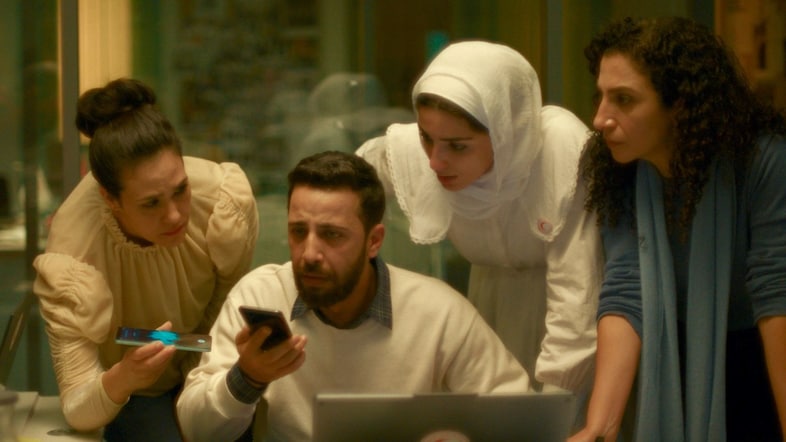
There was also the issue that some of the Red Crescent team weren’t comfortable giving their testimony on camera. So, as Ben Hania has done on previous films – like 2024’s Four Daughters, which exorcised a family’s history by reconstructing painful events with a mix of actors and real-life family members – she settled on a form where fiction and reality commingle.
Ben Hania uses several techniques to signal that what we’re watching isn’t from the imagination of a Hollywood screenwriter, including asking the actors to periodically stop acting. “I would ask them simply to stop, and let them listen to the real voices in the recording.” Another of these Brechtian breaks comes when the ambulance is racing to Hind’s rescue, only to be blown apart metres away from her location, killing two paramedics inside. On screen, a character is recording the situation room on her phone, but on the phone’s screen, we see the real-life Red Crescent workers. “That’s the actual archive from that night,” Ben Hania confirms, “of those poor people wondering what just happened to their colleagues.”
Drawing attention to the film’s construction doesn’t diminish its primal emotion – quite the opposite. But Ben Hania and her producer worried their film might get lost on the festival circuit. “We thought it would be seen as a niche movie,” she explains, “so we thought we should reach out to some big names around us in the business and ask them to put their names to the movie.”

The names they secured don’t get much bigger: Brad Pitt, Joaquin Phoenix, Rooney Mara, Jonathan Glazer. “We were hoping maybe one of them would come on board, but they all said yes. This is how we found ourselves with this long list.” And it keeps getting bigger. “Just yesterday, we added two new executive producers: Spike Lee and Michael Moore.”
I’m not convinced she needed such star wattage. That must have been evident to Ben Hania at her film’s world premiere at last year’s Venice Film Festival, where it received a 23-minute standing ovation, reportedly the longest in the festival’s history. “It was overwhelming,” she confesses of that rapturous debut screening. “They only stopped clapping because they asked us to leave the theatre, because there was another movie just after. So I do remember relief that night, saying, ‘I think Hind’s voice will echo loudly.’”
The Voice of Hind Rajab is out in UK cinemas now.
