
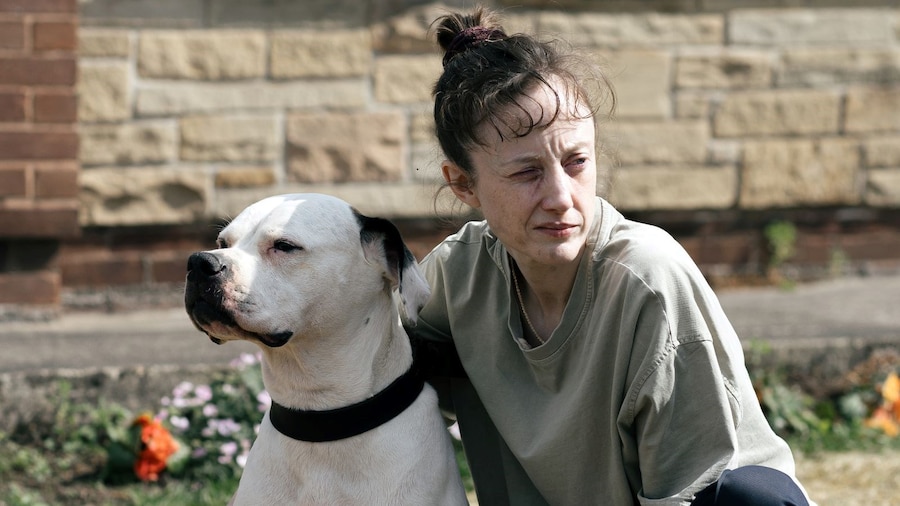
The shapeshifting actor talks about starring in Dragonfly, a social-realist horror on the UK’s loneliness epidemic, playing Isabella Blow in a forthcoming biopic, and her enduring taste for risk-taking drama
Andrea Riseborough is a consummate shapeshifter. In the last few years alone she’s transformed herself into former Vogue editor Audrey Withers (for last year’s Lee Miller biopic), the garish Mrs Wormwood (Matilda: The Musical, 2022) and an alcoholic lottery winner (in Michael Morris’s To Leslie, for which she was Oscar-nominated in 2023). This year, she emerged in a new role altogether, joining actors Fiona Shaw, Minha Kim, Fionn O’Shea and Bel Powley on the runway for Simone Rocha’s Autumn/Winter 2025 show. “Simone’s work is absolutely beautiful, so I was incredibly happy to be part of it, but it helped that we were all having this odd first experience,” she tells me. “It’s becoming less odd – we’re all [actors] becoming these tools of marketing – but that was absolutely not how it felt; it felt like Simone had gathered a lot of creative people she respected.”
In her latest picture – Dragonfly, a carefully observed two-hander from writer-director Paul Andrew Williams, and the real reason for our meeting over Zoom today – Riseborough partnered with another esteemed actor, portraying the 30-something, socially adrift Colleen to Brenda Blethyn’s widowed pensioner Elsie. The two neighbours’ lives start to merge when Colleen offers to do some shopping for Elsie, who has recently suffered a fall and is now at the mercy of overworked carers employed by her largely absent son. “I’ve looked to Brenda as a marker for good work my entire life, let alone career, and she is the most professional, kind, wonderful worker among workers,” says Riseborough of her co-star. “It felt so natural, an environment where there were no insecurities.”
“It’s about a friendship between two people who are complicitly lonely,” Riseborough continues, reflecting on the film’s emotional core. “One through circumstance, which is age, and one through upbringing, or lack thereof.” Lifting its name from a line in James Thurber’s fantasy tale The 13 Clocks, Dragonfly marries social realism with horror, anchored by a thriller-adjacent rhythm that stirs the narrative and asks difficult questions of its audience. Described by Williams as a kind of love story, it’s built upon deep-rooted social issues affecting Britain today – from loneliness and class politics to our creaking healthcare system. There’s even a nod to social media, with Colleen’s attempts to follow a make-up tutorial a tormented echo of Demi Moore’s bathroom mirror freakout in The Substance, albeit with different stakes.
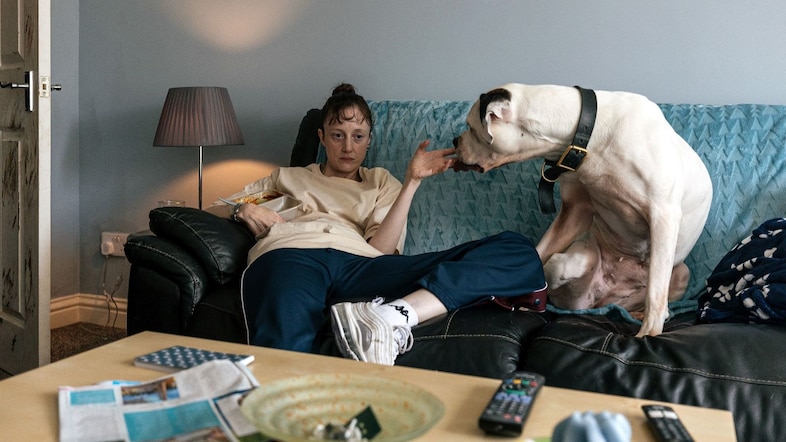
That Williams wrote the film during the pandemic with his own mother and grandmother in mind is perhaps unsurprising, and indeed most of the action takes place inside the protagonists’ homes, which in turn speak to their respective situations. Elsie lives with lace curtains, velvet soft furnishings and family photographs, while Colleen’s space, structurally a mirror image of her neighbour’s, features vertical blinds and impersonal wall art; her beloved American bull terrier Sabre, who shares a bed with his owner and sets in motion the film’s eerie finale, paints the hallway with dirt that never gets cleaned.


“As soon as soon as I read it, I knew I was going to do it,” says Riseborough of Williams’ screenplay for the film. “There are so very few really authentic pieces of work. And I’d wanted to work with Paul for a long time – London to Brighton [his 2006 debut] was beautiful. The space he gave the actors, the rawness of it – I loved everything that the piece represented.” Building the character of Colleen was, she notes, “really personal and singular. [Paul and I] had a tacit understanding that we were both coming from the same place. That’s the sign I think, of a really fitting work relationship – the less there has to be said, the more you know you’re in a trusting situation. If you’re involved in the right project, it feels like second nature anyway.”
When we speak, the actor is a week out from wrapping Mary Page Marlowe at the Old Vic, where she played one of five versions of the titular Mary alongside Susan Sarandon. She carved time from her schedule to attend the London Film Festival for another new film, Good Boy, reuniting her with Matilda co-star Stephen Graham; soon she’ll begin work on a mammoth-sized studio feature (presumably Ebenezer: A Christmas Carol, a new take on the festive classic from Pearl director Ti West). How exactly does she choose her projects? “It starts with people and quality, and the admirable integrity of others,” she offers. “I’ve been really happy learning, working with different people, and taking a little piece of the northeast with me throughout everything [Riseborough grew up in Whitley Bay]. I love working with curious people, because I’m very curious.”

In addition to acting, she is also privy to another side of the industry, having spent the past 15 years producing. It wasn’t wholly intentional, though. “I do find it to be more of a necessity than an ambition,” says Riseborough, who set up the production company Mother Sucker in 2012, and has been vocal about issues of equal pay. “I noticed that these wonderful stories that were beautifully penned were not reaching the screen. Stories about marginalised characters, who I think are the majority, actually, but also things that we’re not used to seeing in film.” Recent producing credits include To Leslie and the campy Amanda Kramer film Please Baby Please, from 2022. There’s also the upcoming biographical drama The Queen of Fashion, in which Riseborough plays the late Isabella Blow; her experience at Simone Rocha was partly research, she observes, “because Izzie walked in Lee [McQueen]’s shows”.
While Dragonfly was not one of her projects, it shares various sensibilities with the kind of stories Riseborough is most excited about helping to get made, both culturally and from a visual standpoint, having been shot on 16mm, a personal favourite. “Film is such a pleasure. It’s so much more immediate, and the [physical] film is so precious,” enthuses the actor. “I’m just about to do a big studio film, which is sort of a different speed and a fascinating process, but independent film feels very much like being in a playful space, like being back in drama school. And with film it’s like a really exciting game of roulette, [trying] to give the absolute best performance with minimal takes, and without being conscious about the time pressure.”
Dragonfly is out in UK cinemas now.
