, 2020-2021, composite iPad painting)
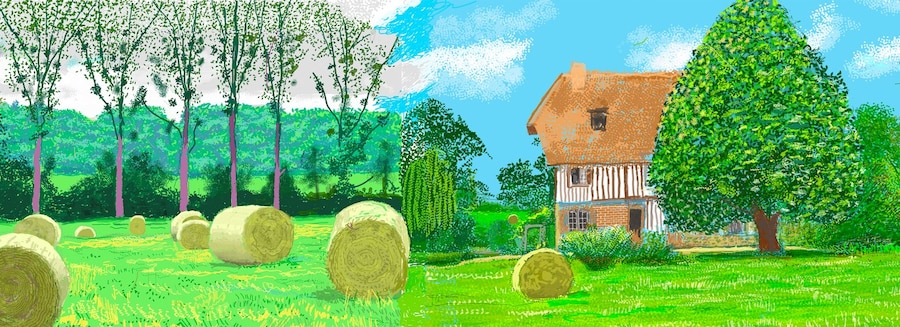
As Hockney’s new Serpentine exhibition opens, artistic director Hans Ulrich Obrist talks about Hockney’s iPad frieze, the use of technology in art and returning to abstraction
David Hockney has long been a figurehead of British contemporary art. Not only in vision, perspective or colour palette, but also in resourcefulness and medium. At 88 years old, the artist continues to push the boundaries of painting with a series of remarkable painted portraits, still lives and a panoramic frieze, comprising panels created on an iPad, now on display at Serpentine North in London. The exhibition, A Year in Normandie and Some Other Thoughts about Painting, is an extension of Hockney’s lifelong fascination with perspective and finding beauty in the quotidian, co-curated by the gallery’s artistic director Hans Ulrich Obrist and curator-at-large Claude Adjil, marking the artist’s first show at the gallery.
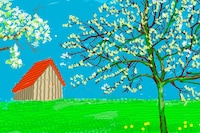
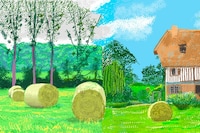
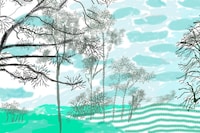
Created over the course of 12 months from 2020 to 2021, the frieze documents time and space as the seasons change in Normandy, where the artist now lives. The 90-metre-long panoramic, titled A Year in Normandie (2020-2021), is made up of around 100 of 220 digital panels Hockney painted on his iPad. The inspiration behind it is eclectic. There are elements of Monet’s en plein air paintings, Bruegel’s Tower of Babel and ancient Chinese scroll paintings, but principally, it’s Hockney’s contemporary take on the late 11th-century Bayeux Tapestry, which is housed in the Bayeux Museum, not so far from his northern France residence.
Hockney’s history with the 70-metre-long embroidery is a storied one. He first came across it in a textbook at school, then visited it after finishing at the Royal Academy of Art in 1962 – a moment he recalls was timestamped by the death of Marilyn Monroe. He has frequented ever since. Thought to span a period of two-and-a-half years, the tapestry depicts the Norman invasion of England following the Battle of Hastings. While the nature of the Bradford-born artist’s digital succession is one of peace and pacifism, a document of a year spent watching the Norman weather, parallels can be drawn between the two as both denote time passing through a sequence of events in one sweeping motion. Olivia Laing, who writes on Hockney for the exhibition’s catalogue (published by Heni), considers this mode of painting to be more like a novel or a film than a static image, while maintaining commitment to a single pictorial field.
, 2020-2021. Composite iPad painting)
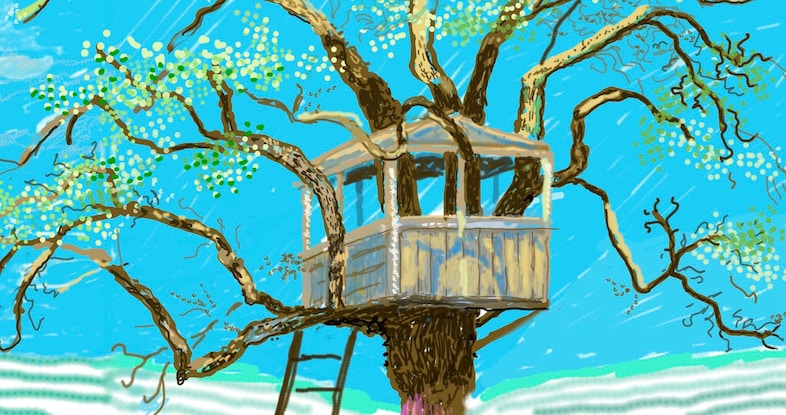
“A Year in Normandie is a work that very much invites us to move, to zoom in and out,” Hans Ulrich Obrist says. “It invites us to slow down, to look closely, and of course, to experience the change of seasons.” Like Monet’s Water Lilies and les grandes décorations displayed at the Musée de l'Orangerie in Paris, Hockney intends for us to interact with different parts of the piece as we move through the promenade, perhaps also moved by the changing of the seasons taking place outside as the exhibition runs its six-month course. “Hockney’s move to Normandy, his recording of the landscape, season by season, en plein air, is very similar to Monet – the connection is very real,” says Obrist. In her book Monet: The Restless Vision, Jackie Wullschläger writes that Monet was excited every day of his life, and he painted that way – a sentiment reminiscent of Hockney’s famous attitude to ‘Love Life’. “The accumulation of art must have been magnificent for him [Monet], in his mind and in debate,” says Obrist, “and it’s fascinating to revisit Wullschläger’s biography on Monet in relation to Hockney.”
Hockney has long been interested in technology; as early as the 1980s, he and Keith Haring were invited to use the computer, which, at that point, he found too slow, finding sketching more efficient. Rediscovering or unearthing technologies in art was the central theme of his 2001 book, Secret Knowledge: Rediscovering the Lost Techniques of the Old Masters. But Hockney’s interest was never just in technology alone, Obrist tells me. “He always focuses on technology in the service of seeing, or rather enabling seeing, and the mediation of the eye.” Which is what Secret Knowledge is about – the mirror, the lens, the camera lucida, the camera obscura. The iPhone is yet another tool that has offered Hockney such possibilities. The tablet and iPad too, and he’s been mastering the fiddly craft of which since 2008. In Hockney’s case, such tools allowed him to create in places artists of previous generations would not have been able to, to paint en plein air through the winter months – no easel, no light, at night, sat in his truck with the heating on, looking out through the windscreen, not so en plein air as en chaud air. Such methods not only enabled this frieze but works included in his moon room series too. “New ways of seeing mean new ways of feeling,” says Hockney.

If we are to talk of technology in art today, it’s impossible to ignore one of the most contentious debates in art history: authorship in the face of automation and AI-generation. Last winter, Serpentine North showed an extraordinary immersive exhibition by artists Holly Herndon and Mat Dryhurst, which explored AI as an opportunity, a coordination technology, rather than a cheat tool. The exhibition, titled The Call, featured AI-generated choral music and community-trained models that made a case for the correct support systems and legislation surrounding the inevitable rise of AI and art. While there is no direct connection between that exhibition and Hockney’s in terms of form or medium per se, the inherent questions asked are similar: What can a tool do for the hand and the eye? What happens if we connect old ways of making with new ones? How far can we take this? “And that is the thesis of Secret Knowledge,” Obrist concurs. “It’s a manifesto that the masters used pioneering technologies. Hockney wanted to make this visible.”
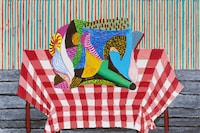
But for Hockney, it always comes back to painting, as it has done for seven decades. “I do believe that painting can change the world,” says the artist. Shown in tandem with the frieze are five still lifes and five portraits, created specifically for the show, and a large mural featured on a wall outside. “They are a continuation of Hockney’s longstanding exploration of many different painting styles from older masters to impressionism to cubism and abstraction,” says Obrist.

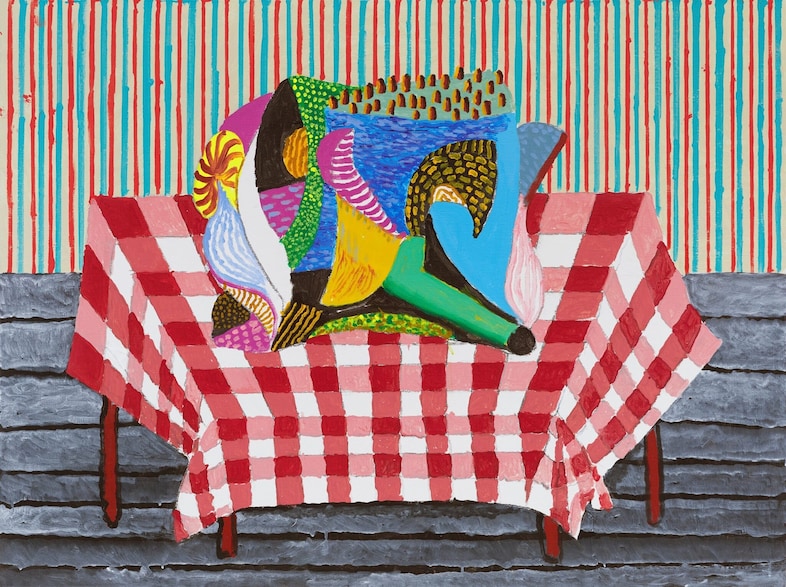
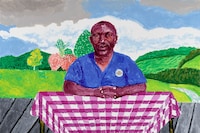
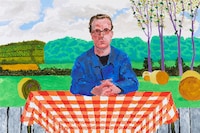
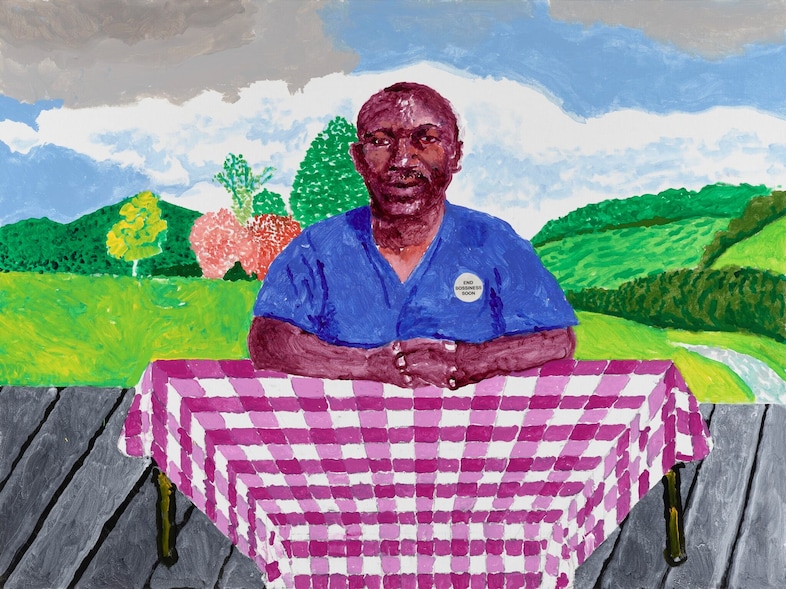
A common thread that runs through both the portraits and still lifes is a gingham tablecloth, inspired by his local French bistros. In each portrait, the tablecloth is abstracted into reverse perspective, drawing distant objects forward. For Hockney, all figurative painting is inherently abstract – and everything on a flat surface is an abstraction. “Francis Bacon used to quote Giacometti saying ‘Abstraction, c’est l’arte du mouchoir’ – the art of the handkerchief,” Hockney recalls in a conversation with Obrist, featured in the catalogue. Flat surfaces only occur in nature – the surface of a pond, say, but not the ocean or much else for that matter. “The flat surface of the canvas is only flat because of the scale of me, but to an insect it would be a hilly place,” says Hockney.
The somewhat figurative portraits are depictions of people in his close circle – his partner Jean-Pierre Gonçlaves de Lima, resting on a blue and white checkered tablecloth; great-nephew Richard Hockney on a red and white one; friend Joe Hage; Jack Ransome, who makes his glasses; Thomas Mupfupi, one of his carers. “Similarly to the landscape, you can’t look at the portraits all at once,” says Obrist. Every detail is multifaceted, each person is not necessarily painted in perfect likeness. Instead, Hockney focuses on capturing their essence, their presence. “Hockney once said to me: a person might sit still, but their thoughts always move. For him, it’s not about copying appearance – accuracy can be boring in a portrait – but rather his search for the truth about them, for the dialogue.” And, much like in his frieze, I suppose, the beauty of the passage of time.
A Year in Normandie and Some Other Thoughts about Painting by David Hockney is on show at Serpentine North Gallery in London until 23 August 2026.
