
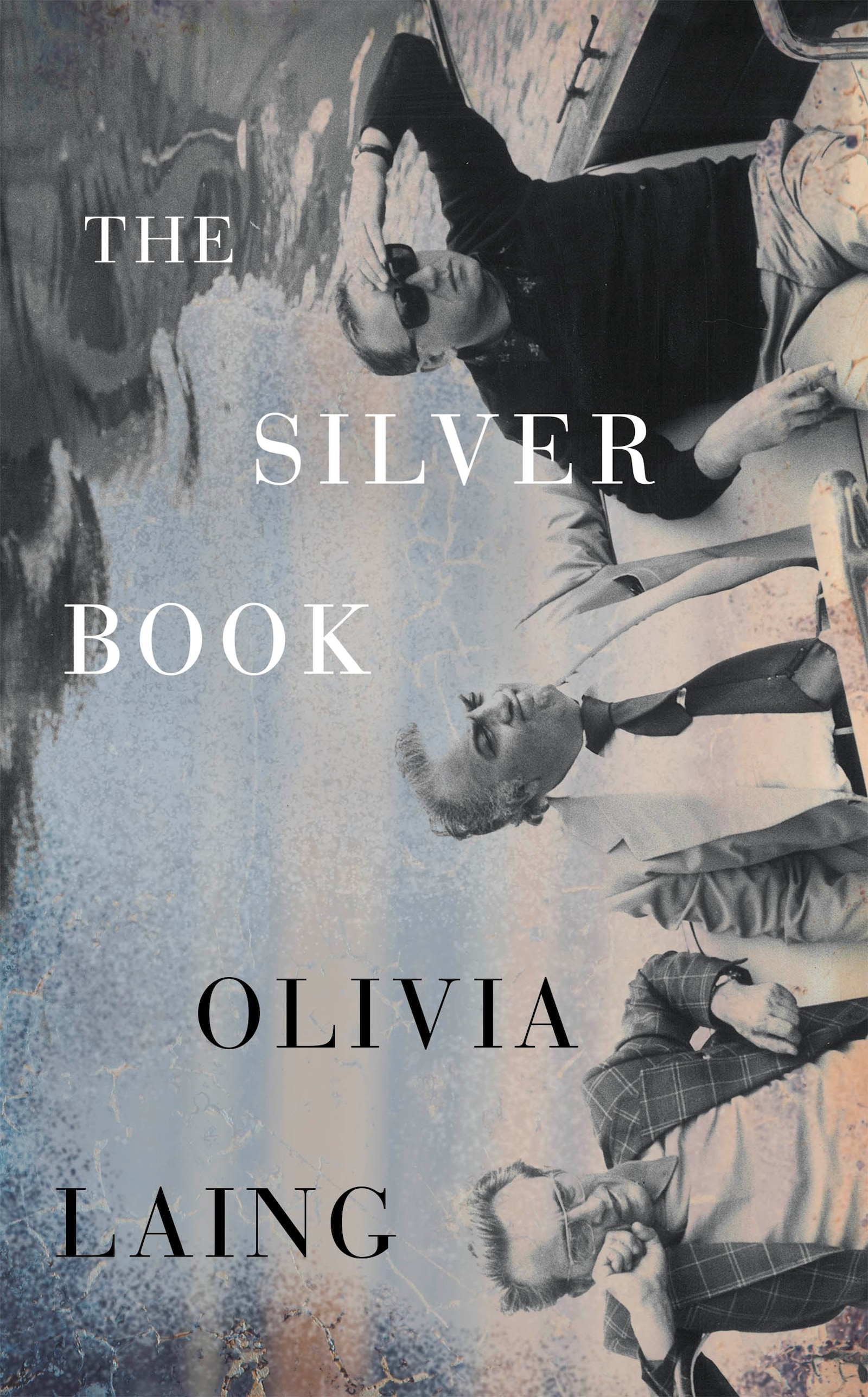
In 1975 on a scrappy patch of coast a short drive from Rome, Pier Paolo Pasolini was bludgeoned to death – the gory climax to a raging, passionate career of film and poetry. Olivia Laing’s new fever-dream of a novel traces the high-strung build-up to that murder, amid the pressure cooker of Italy’s anni di piombo, an era of political and social turmoil, bombings, kidnappings and bloodshed. Two uncanny works of Italian cinema were produced that year: Federico Fellini’s fantastical spectacle Casanova, and Pasolini’s infamous final feature, Salò, an excoriating fable of fascism.
The Silver Book delves behind the scenes of their production at Rome’s Cinecittà studios, a sorcerer’s den of tricks and illusions whose ringleader is the late Danilo Donati, the costume and set designer responsible for some of cinema’s most ingenious flights of imagination. His improvised creations – fluttering black bin-bags for Venice canal water, cheap lace curtains safety-pinned into regal robes, boiled sweets glued together as Roman mosaics – won him handfuls of awards during his lifetime, including two Oscars.
In Laing’s telling, Donati falls fatefully in love with a young English drifter who becomes the unwitting accelerant to an already combustible moment, tangled in murky conspiracies he’s unable to fully grasp. It’s a transportive, hot-blooded book, flooded by Roman light, sticky heat and scooter exhaust – and a potent tribute to the fierce, uncompromising vision of Pasolini, whose dark warnings have come home to roost 50 years later.
Below, Olivia Laing talks more about The Silver Book.

Hannah Lack: Often costume designers are celebrated for their historical accuracy – but Danilo Donati was more like a master of illusions – he used cheap fabrics, Christmas ornaments, bottle tops, papier mache ... Was there a particular costume or set that sparked your fascination with him?
Olivia Laing: I watched Pasolini’s The Canterbury Tales during the pandemic, and there’s this scene with these medieval squires wearing absolutely insane jackets that look like they’re Hedi Slimane Celine from ten years ago. I was like, who made those jackets?! In Oedipus Rex, the costumes are crazy in a different way, hats and masks made of shells and grass and feathers. And then there’s a breathtaking set in Fellini’s Casanova, which is a whale whose mouth you can walk into, and there’s a bar inside. Casanova is such a strange film because in some ways the dramatic tension isn’t there, but the sets are the most beautiful. It’s in London by the Thames, engulfed by fog, and it feels like a sort of 18th-century circus. So I got very excited that there was this one creative genius behind all these different moments of cinema that I’ve loved so much.
HL: You set The Silver Book in 1975, during Italy’s “Years of Lead”. What was it about that moment that fixated you?
OL: I think it’s got so much to do with now – 1975 is this real moment of political turbulence between the far left and the far right, and Pasolini is in the middle of that, making these eerie prophecies. He will not shut up. He’s writing in the papers, he’s talking all the time, and what he’s saying is: fascism is going to come back. It won’t look like it did in the second world war; they won’t come marching in with jack boots and Nazi uniforms. It is going to merge with capitalism. It is going to destroy ecology. It’s going to ruin the social fabric. It is going to cause danger to all of us. I think he saw the moment that we’re living in now before anybody else. It was that uncanny feeling that I was gripped by. His film Salò – that’s his warning. And what he’s saying in that film isn’t just that fascists are dangerous and cruel. He’s saying the true danger is to be compliant and complicit. The victims in that film are like sleepwalkers; they can’t wake up. I think what Pasolini is saying is, wake the fuck up!
“It’s increasingly clear Pasolini was killed because of the warnings he was making about political conspiracies in Italy at the time” – Olivia Laing
HL: I think that’s why those neat schoolgirl costumes Donati designed for Salò are so chilling.
OL: Oh yes, they’re real good-girl clothes.
HL: Towards the end of the book, Donati says people are going to think Pasolini invited his own death because of the horror of Salò. I think that idea has persisted, the feeling that he was toying with the dark side. What conclusions did you come to about his murder?
OL: What’s really clear is that it was a political assassination and that it was done in the most clever way. If he’d been shot in the head, he would’ve become a martyr. Instead, to introduce this confusion that perhaps he was looking for it … Even now I’m doing interviews where people are saying, “But Pasolini committed suicide, didn’t he?” He committed suicide by being run over by his own car? And of course, the person who went to prison for his death didn’t kill him. That boy had no blood on him and yet had apparently bludgeoned a grown man to death. So I think it’s increasingly clear that Pasolini was killed because of the warnings he was making about political conspiracies in Italy at the time. Lots of the time I’m making up dialogue for people who are real in this book. But that bit right at the end, those are Pasolini’s exact words, about how we are all in danger. I wanted it to feel, especially to young readers who might not know who he is, that this voice comes from the past, through the book and into your ears, so that you think, what is this person telling me about my world?
HL: You include a photograph of Pasolini’s funeral, and it’s extraordinary, the crowds that came out.
OL: Yeah, part of the reason I put that in is because I’d read a piece about him quite recently that said nobody cared when he died. He was just thought of as a faggot. But people did care. And the people who cared were the working classes. Watching that footage of his funeral, you see people raising their fists in the air. They loved him. They understood that he was their champion.
“Nonfiction can’t keep up with how strange and fast-moving reality has become. I had to switch to fiction because it allows me to be swift and direct like an arrow” – Olivia Laing
HL: I don’t know many people who have managed to watch Salò more than once. How was it spending time with that film?
OL: I approached it from the perspective of the making of it. The crew had problems to solve – they’ve got to work out how to create realistic-looking shit, or how to get all these kids to stop laughing while they’re filming a torture scene. It becomes completely different from being trapped in the horror of a person in a screening room watching it. None of those people knew exactly the horror of what they were making. Pasolini did, but the mood on the set was reportedly hilarious. People were laughing, playing tricks on each other. It didn’t have a heaviness about it. Whereas Fellini’s Casanova was a bad-vibe film project. People thought there was a curse on the set. They were all very unhappy and there were lots of fights.
HL: And Donald Sutherland as Casanova was really bullied by Fellini …
OL: Yes! So that’s the strangeness of the illusion-making of cinema – what you see at the end isn’t at all the experience of the people making it.
HL: Donati has such presence and charisma, the way you write him. What sources were you pulling from?
OL: Obviously the technicians on a film are backroom people. But I watched loads of documentaries, like Ciao, Federico, a documentary about Fellini in the 70s, and occasionally Danilo would walk across the back of the shot wearing sunglasses and I’d freeze the frame. I’ve got loads of these screenshots stuck on my wall. I wrote the book in Rome, so I got to look at the costumes in the Sartoria Farani archive and talk to people who’d worked with him. I was living at the British School, which is behind the Borghese Gardens, writing long hours each day, and then going out for these walks, gathering things from the city: OK, that’s what the light looks like hitting that building; there’s that cafe that Fellini loved and this is what the waiters look like. Pulling stuff back from the city and taking it into the book but also trying to time-travel back 50 years. It’s so visually overwhelming, Rome, so sensitive, loud and intense.
HL: And in the book we see the city through the eyes of an outsider, the fictional character Nicholas, who I imagine coming straight out of the film Performance, this seedy decadent London world …
OL: That’s exactly right, I really had Performance in my mind, because it felt like that moment in London where things are getting a bit dark and you’ve got to get out. The book really came in one strange vision. I was in Venice in 2023, and I’d been thinking about these ideas, and then I had this vision of Danilo walking into Campo Santo Stefano and seeing this beautiful redheaded English boy and the two of them falling into this love affair that would bring all sorts of wreckage in its wake. Nicholas is a kind of accelerant to the situation in Italy, which at that moment was such a petrol keg. In some ways, this is a book about being young – you’re so cocky when you’re young, you think you understand everything and you’re controlling things. And it’s very hard to realise that you are a pawn in somebody else’s game. Nicholas is somebody who can’t really grasp how insignificant he is inside these larger stories because, to himself, he’s the central character. It’s horrifying and embarrassing when you later realise that you didn’t understand anything and you weren’t paying attention to the right things. Loads of my friends read the book and said, ”I’m Nicholas” – I think we’re all Nicholas.
“We’re entering a moment of very dangerous illusions – the illusions of the far right, but also the illusions of AI” – Olivia Laing
HL: Fellini and Pasolini are such different personalities – one throws extravagant tantrums, the other is very precise and controlled. What was it like, having the voices of these two giants of cinema in your head?
OL: It was the weirdest experience. I’ve written a lot of books, and they’re very slow and archive based, and they’re about things being true. With this book, I got to Rome and honestly, it was like I tuned a radio set – I could hear the whole thing and I just wrote it down as fast as I could. It was absolutely uncanny. I’ve been writing nonfiction books for a long time, and I’ve come to the end of it. They can’t keep up with how strange and how fast-moving reality has become. I had to switch over to fiction because it allows me to be swift and direct like an arrow. You can go straight to the heart of scenes.
HL: There’s a quote by Fellini you open with: “Making yourself up is an offshoot of modernity. So I’m everything and nothing. I am what I invent.” It feels very contemporary somehow.
OL: I was thinking a lot about AI. This is a book about illusions, about people who are professional creators of illusion, but their illusions are handmade. They work collaboratively and create illusions that seek to tell the truth and are designed to sustain people. That’s the kind of illusion I think Danilo Donati was deeply invested in. He wants to be able to tell the truth about the world, and he does it by making these costumes or sets that people can see and understand without necessarily using language. And then there are other kinds of illusions that are political illusions. And Pasolini was so determined to pierce them, to tell people the truth. And it really struck me that we’re entering this moment of very dangerous illusions – the illusions of the far right, but also the illusions of AI. Human creativity is being drastically devalued and replaced by slop – something that doesn’t feed us, doesn’t nourish us. I think it’s dangerous, and I wanted to write this book as a love letter to human creativity. It’s a love story about Danilo and Nico, but it’s also a love story about people making things for other people: the strange, great gift of art.
The Silver Book by Olivia Laing is published by Hamish Hamilton and is out now.
