
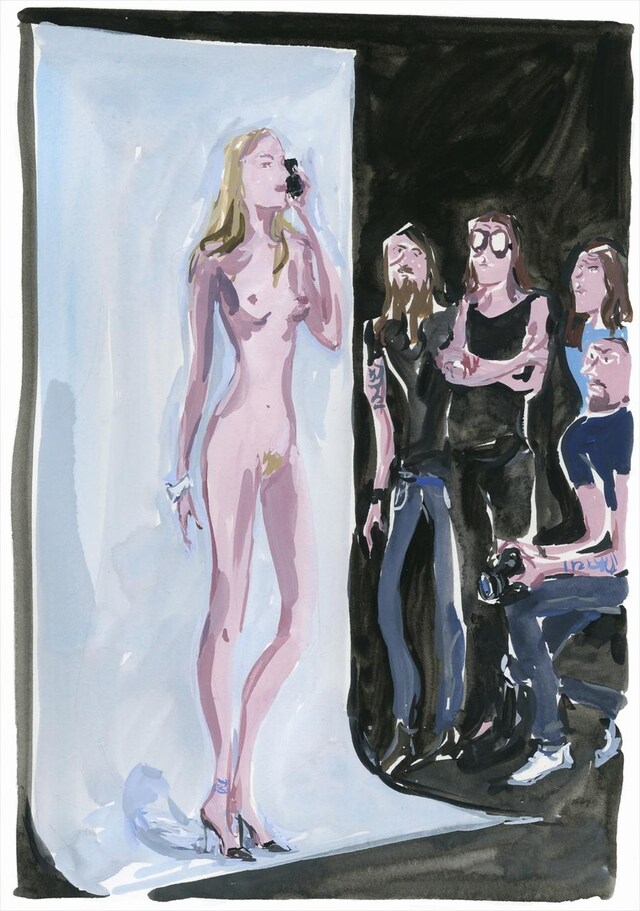
Jean-Philippe Delhomme, like his friend Glenn O’Brien, is one of the most accomplished Renaissance men one could encounter today: as illustrator, he works for publications such as GQ and the Los Angeles Times...
Jean-Philippe Delhomme, like his friend Glenn O’Brien, is one of the most accomplished Renaissance men one could encounter today: as illustrator, he works for publications such as GQ and the Los Angeles Times. He has designed advertising campaigns for clients including Barney’s, The Mark Hotel in New York and Le Bon Marché in Paris. Delhomme is also an author who has written novels published in French, such as Mémoires d’un Pitbull (Memories of a Pitbull, 1999) and La dissolution de l’artiste (The Diluted Artist, 2001). An astute observer of contemporary lifestyle, he describes them on his blog The Unknown Hipster and in his recent books Design Addicts (2007) and The Cultivated Life (2009).
How would you connect fashion to elegance?
These are two paths that go in different directions, even though they might luckily cross each other once in a while. A large part of fashion is loudly status-based, while elegance is understatement and a refined sense of discretion. There’s a large supply of new billionaires who don’t care about cultural subtleties and just want to advertise sex and raw power. It’s more realistic for fashion to catter for this crowd, rather than for a bunch of intellectuals.
What is the role of history and art history in your conception of fashion?
Originally (although it’s questionnable), art and fashion were two distinct creative fields. They coincided, however, when classic painters used the fashion of the time as a motive in portraiture, or when Yves Saint Laurent used a Mondrian on a dress. But while it’s charming to think of a woman wearing a Mondrian, the obliged association between contemporary art and fashion has become a cliché. As a result, the most expensive and famous art can hardly be seen for something else than another obvious status symbol. To be fair, one has to admit that fashion has taken the role of museums and cultural institutions to commission art and the most innovative architectures. Today, a new flagship store is a new Guggenheim.
"A large part of fashion is loudly status-based, while elegance is understatement and a refined sense of discretion"
Would you describe fashion as a language and a discourse, as Barthes did it?
Barthes' "Système de la Mode" is a hard read, while fashion is easy enough to understand for its own people. It’s an abridged, simplified language. When you look at a fashion advertisement in a magazine, you can immediately decipher what it’s meant to symbolise. It doesn’t require an extensive knowledge, it’s instant culture, you just have to live in a world not deprived of medias. And aside from some great fashion critics, the memory of most people in that world does not last for more than three years: this season, and maybe two years before.
The word intellectual was coined in a time of great political distress. Does fashion have a political role, and in which way?
Apart from its most creative or underground aspects fashion is conformism, and as said before, status symbol. So if it’s political, let’s say it’s as political as sport car can be. But of course, there’s also a part of fashion which is taking its distance, which is more ironical, and poetic, this is the fashion I like.
Would you relate the concept of fashion to the one of style?
Style is about expressing a certain spirit, while fashion is enforcing the trends. Apart from a few designers who act like true artists, the rest of them seem not to have any personal aesthetics, or commitment to a personal style. Even within one collection. It’s like the annual show of the amateur painting club: there’s the abstracts, the surrealist, the nudes, the landscapes. In most collections, you’ll find the minimalist white, the all black, the floral, the graphic, etc…and one wonders: how can it be that the same designer would like this and that?
What does fashion have to do with intellectuality?
In fashion, intellectuality is a stylist's idea for a fashion shoot: let’s do the existentialists, the Beat!…or girls in lingerie pretending to read serious books.
You have born witness of the different worlds you’ve encountered, from literature to the arts and of course fashion. Is there a specificity of the fashion world?
I think fashion shows give the best idea of what Versailles must have been during Louis XIV. Fashion is a totally self-generated aristocracy, and nowhere else you’ll see this sense of privilege (the Front Row), boosted egos, and rivalry. The funny thing is that this mock-up aristocracy, instead of being exclusive, actually forms a huge crowd. It has became a whole category of people on its own, as general as the retired or the seniors. Around the world, there are resorts designed specifically for fashion people where they fly all at once with the seasons, just like migrating birds. There is a shared language made of brand names, a common sense of humor, and an identical hedonist lifestyle which has never been better expressed than in the New York Standard Hotel’s tag line "Work and Play".
You see fashion as a witness, an illustrator, a commentator, and someone who works in advertisement. What is the impact of all these different experiences on how you see fashion?
I’m grateful that my work enables me to meet people coming from very different fields: artists, designers, but also CEOs, investors, chefs. I’m always interested to see how people live in each milieu. That’s why I admire Tom Wolfe so much: it’s so realistic, that it becomes jubilatory. And for fashion, when it’s supposed to be breaking the rules, you just feel you have been reading it before in Balzac or Proust.
Dressed For Art, an exhibition of Jean-Philippe Delhomme's drawings, is on show at New York’s FIAF Gallery until April 14.
In two weeks Donatien will be interviewing the fashion academic Caroline Evans.
