
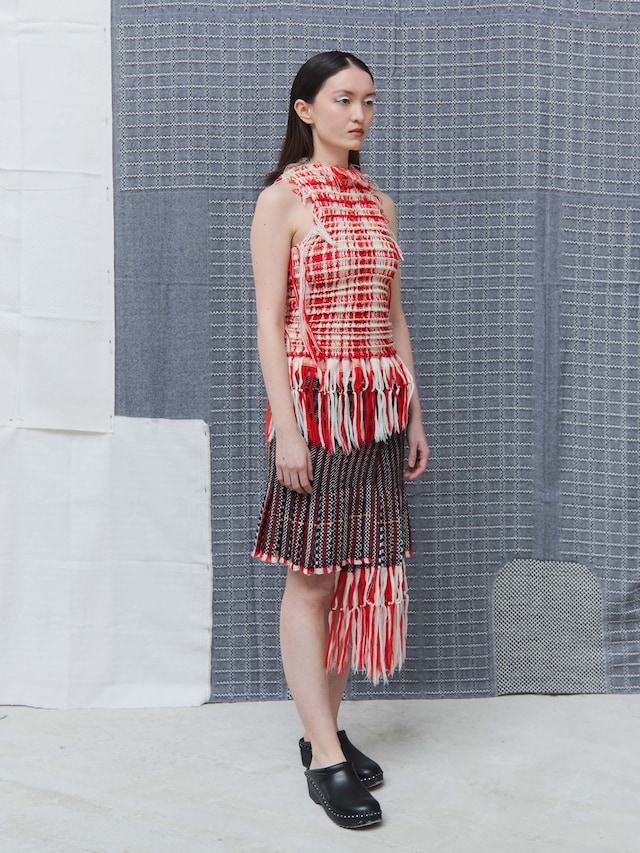
Sarah Brunnhuber’s Autumn/Winter 2026 collection was composed entirely of wool, centring on a yarn the designer has spent years refining
- Who is it? Stem is the Copenhagen-based label founded by textile designer and weaver Sarah Brunnhuber
- Why do I want it? Material-led garments where elastic wool innovation meets rigorous zero-waste construction
- Where can I find it? Stem is available via the brand’s own website, as well as selected stockists


Who is it? For Copenhagen-based designer Sarah Brunnhuber, garment construction starts with humble fibre: the tension of yarn and the structure of weave precede any silhouette. “I think of myself as a weaver first,” she says of Stem, the brand she founded in 2021 – a distinction that places process at the centre of her practice, summarised simply as “form follows technique.” “On average, we throw away 15 to 25 per cent of a fabric when we cut a garment,” she explains. And it’s this persistent loss that informs Stem’s signature method of making: construction is woven in from the outset, and aesthetic detailing emerges from the internal logic of its production.
After completing a foundation course in London, Brunnhuber studied design in the Netherlands, where weaving – begun in her first semester – offered her a way into fashion’s underlying systems, each structure mapping the relationship between material, labour, and form. When she launched Stem in 2021, she initially imagined it as collaborative; an early three-piece denim capsule with Ganni tested how her construction techniques translate across another brand’s language. Such openness has since grown beyond collaboration alone: Brunnhuber is now developing a weaving mill in Denmark – where none presently serve the fashion industry – imagined as a shared resource for designers attentive to material and method. Stem runs alongside it, not as a side project, but as a lived example of what this infrastructure might make possible.

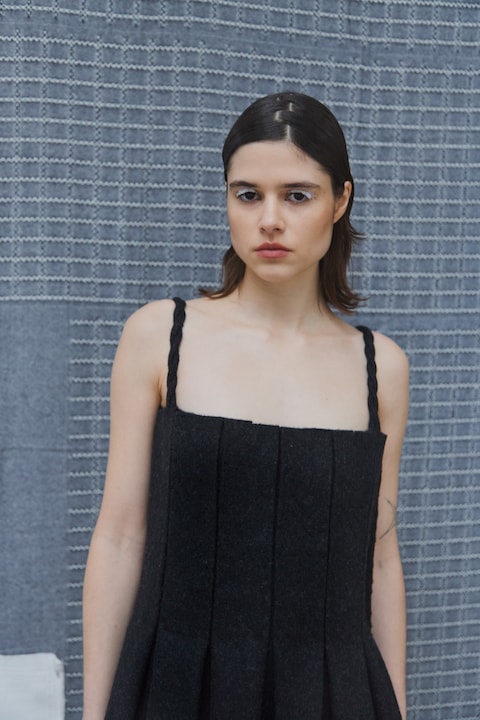
If production is her subject, then education becomes its natural extension. During Copenhagen Fashion Week, Stem’s latest presentation unfolded as a wool felting workshop alongside a runway show. Guests gathered around communal tables, guided by the collective Hedestrik (who source raw fibre from the same Danish shepherdess Brunnhuber works with), handling the material that underpins the collection. “As soon as you start to understand how something is made, you can’t unsee it,” she reflects. For Brunnhuber, this tempering of perception matters; engagement with material, however small, has the capacity to recalibrate the value we place on what we wear.
Why do I want it? The title of her latest collection, To Wool, reads as both ode and instruction, and the garments follow suit. Composed entirely of wool – stitched even with wool thread – the collection centres on a yarn Brunnhuber has spent years refining. Developed in collaboration with a yarn research studio, the high-twist fibre carries an unexpected elasticity, allowing the weave to stretch and return without reliance on synthetics. “If you want a stretchy garment at the moment, it’s either knitted or it’s got synthetics,” she explains. Here, resilience is drawn from the fibre itself, extending the physical vocabulary of what a woven form can do.
Brunnhuber’s construction process is engineered to eliminate the waste she identified at the outset of her practice. Each garment is digitally mapped before it is woven, pattern pieces nested into the fabric itself so that the areas traditionally discarded remain structurally attached. When cut, those sections transform into fringed seams and textural detailing, the so-called excess absorbed back into the garment’s architecture. The aesthetic – elongated edges, softened grids, checks that subtly distort across a loose weave – emerges directly from this method. Form follows technique in its most literal sense.

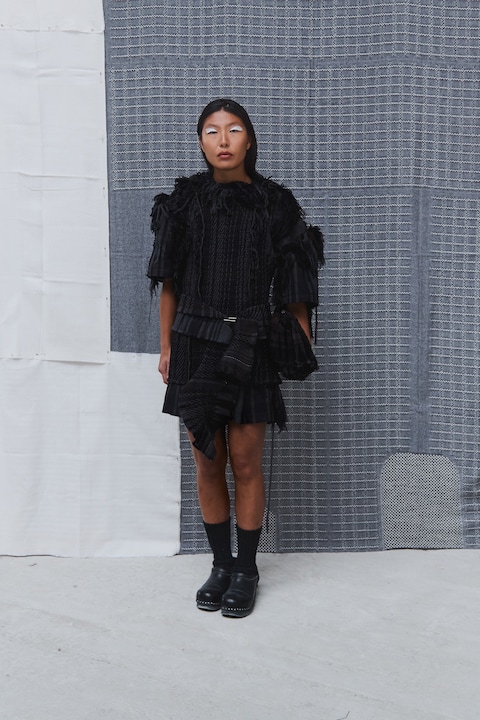
With its mono-material integrity, each garment, at the end of its life, can return to fibre once more. Production takes place in Denmark, with a partner sewing studio in Lithuania, a balance that reflects Brunnhuber’s commitment to proximity without sacrificing viability. Her broader ambition for the mill follows the same logic: moving beyond sustainability as containment towards regeneration as contribution, building a site that benefits the people and ecosystem around it.
In this sense, the mill becomes an experimental site – an infrastructure designed to support other designers as much as her own work. She remains clear that her method is neither singular nor prescriptive. “We need hundreds of solutions,” she says. Stem is hers: a material proposition among many, woven with woollen rigour, and intended to endure.
Where can I find it? Stem is available via the brand’s own website, as well as selected stockists.
