
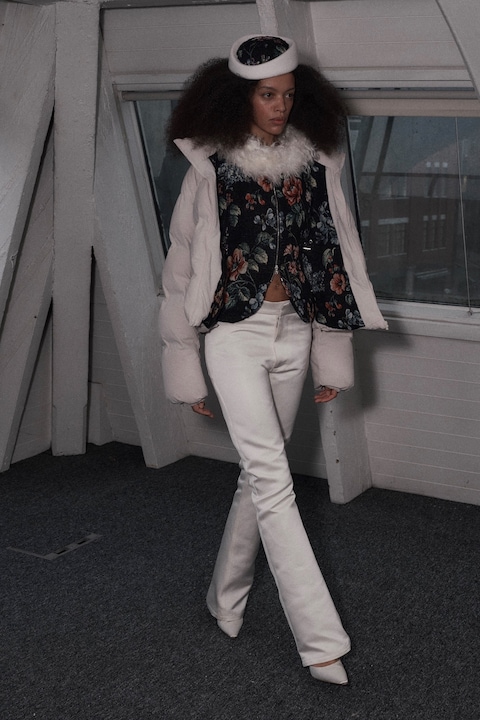
The Swedish designer’s Autumn/Winter 2026 collection draws on her memories of figure-skating, proposing a woman defined by spectacle under the pressure of competition
- Who is it? Petra Fagerström is a Swedish designer known for her lenticular pleated looks that evoke lost memories
- Why do I want it? Her collections balance severe discipline with an undone glamour. Autumn/Winter 2026 was inspired by the figure-skating prodigies now dominating headlines
- Where can I find it? Dover Street Market Paris, 10 Corso Como, H Lorenzo and the label’s own website

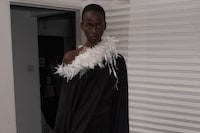

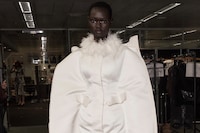
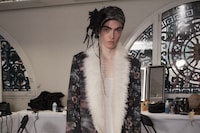
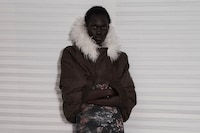
Who is it? Petra Fagerström is eager to show me the second-hand princess pleater now bolted to a worktop in her Smithfield Market studio. The machine, which looks a bit like a relic of heirloom sewing, produces precise rows of parallel gathers usually destined for smocking or shibori. The Swedish designer has other ideas. “I need to see if I can make it work with my lenticular pleating,” she says. She reaches for a half-finished piece: a length of fabric printed in two directions, soon to be hand-sewn and ironed into the three-dimensional image flips that have become something of a signature. The process is slow and exacting – hours of stitching before the pleats are coaxed into place, but the effect is worth it. The garments seem to shift as you move around them like fragments of memory coming into focus.
Which is a great metaphor for Fagerström’s work more broadly. Her collections often begin with recollections before being translated into clothes that feel severe and strangely intimate. Still only a year out of a Masters at Central Saint Martins, the Swedish designer has quickly established a distinctive language of outerwear and eveningwear spliced together into fierce silhouettes that suggest glamour under pressure.

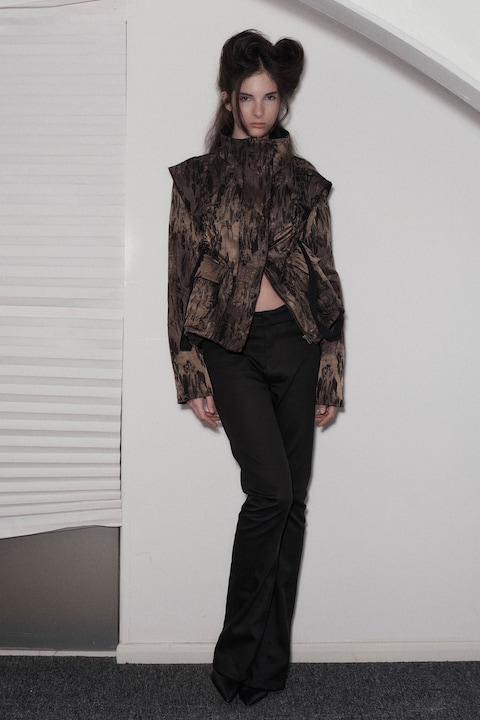
Raised in Gothenburg, Sweden, Fagerström first learned to sew as a competitive figure skater. She was attracted to the spectacle of it. “Getting to wear a pretty dress, the make-up and hair – that was a big part of why I loved figure skating,” she remembers. Most skaters made their own costumes, and the process sparked an early fascination with craft that would eventually lead her to fashion.
But the love for high fashion began online: she shyly admits that, as a teenager, she ran a Tumblr devoted to Rihanna, tracing what she wore and falling down digital rabbit holes of runway imagery. Discovering Nicolas Ghesquière’s Balenciaga proved formative: “I was hooked. It became this rabbit hole of looking at these things that I would never see in real life.” After studying at Parsons Paris and working at Acne Studios and Balenciaga, Fagerström enrolled at Central Saint Martins to define her own visual language. “Fashion for me was really about creating a persona,” she says. That persona has become central to her practice. Each collection proposes a woman with a life and inner logic; Fagerström imagines her routines and temperament with near-method intensity. “Sometimes I make decisions in my life thinking of what she would do.”
The pieces that emerge balance severity and glamour – structured outerwear colliding with eveningwear fabrics in silhouettes that feel disciplined but twisted and undone. “I love there to be a bit of tension,” she says. Even now, as stockists in Paris, Milan and Los Angeles begin to pick up her work, she still produces much of it herself. “I make everything in my collection,” she says – an approach that gives the clothes a sense of authorship as well as labour.

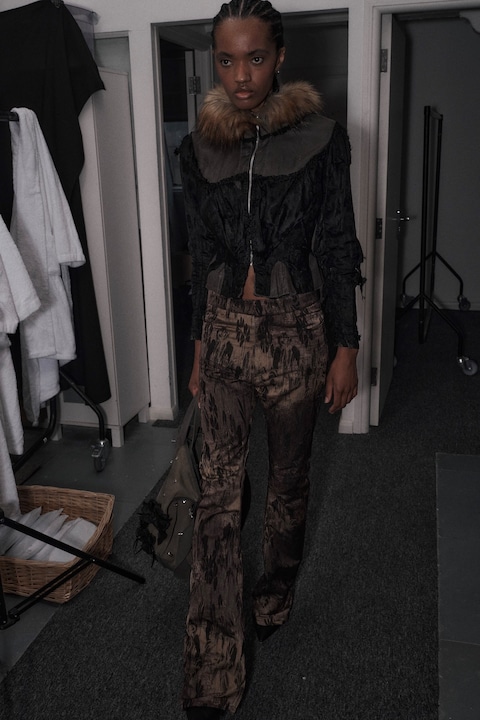
Why do I want it? Her Autumn/Winter 2026 collection, titled After Everything I Did for You, begins with the figure skating mother and reimagines her with unexpected empathy. The collection explores the subtle power dynamics between mentor and prodigy, where discipline and devotion blur into control. “I wanted to work around this woman in a non-satirical way,” Fagerström says. Rather than caricature the stage mother, she focuses on a “mature woman who carries the memory of her glory days,” exploring the mixture of pride, ambition and sacrifice embedded in the role.
In striking serendipity when we spoke, the Winter Olympics were underway in Milan. Just days earlier, the overwhelming favourite Ilia Malinin had faltered in the men’s free skate, falling out of medal contention in a reminder of how quickly prodigies can become disappointments. It is precisely that atmosphere that runs through Fagerström’s collection.

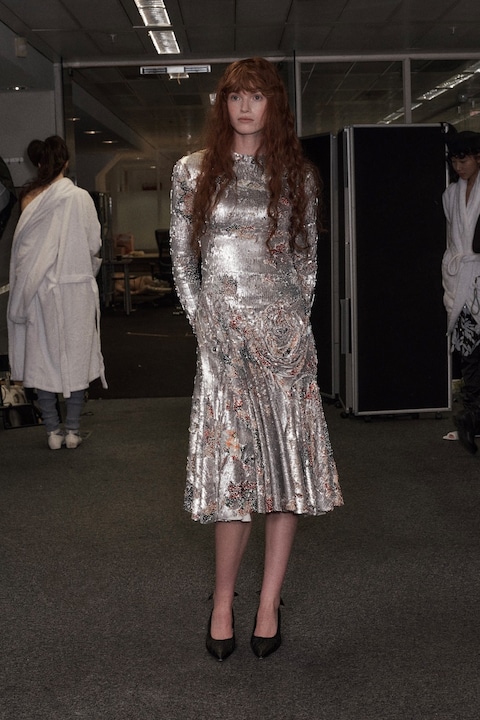
Slinky Swarovski dresses are worn with dowdier parkas and soft fleecey layers – combinations lifted directly from the realities on the rinkside. “There’s this tension between performance and glamour and a lot of random, coincidental things that can be quite beautiful,” she says. That friction plays out in the clothes themselves: sequins under bomber jackets, structured coats stitched and worn open over puffers, eveningwear offset with sweatpants, all paired with Manolo Blahnik heels. One look pairs a sequin dress with a bomber cape, capturing what she describes as a “severe, glamorous” silhouette.
Technically, the collection pushes her strangely compelling language forward. Tailoring appears for the first time alongside painstaking hand-worked textiles and custom ribbing. Some fabrics require hours of stitching before they are ironed into optical illusions. “There is just no other way so far to get the illusion perfect,” she says. The result is a wardrobe that feels emotionally charged but grounded in lived experience. Fagerström is wary of having her work described as purely artistic. For her, the point is always the woman inside the clothes, a figure she continues to refine, collection by collection.
Where can I find it? Petra Fagerström is available to purchase from Dover Street Market Paris, 10 Corso Como, H Lorenzo and the label’s own website.
