
The Norwegian auteur behind The Testament of Ann Lee presents a hypnotic “tone poem” for Miu Miu Women’s Tales, comprising puppets, Miu Miu dresses and choreographed movement
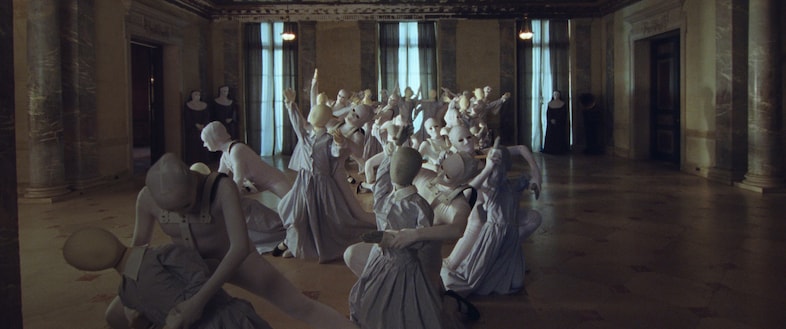
In a grand rural boarding school, bathed in golden light, a young girl steps out of line from her fellow pupils and into the world, finally visible, but not yet fully formed. Such is the premise of Discipline, a new film by Norwegian auteur and actress Mona Fastvold for Miu Miu Women’s Tales, the long-running series of women-led shorts commissioned by the Italian fashion house.
When Miu Miu approached her, Fastvold was in the midst of the promotional tour for her latest feature, The Testament of Ann Lee, a rousing musical biopic about the founder of The Shakers – that ecstatic Christian sect known for their dance-led style of worship. Inspired by a Miu Miu dress with sentimental value and a desire to bring her Ann Lee team back together (including the British composer Daniel Blumberg, choreographer Celia Rowlson-Hall, leading actress Amanda Seyfried, and cinematographer William Rexer), Fastvold set to work.
The filmmaker describes the resulting piece as a “tone poem”, different to the work she’s produced so far – which includes her first two features, The Sleepwalker and The World to Come, and The Brutalist screenplay, which she co-wrote with her partner, Brady Corbet – but bearing many of the same hallmarks: atmospheric isolated settings, character-driven storytelling (enhanced by costume) and deeply expressive movement.
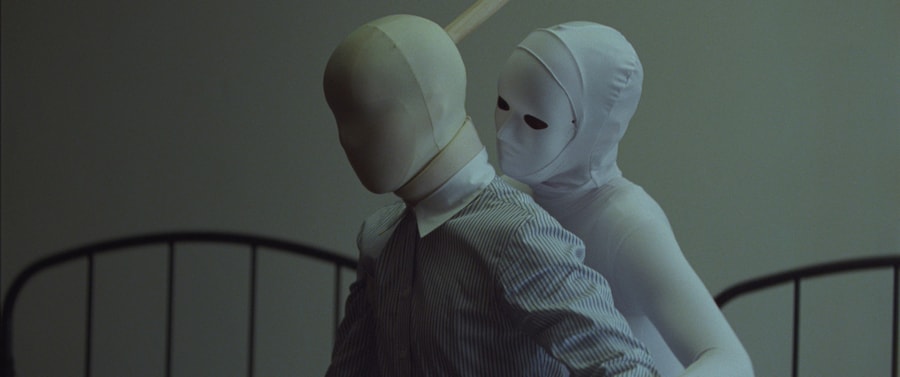
Beautifully shot on 35mm, set to an experimental soundtrack of syncopated drums and wobbly flute, and led by a troupe of dancers operating bespoke, life-sized puppets, Discipline is a surreal and sublime ode to teenage transformation. Ahead of its premiere in New York, Mona Fastvold sat down with AnOther to discuss its realisation.
Daisy Woodward: What was your starting point for Discipline?
Mona Fastvold: The parameters for the piece are to use clothing made specially for it. Beyond that, you can do whatever you want, which is lovely, but I liked that construct: creating a piece that’s in dialogue with a garment, and putting it centre stage.
DW: I read that the girls’ dresses were based on one you wore to the Venice Film Festival.
MF: Yes, the one I wore for The Testament of Ann Lee press conference. The very first time you talk about a film is stressful and nerve-wracking – you haven’t quite found your words about it yet – so finding something you feel protected in, in that moment, is important. That was the garment I had the strongest emotional attachment to, so I decided to write something for that dress, to use a version of it and see if I could explore a different meaning of it. I wanted the film to be silent and for the dress to be inhabited by someone invisible – the puppets – to really give space to the piece.
DW: Tell us more about the puppets.
MF: I’d been wanting to work with puppets and puppeteering for a while, and to explore more movement. I was thinking that if you have a life-size puppet and it’s being operated by a dancer, then it sort of becomes this other self, this separation of the self. I thought a lot about the fracture and merging [of self]. For me, there’s always been something about Miu Miu that feels a little bit like a uniform – this play between adult womanhood and girliness. So that was the spark: the beginning of that move from girl to becoming a young woman, and thinking about it as if you’re dressing and preparing a character you’re operating instead of yourself.
I have an 11-year-old daughter and I see how meticulous young girls are with what they’re wearing. There’s so much meaning in garments at this pre-teen, early teen stage: you’re constantly trying on personalities. For the film’s last improvised section of the movement piece, the assignment was that each dancer should be in dialogue with their 13-year-old self. There’s a lot of tenderness in that movement, which leads to the birth of this ‘real girl’. I could have shot that part for days!


DW: The ‘real girl’ is wearing an amazing pink dress. How did you land on that?
MF: I knew I was going to use a piece from the new Miu Miu collection, which is so radical. It has a lot of masculine elements but there’s femininity too, as well as things like the aprons, which point to a different period in Italy. The previous collection had all the girlish, uniform references, so I thought, “This is exciting, I can do a cocoon-butterfly story.”
DW: You worked with your longtime collaborator, the choreographer Celia Rowlson-Hall, who also choreographed Ann Lee.
MF: Yes, I worked with Celia on the choreographed section and the improvisational piece. We worked with 18 dancers, and two principal dancers: one is the puppet – the human inside the costume – and the other is operating the puppet.
DW: The two films feel like they are from the same world, somehow.
MF: They are really in dialogue. This is very different, but it’s like a super weird bonus track.
DW: Did the decision to set the film in a Catholic school stem from the religious context of Ann Lee?
MF: It was more to do with Italy in relation to Prada, honestly. I was thinking about Italian boarding schools, and Fleur Jaeggy’s book The Sweet Days of Discipline, which takes place at a boarding school in the Alps. I had the idea of creating this isolated school where everything is very uniform and simple.

DW: Did you film in Italy?
MF: No, I shot it in upstate New York in this mansion from the Gilded Age with beautiful bones and great marble and wood. I wanted a palette that had a lot of history to it, and that would evoke this Italian boarding school in my mind, without tying it to a very specific time or place. With this piece, I worked as if I were creating a poem out of images. It was less of an intellectual approach because it was going to be really focused on movement and could be silent.
DW: What was it like to revisit the short-film format after making feature films?
MF: It’s hard because I’m so used to writing long screenplays – I guess restraint in that department is not really my fortitude! When it’s a short film, you have to have a very simple idea, something very precise. But that’s what was nice with Discipline – I felt like it didn’t really have to explain itself or come to any conclusion. It could just be an exploration of ideas, which is what short films often are. It felt absolutely incredible to do something with my team that was just playful and exploratory, with no expectation of delivering something in a specific way – not even for yourself.
Miu Miu Women’s Tales Number 31: Discipline is out now. The Testament of Ann Lee is in UK cinemas from February 27.
