
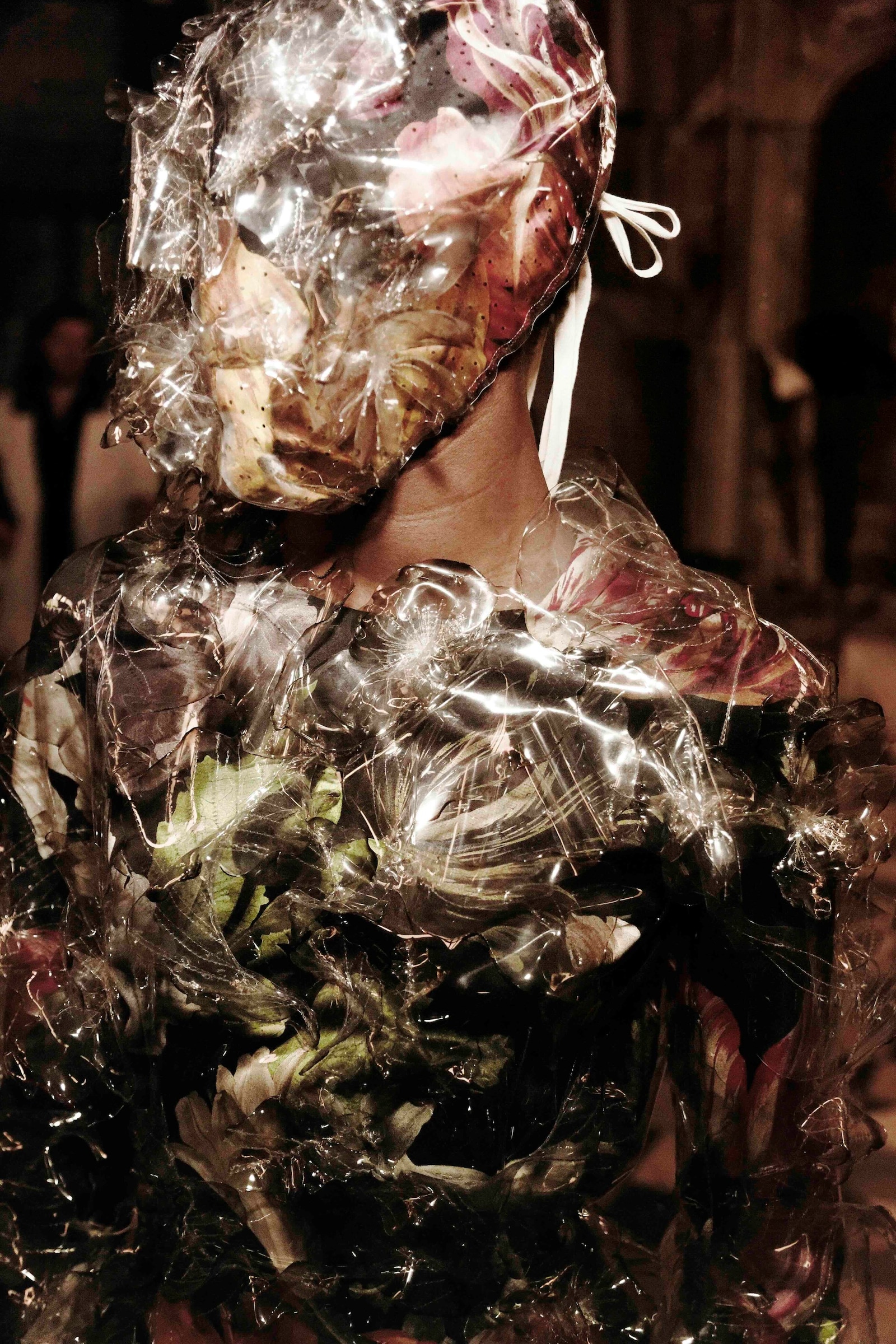
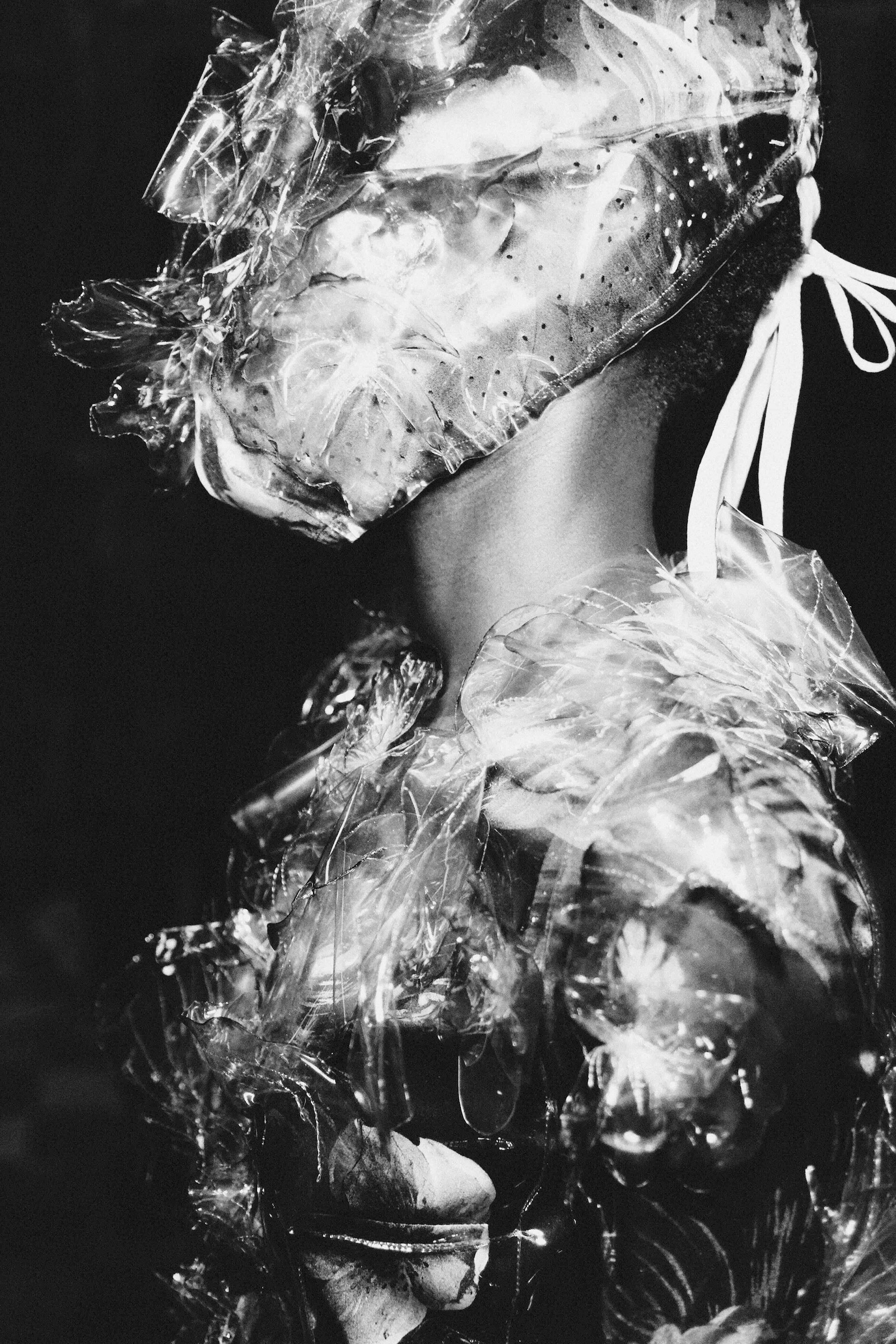
OK, let’s talk about symbolism. Did it matter more that Glenn Martens showed his Maison Margiela Artisanal debut in the same space that, in October 2008, Martin himself staged his grand farewell show, a retrospective trip closing with a giant walking cake? Or does it mean more that said space was not, as conjectured by various members of the press, a crematorium nor abattoir, but actually a space that for over 120 years, housed the city undertakers for Paris, organising 150 funeral processions per day? The main hall where Martens showed used to be stacked with coffins and catafalques. Was Martens paying direct homage, or waking the dead? Or maybe a little bit of both. Margiela has, of course, been far from dormant over the past decade, led by John Galliano. But certain elements from the archive have been absent, subsumed by the obsessions of a different talent. Martens began his collection with veiled faces – some in kinky, asphyxiatory plastics, compressed recycled metal, that ended up resembling death masks. Yet this wasn’t a collection obsessed with the past, nor with the passed. Rather, it was about reimagining Margiela ideas and ideologies through a talent that has proved to be one of the most original in fashion today.






That’s a big swing – it’s also especially big coming after Galliano, universally acknowledged as one of the all-time greats, one of the few living creatives who can stand up next to Margiela in terms of ongoing influence. Rather than attempt to wipe the recent slate clean with this effort, Martens did something far more elegant, and difficult: he acknowledged Galliano’s impact, his imprint on the house, the traces of his work. It reminded me of the idea behind Margiela painting everything white – walls, furniture, even clothes – not to sanitise or obliterate, but rather to emphasise the passage of time, through marks left on the paint, its cracking on the garment. Martens presented corsets, bien sûr, they’re everywhere in haute couture, and arguably it was Galliano’s cinched Margiela show of last January that kicked all that off. Martens’ corsets were different, but they subtly acknowledged that debt of gratitude, just as the rest of the collections nudged and winked at Margielaisms past.
As well they should. “Margiela created a school of thinking,” Martens told AnOther Magazine back in 2018, tracing the influence of the founder on an entire generation (and then some) of fashion designers. His name cropped up in Jonathan Anderson’s discussion of his Dior debut, too. Indeed, it’s rarely absent from any designer discussing seminal influence. So to take the helm and dive into the teachings of that school first-hand must’ve been a dream for a geek like him.

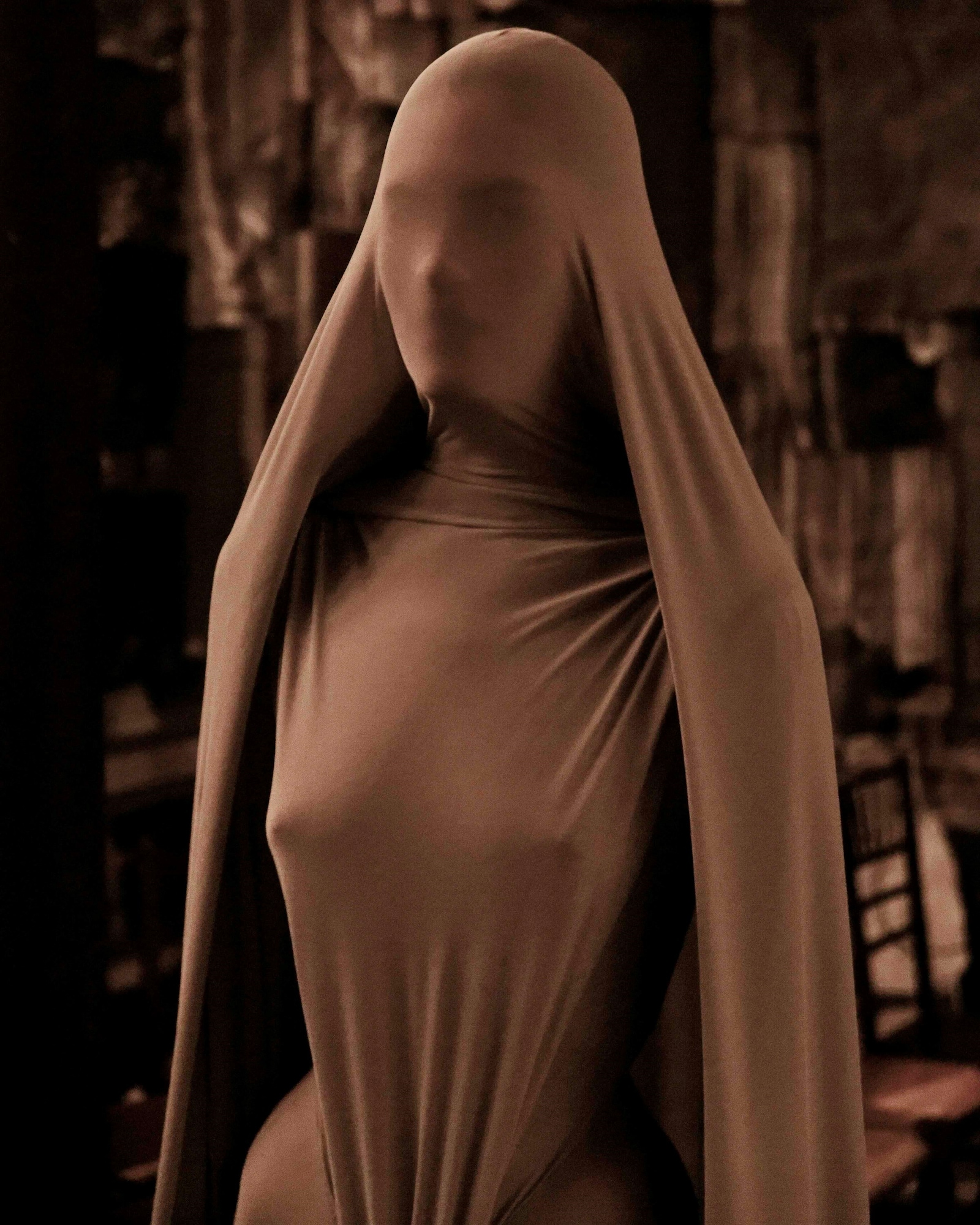
One of Margiela’s many fashion inventions was the idea of the replica, a precise reconstruction of an existing piece, with minimal, if any, changes. It must’ve been tempting to do that, especially as an avowed fan, to reiterate those Margiela greats that everyone else references, albeit with the legitimacy that blank white label affords. Martens however did something more clever, which was to reimagine Margiela, to draw parallels with himself and his own approach and, like a smear on white paint, to record his passage and make his mark.
The collection itself was inspired by Flanders and the Netherlands – Margiela’s birthplace, but Marten’s too, Genk and Bruges, respectively. So there were references to the gothic architecture of Bruges, draped forms recalling statues studding church façades – there aren’t any of those in Genk, although the main church is dedicated, ironically, to Saint Martin. And the interiors of Northern European homes inspired treatments replicating hand-embossed wallpapers, and prints based on 17th-century Flemish masters. In another supremely elegant touch, a few crystal-encrusted masks even nodded to those produced in the period when Matthieu Blazy – incoming Chanel creative head – led the house’s Artisanal operation. Others were transparent – the masks slipped, letting the identity be known. Just as, presumably, Martens wants his to be, behind this show.

Back and forth, then and now, Margiela and Martens. That’s been a theme of this haute couture week – and before, stretching into menswear and the Celine debut of Michael Rider. It’s natural, considering most designers are showing under someone else’s name, assuming another identity. Margiela is the one perhaps most emulated in contemporary fashion, and it is a mark of Martens’ skill that he brought plenty of himself to the table. A series of dresses in an aged duchess, crushed and creased around the body thanks to metal filaments in the textile, nodded to a poufy taffeta gown Martens showed a few years ago when he made his haute couture debut for Jean Paul Gaultier. He’s kind of a dab hand at navigating this appearing-as-other designer gig, without losing his soul, and Margiela, incidentally, worked for Gaultier too before starting his own thing. Memory is a great thing to have in fashion. Here, Martens made something worth remembering, and it’s only the start.
