
On the outside of the Dior show space on the southernmost point of the Hôtel des Invalides, a giant, distorted facsimile of Dior’s Louis-Hooey salon was printed. A sofa stretched 20 feet across. I say Louis-Hooey because, although it looks 18th century, those salons are actually the decorator Victor Grandpierre’s 1940s fantasy of the 1780s, filtered through the haute bourgeoisie taste of the Belle Époque. It was Dior’s pearl-tone dream of his childhood home, a “Helleu fantasy” in his own words, referencing the scribbly, impressionistic portrait painter of choice of that period. In short, an imagining of an imagining of history, which is very Dior. As is staging a show here – a complex of monuments dedicated to the might of France’s past, when they conquered the world. As Dior did, back in the day.
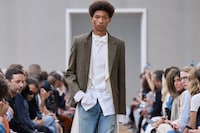
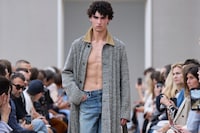
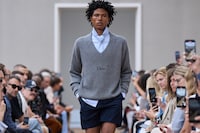
Christian Dior himself died after a short, intense decade of creation. “You realise, what he did in ten years is just like ... one dress is like a collection for a designer today,” Anderson said a few days before the show. He was speaking in the Dior studios, and seemed to be laying out his blueprint not just for this Spring/Summer 2026 menswear collection, but for his Dior regime as a whole. The Andy Warhol Polaroids of Jean-Michel Basquiat and Lee Radziwill promo’d on Dior’s Instagram ahead of time weren’t intended as direct references, but to set a mood. “The idea of personal style,” is how Anderson summed it up – a break away from Dior’s history as a designer dictator, whose ‘New Look’ of 1947 obliterated all fashion before it and instantly made the short skirts and sharp, squared shoulders of wartime dress bluntly redundant.
Anderson wasn’t aiming for another New Look with this collection: that kind of world-shifting succès fou is utterly impossible in the multifaceted fashion world of 2025. But, what he wanted to do was take a similar approach to Christian Dior himself – a backwards glance, a love of construction, a whiff of 18th-century opulence – and translate it to today. And there’s also the fact that Dior’s so-called ‘New Look’ wasn’t really new – it was inspired by the past, but was also shaped by what was going on around Dior at that time. There were nods to a few other couturiers’ not-so-new looks – Cristobal Balenciaga had shown pre-war gowns inspired by Spanish Infantas. Dior dubbed him ‘the master of us all,’ so I hope he wouldn’t mind the comparison. Meanwhile, the work of the megalomaniacal Anglo-American couturier Charles James had brought 19th-century volumes back to grand ballrooms around the globe. But, more fundamentally, Dior sensed the mood of his time. “Europe was tired of dropping bombs and now only wanted to let off fireworks,” he later wrote.

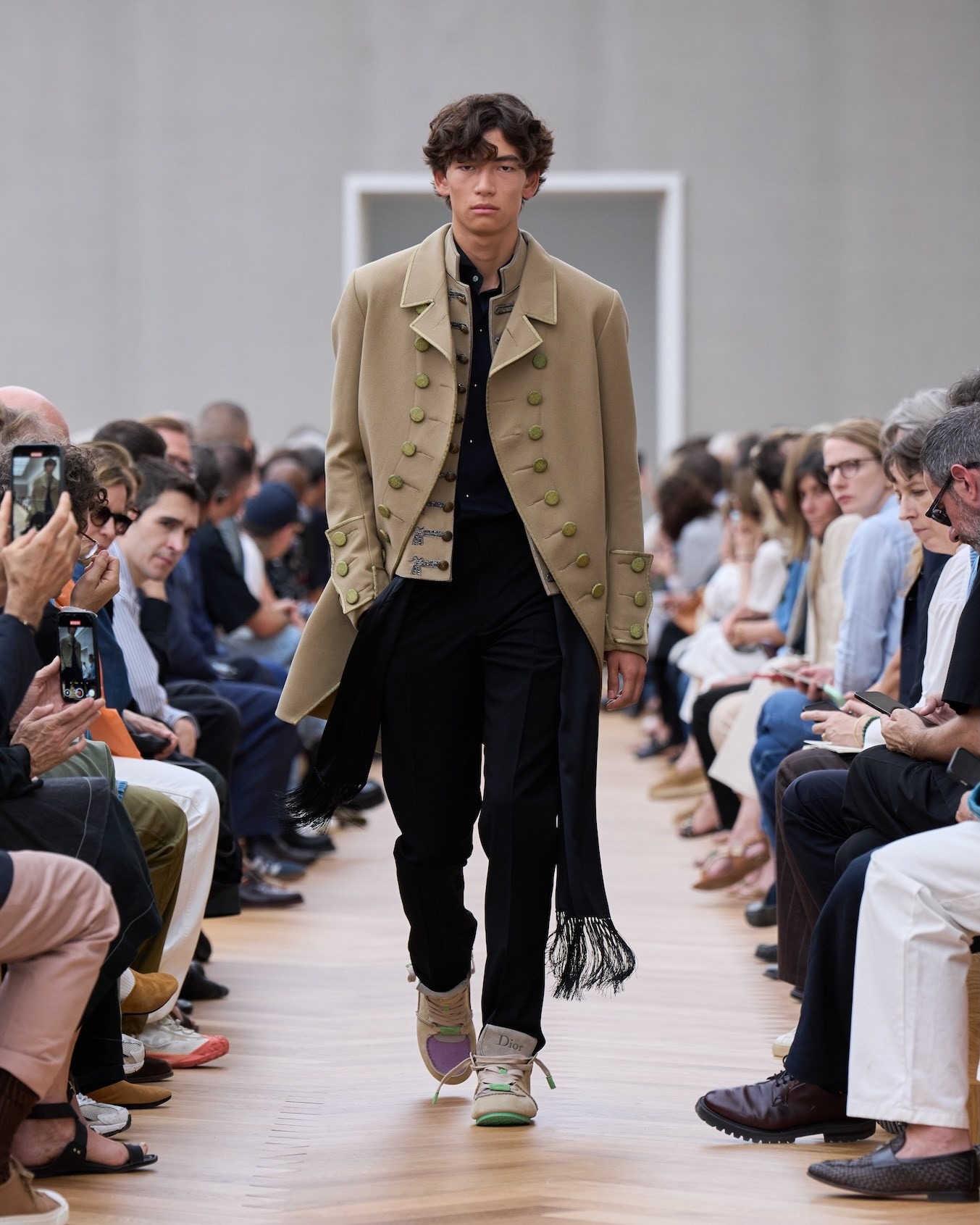

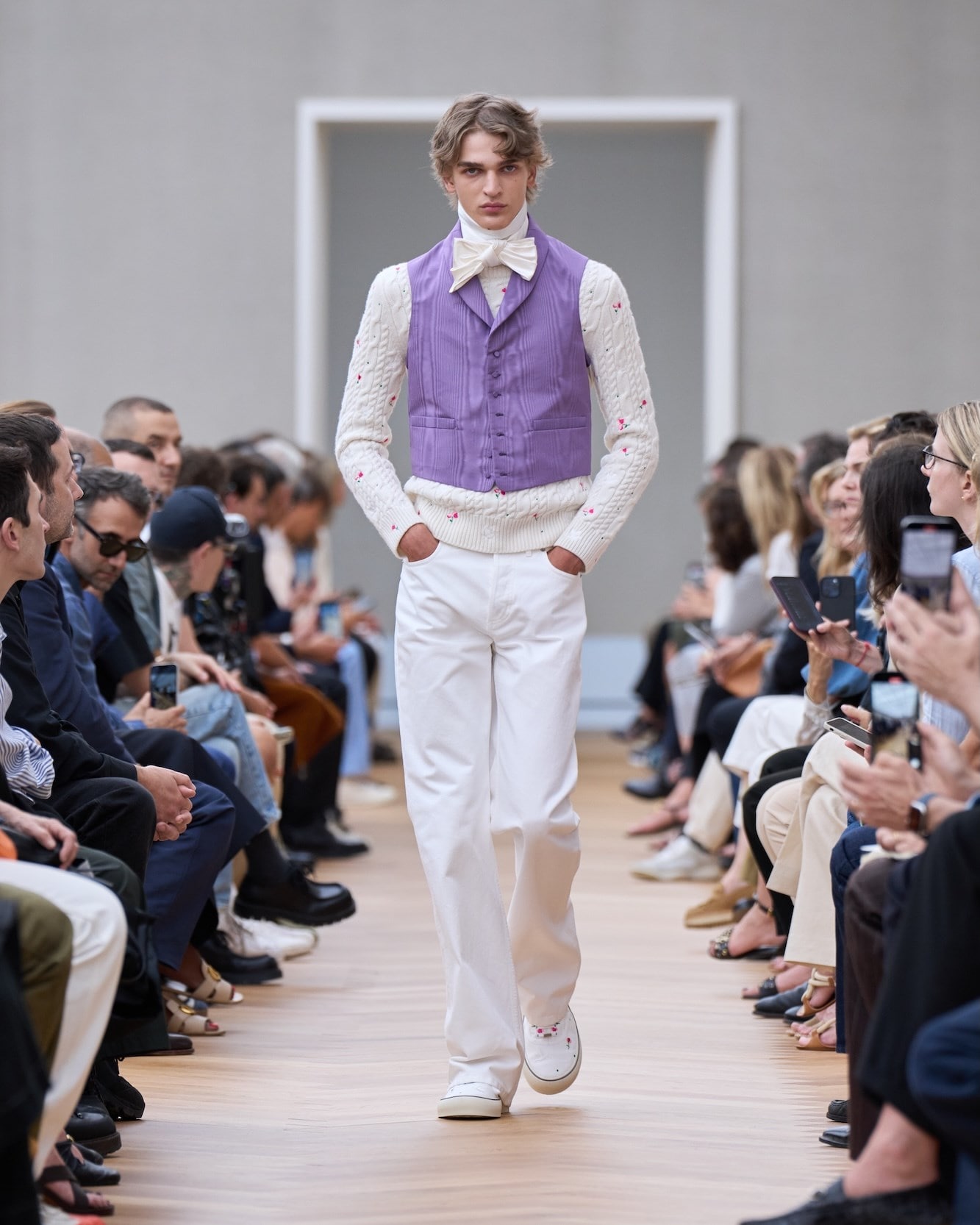
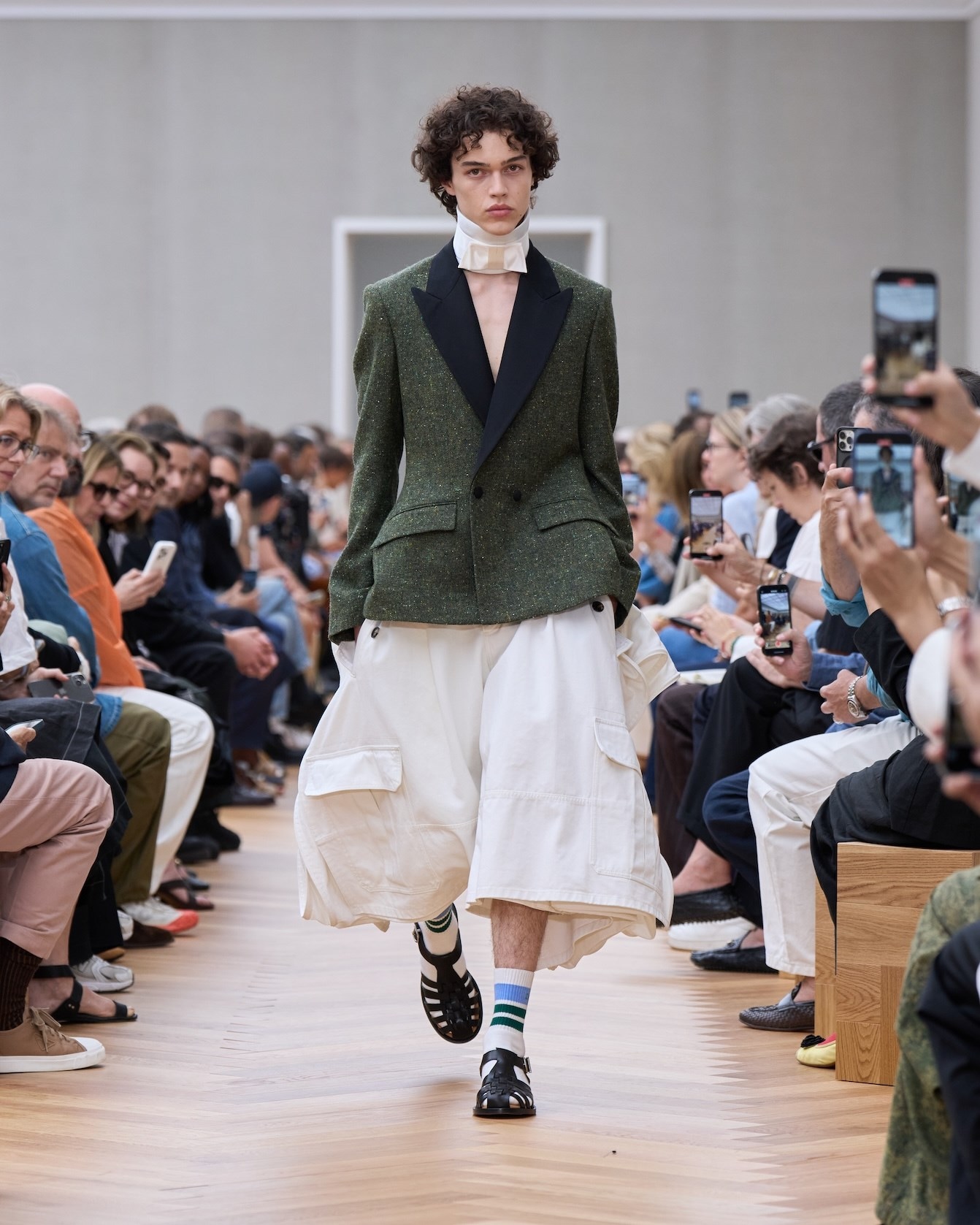
Anderson is also plugged in and clued up to what is going on. The idea of style, of clothes mixed together in unexpected, unanticipated ways – Regency tail-coats with jeans, military frogging transposed to a button-down shirt, the pleats and bustles of Dior evening gowns executed in cotton canvas and applied to cargo shorts that, in their blooming grandeur, pay homage to Dior’s femme fleurs – but, pour homme. Of course, there were Bar jackets, which Anderson cut in Irish tweed, to inject a bit of himself right back into that storied house. And, in a direct take on the past, 18th-century Fraques in powdery, Marie Antoinette shades were recreated according to the precise colours of originals. So were waistcoats that were basically replicas of historical dress – very little menswear exists, pre-1720. “It’s underrepresented in institutions,” versus womenswear, Anderson said. “Which is the reverse in art.”
There was a sense of reality here – this wasn’t an exercise in deep fantasy that has coloured so many of the house’s artistic directors, including Dior himself, who once plainly stated, “My dream is to save women from nature.” Rather, Anderson’s approach is character-driven, based on individuals – which does have a kinship to couture, based as it always is on one-offmanship, as well as one-upmanship, giving us an insight into his approach to his January debut in that milieu. Anderson isn’t so interested in dreaming. He may adore the 1952 dress known as La Cigale, a feat of architecture in pale Dior grey silk moiré so poised and structured it can stand up by itself, but he realises it doesn’t have relevance today. He had a print-out of that hip-jutting silhouette in his studio. He tapped it. “We are not here anymore,” he said. It was translated, incidentally, into the sharp hip on another pair of chino cargo shorts, if you looked hard enough – they seem to be his Trojan horses for Dior references. Then again, he did comment that “Dior loved moiré. So this is a code that will go forward for me.” He pauses. “Obviously, very French.”
There was a distinct, discernible Frenchness to this Dior opening salvo – his models wound up looking like well-bred 16th arrondissement schoolboys in chinos and denims, knotted lycée ties askew. He cleverly cast the Paris-born French national soccer captain Kylian Mbappé as an embodiment of modern French masculinity ahead of this first Dior show, and dressed him in a preppy striped tie, like a bookish teenager. Oh, speaking of books, there were bags embroidered with first edition covers of everything from Dracula (written by fellow countryman Bram Stoker) and Dior’s own autobiography, Dior by Dior, where I’m ripping so many quotes from. The actor Louis Garrel also read it out in the venue, as a pre-show soundtrack. Dior in the round.
The mix of clothes, of references, of eras and approaches, was mind-boggling in its sophistication and complexity, in its deep grasp of Dior. It certainly wasn’t just about the clothes. “For me, it’s about how do you kind of capture it, the whole thing,” Anderson posited, rhetorically. “It’s curating it. And celebrating it, and just enjoying it. I think I want to enjoy this process and all this time because, you know.” He paused, smiled broadly. “It’s Dior.”
