
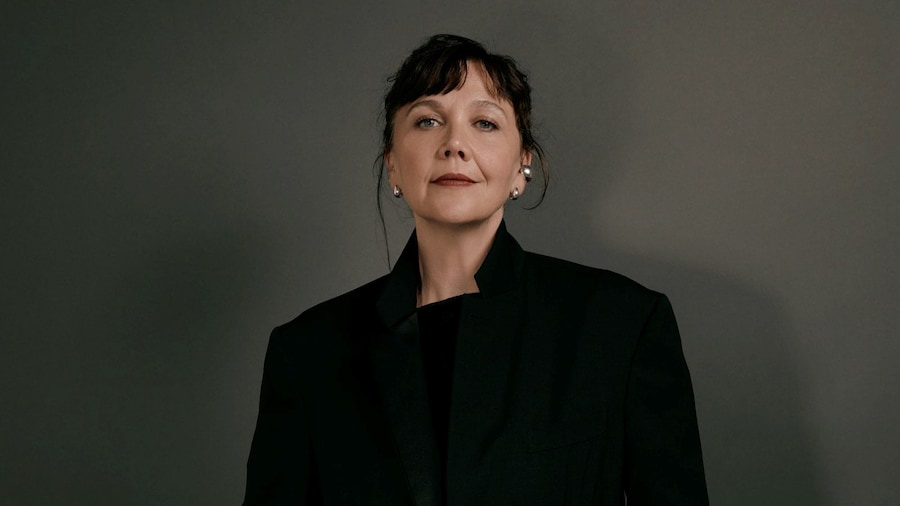
With The Bride!, the Secretary star-turned-director went all guns blazing with a feminist take on the Frankenstein myth – here, she discusses her years-long fight for creative control, and the brilliant women who inspired her
Maggie Gyllenhaal has, over decades as an actress, brought curiosity and intellect to risky, acclaimed performances as unconventional women frowned on by polite society, from her breakthrough in Secretary (2002) as a typist in a BDSM relationship with her boss, to a sex worker with ambitions to become a porn director in David Simon’s HBO series The Deuce. But even in smartly chosen, complex roles, she lacked control over determining the truth of her characters, in an industry that overwhelmingly favours placing a production’s vision in the hands of a man. So she stepped into the writer-director’s role, first with her disquieting 2021 adaptation of an Elena Ferrante novel, The Lost Daughter, and now with The Bride!, a hurricane-force, maximalist riot of gothic revisionism glittering with rage that has strongly divided audiences, and whose Mary Shelley-channeling antiheroine is her most defiant yet.
“It’s not that I’m interested in what is taboo, it just comes off that way because there’ve been so few women making movies,” Gyllenhaal tells AnOther at the Karlovy Vary film festival, where she presented a special screening of The Bride! and received a President’s Award in recognition of her work to date. “It seems that these things are off limits, but many of them just haven’t been explored. And I did not expect to make people so angry by exploring them.” Gyllenhaal navigated requests to tone down the film’s violence during production, but she is adamant she does not want to sugarcoat or bend women’s lived realities. She is now prepping another feature as writer-director for Warner Brothers, an adaptation of Rachel Kushner’s eco-espionage novel Creation Lake.

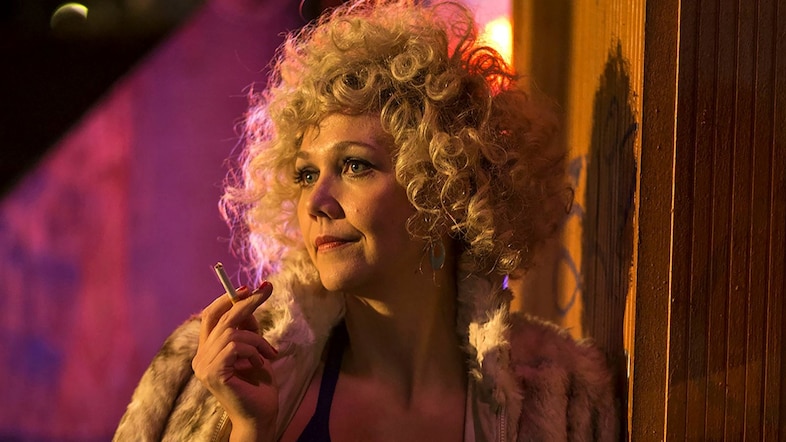
“Part of the reason I moved into being a writer and a director is because I found that many directors were not interested in my artistic expression, if it looked different than what they’d imagined when they were alone in their room – and of course it’s going to look different, because it’s mine,” she says. “I got very good at figuring out ways to protect the little bit of real estate around me so I could express what I need to express in the project, but I got tired of having to do that dance, and I need more space. Not only do I want the freedom to express myself, I want to offer that freedom to other artists.”
According to Gyllenhaal, “The Bride! is about what happens when you just really cannot fit inside your box”. The film takes James Whale’s 1935 horror The Bride of Frankenstein – in turn based on Mary Shelley’s audacious 19th-century novel Frankenstein – as the starting point for an energetic reimagining that changes the companion created for Frankenstein’s monster from a side character into a wilful, uncontainable being whose self-discovery is at the centre of the genre-splicing film, with all its unapologetically messy twists. “It’s a movie about monsters but it is itself a monster, which is a complicated thing to be,” says Gyllenhaal. “When I read Frankenstein, I closed the book and wondered if there was anything else this brilliant woman might have wanted to say, that she wasn’t able to say, or maybe even think, in 1818.”
As the Bride, Jessie Buckley is on top form, with a punk ferocity turned up to 11 from the very first scenes. She plays Ida, a sex worker possessed by the ghost of dead writer Shelley (also Buckley). While wild, roaring drunk at a 1930s Chicago nightclub, she gets into a fight with mobsters and ends up dead at the bottom of the stairs. Her corpse is soon reanimated by a scientist, Dr Cornelia Euphronius (Annette Bening), as the wife-to-be pleaded for by Frankenstein’s first lonely creation (Christian Bale). She jolts back to life just as confrontational and uncompliant, and it’s a rocky road for the two monsters, who are soon on a chaotic cross-country crime spree.

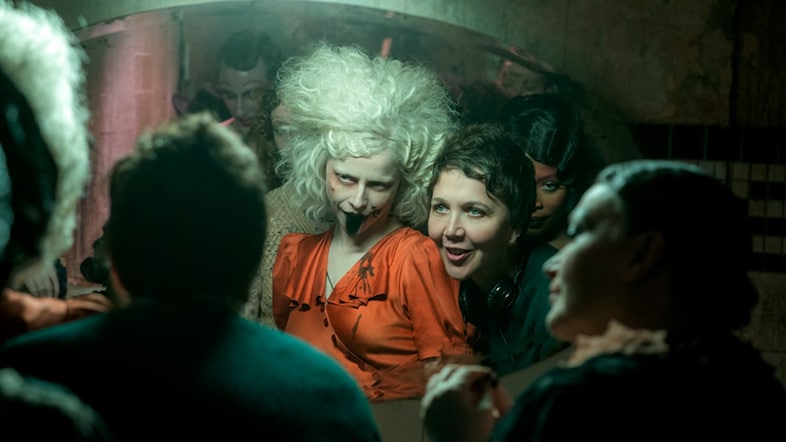
The two monsters are pursued by detective Jake Wiles (Peter Sarsgaard) and his savvy assistant Myrna Malloy (Penélope Cruz), who is unrecognised as the duo’s real brain. Undervalued feminine competency is a running theme, echoing the doubts often levelled at women directors. “In the 19th century, if you loved medicine, you became a nurse,” says Gyllenhaal. “When I was growing up, if you loved movies, were a storyteller and a woman, you became an actress. There were tons of examples around me of smart, interesting, curious, unusual, wild women who were actresses, and of women who were directors there were basically none.
“I know that’s not totally true,” the director continues. “Agnès Varda was making movies, but I wasn’t cool enough to know about her. When I saw The Piano, which Jane Campion directed, I remember thinking, ‘Wow, this is in a language that I speak.’ It just goes in like water, I don’t have to translate it. And it was such a pleasure. If you’re going to watch The Bride!, it might be in a language that feels foreign to you. You can learn it, and jump in whenever you want. Isn’t that an interesting hand to hold out?”
