
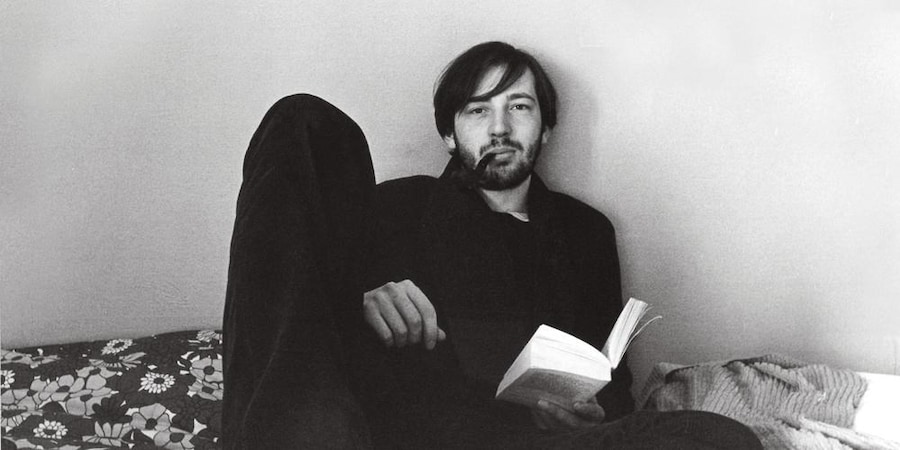
A new English language reissue and forthcoming film adaption brings Pier Vittorio Tondelli’s novel Separate Rooms to a new generation of readers
Some novels are entertaining, others thrilling or even shocking. But Pier Vittorio Tondelli’s Camere Separate, or Separate Rooms, has a haunting tone of its own. Its austere-sounding title hides a beguiling and deliberately non-linear narrative that is confronting and revelatory. The novel’s protagonist, Leo, is an itinerant writer in his early thirties who is frozen by grief following the death of his younger partner, Thomas. The HIV/AIDS epidemic is never explicitly mentioned, but because of the era in which Separate Rooms unfolds, it feels almost impossible not to presume that Thomas has become one of its victims. Tondelli’s own life was cut short by AIDS in 1991, just two years after the novel was first published in his native Italian.
Now, thanks to an overdue reissue of the novel’s English-language edition and a film adaptation by director Luca Guadagnino (Call Me by Your Name, Queer), Separate Rooms is set to entrance a new generation. “We meet Leo for the first time as he’s looking at himself in the glass of an aeroplane window. He doesn’t have a traditional job, he won’t have children, and he’s even an outsider in his hometown," notes Olga Campofreda, who has organised an event celebrating Tondelli’s novel at the Italian Cultural Institute in London.
For Campofreda, a researcher and writer with a PhD in Italian Studies, Separate Rooms reads as “a deep meditation on how to rethink the coming-of-age story in a society that has deeply changed”, but which retains tangible anti-queer hostilities. Writer and translator Claudia Durastanti, a speaker at the Italian Cultural Institute event, characterises the novel as a “cult queer classic” with surprisingly diverse appeal. “Even though it’s full of cultural markers, queer love and the leftovers of a fast life in European creative capital cities, there is enough elegy, solitude and a sort of low vibe mysticism to welcome a wide audience of readers,” she says.
As the novel progresses, shifting back and forth in time between Leo’s early encounters with Thomas and his period of mourning, the titular idea becomes increasingly poignant. Though the two men fall almost painfully in love with one another, Leo is convinced that they can never live together on any kind of permanent basis. In his eyes, they need space – or separate rooms – to keep their relationship healthy. Call Me by Your Name author André Aciman writes in an insightful foreword to the new reprint that Separate Rooms is “exceptionally moving yet exceptionally lucid as it weaves its way through the twisted strands of what Leo is desperately trying to unearth and parse in himself.”

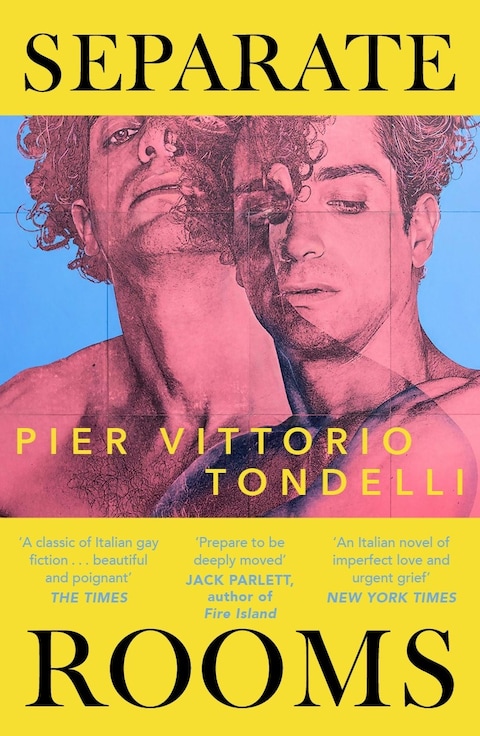
Leo’s conception of same-sex relationships reflects the era that he – and the novel’s author – are trying to navigate. As Tondelli writes in Separate Rooms’ third and final “movement” – a structural conceit that nods to Thomas’s career as a classical musician – Leo “had no models to follow, no experience to recycle and fall back on” in terms of building a life as one half of a queer couple. Though Leo travels freely and sometimes aimlessly around Europe, he remains irrevocably shaped by the staunchly Catholic values of the small rural town where he grew up. Arguably, his plea for “separate rooms” is more about Leo’s internal shame than his domestic compatibility, or lack thereof, with Thomas.
“I think it’s a very good representation of what it meant to be gay in Italy at the time,” says Eugenio Bolongaro, an associate professor at McGill University who focuses on Italian literature and film from the end of World War II to the present. “And that representation is still pertinent today, especially with the rise of the right,” Bolongaro adds, noting that Italy remains one of the last countries in Western Europe not to have legalised same-sex marriage. Civil unions have been recognised since 2016, but as it stands, the law doesn’t grant same-sex couples equal adoption rights or access to IVF treatment.
Tondelli’s own relationship with his sexuality was complex and fraught with tension. His debut book, the 1980s short story collection Altri Libertini, made him a rising star of Italian literature, partly because of its unflinching depictions of queer sex and drug use. “He was celebrated by younger readers as the authentic chronicler of his generation: its nomadism, its music culture, its emotional restlessness,” Campofreda notes. However, despite Tondelli’s fondness for bracingly modern subject matter, and further success with novels including 1986’s Rimini, which is also being reprinted in English this summer, the author never came out as gay in his lifetime. His family initially kept his cause of death private, but as details of Tondelli’s sexuality gradually emerged in the 1990s and beyond, Campofreda says “the Italian queer community has found in his voice an important reference point.”
Though sections of Separate Rooms are poignant and even desolate, there are glimmers of optimism at the end when Leo forms what we might now describe as a chosen family. He also realises that he needs “separate rooms” primarily because he’s a writer: an observer, always slightly removed from the action. For Bolongaro, the novel carries an enduringly important message about the nature of romantic relationships, irrespective of a person’s sexuality. “The idea of separate rooms isn’t about division; it’s an acknowledgement of each other’s independence and autonomy in that relationship,” he says. It’s precisely this rejection of heteronormative ideals that makes Separate Rooms so confronting and revelatory. Tondelli’s novel reminds us that there are many ways to love and form bonds; not everyone needs to feel completed by their “other half”.
Pier Vittorio Tondelli’s Separate Rooms is out now, published by Sceptre, and will be followed by Rimini on 30 July. Once Upon a Time in Italy #1: the 80s. Separate Rooms by Pier Vittorio Tondelli takes place at London’s Italian Cultural Institute on 11 June.
