
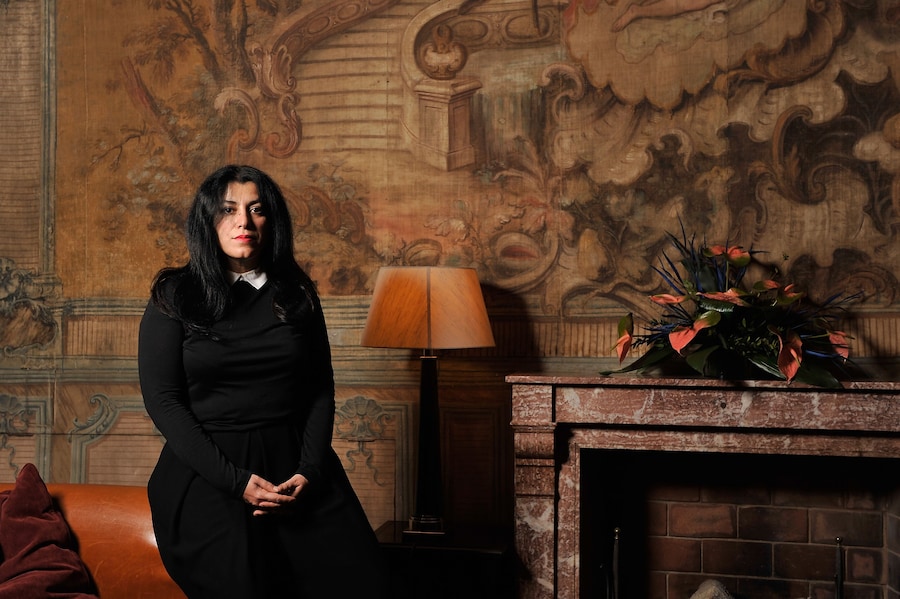
Following news of the Persepolis author and filmmaker’s death at the age of 56, writer Anahit Behrooz reflects on the extraordinary power of her work to evoke a life at once familiar and strange
Marjane Satrapi’s graphic novel Persepolis is bifurcated into two halves – The Story of a Childhood and The Story of a Return. Childhood introduces the ten-year old Marji in 1980, one year after the Islamic Revolution entirely upended Iran’s society, and follows her coming-of-age as she navigates the totalitarian rules of the new regime. Return follows young adult Marji, who is sent away to boarding school in Europe, returns to Iran after a period of political exile, and eventually leaves again for Europe.
Growing up, what Satrapi told of her childhood was familiar to me in the way that fairytales in my picture books were: I had seen the school photographs of my mother in the years after the revolution, the small white oval of her face enclosed in black; I had been told the stories of people leaving in the dead of night; I had overheard my grandmother complaining about driving through Tehran during the Iran-Iraq bombings. Return, however, felt like a work of pure fantasy. My family had not returned to Iran since the 1980s; my siblings and I had never been.

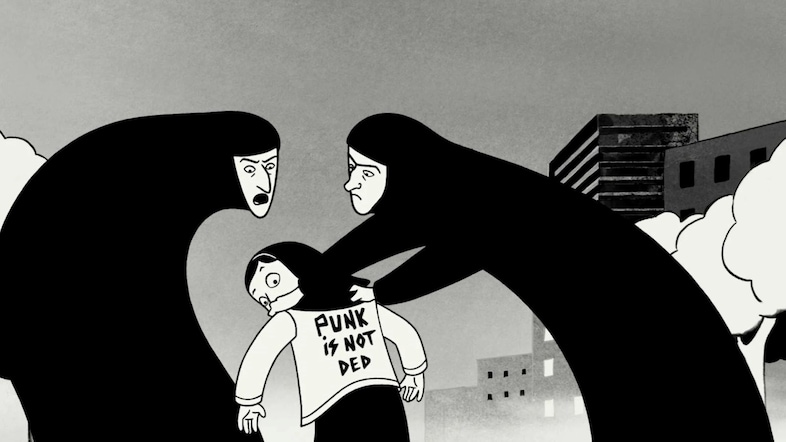
In Satrapi’s work, I found a language for a life that was so nearly my own, and that I had not fully realised was lost until that moment. Satrapi lost that life too: she left Iran when she was 21. She was the first artist of the Iranian diaspora that I encountered, opening up to me a whole host of other Iranian voices – Ana Lily Amirpour, Shirin Neshat, Kaveh Akbar – whose work was fundamentally concerned with the diasporic condition. I was, and am, forever grateful to Satrapi for showing me what it felt like to be caught between two worlds, one of which was gone forever.
In a 2008 interview with AnOther, around the release of Persepolis’ acclaimed film adaptation, Satrapi spoke of her new home in Paris and the country she left behind. “It leaves me in a floating world,” she said. “I’m sitting between two chairs, and it’s not that comfortable but I can lie down if I’m tired. The person who has one chair is more comfortably seated but they can never lie down.” In Persepolis, liminal states of belonging are both burden and gift: the young Marji listens to western rock music, she is deeply entangled in her family history, she becomes fiercely political within an increasingly oppressive context. Satrapi frequently talked of Persepolis as a universal story, extending beyond the particularities of Iranian political history that it depicted. In this way, it is one of the 21st century’s most prescient coming-of-age stories – it imagines identity formation beyond the boundaries of nationhood and culture.

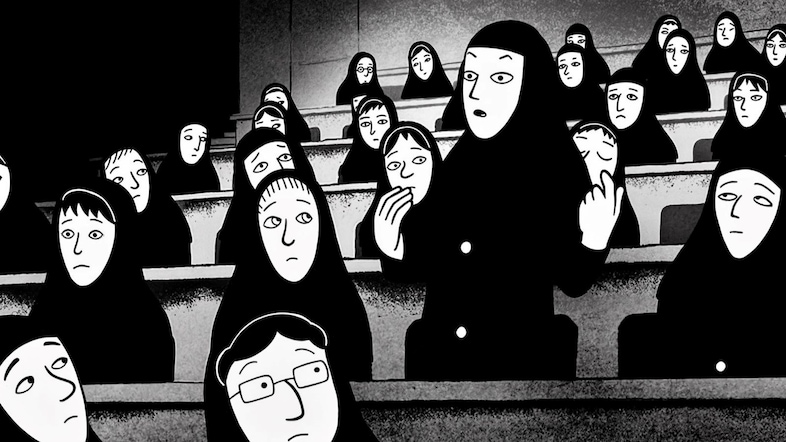
Persepolis was the first book that Satrapi published. She went on to publish other comic books, such as Embroideries and Chicken With Plums – the latter was adapted by her into a live action film in 2011, four years after the screen adaptation of Persepolis was released with Satrapi serving as both writer and co-director. Her contribution to both French cinema and Iranian culture was immense: while Persepolis was, after a few highly censored public screenings, banned in Iran, it found an enormous footprint in the country’s thriving black market. It also shifted how many in the West saw Iran and its people following years of hostility in the wake of the Islamic Revolution and the 1979 hostage crisis. Yet Persepolis was and has always been much bigger than a primer on Iranian politics, or a cross-cultural olive branch. Its ambitions were far greater than humanising an entire population; instead, it took their humanity as a given, finding common ground in the particularities of their lived experience.
For me, Persepolis will always be a work that not only exists in the in-between, but finds possibility in it. It gave me a language for a particular diasporic experience of exile and loss, of what it is to belong not to two places, but to neither. Satrapi made art out of being an outsider, and she continued to do so until her last days: her final book, Woman, Life, Freedom, was created in collaboration with journalists and activists, and documents the stories behind the Iranian people’s 2022 uprising, and the social, political and emotional experience of existing in a country that does not belong to you. In the introduction to Persepolis, Satrapi writes that she did not want the Iranians who lost their lives or fled under the regime to be forgotten. “One can forgive,” she says, “but one should never forget.” Through her art, Satrapi made it impossible to forget the lives we have lived, the stories that we carry – even if those stories are not our own.
