
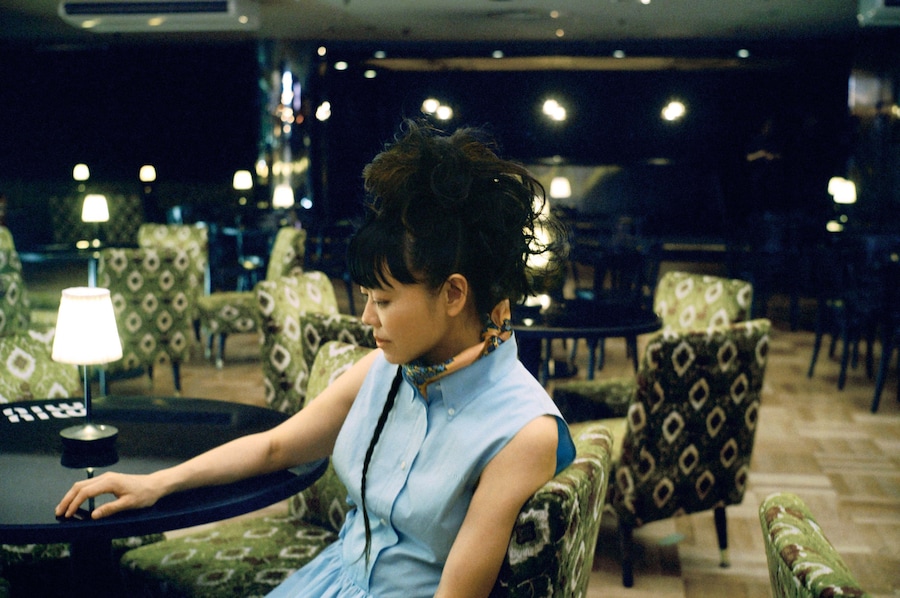
Following her performance at Miu Miu Jazz Club, the virtuoso pianist and composer reflects on the unorthodox teachings of her childhood tutor Noriko Hikida
“I started taking piano lessons when I was six years old. I think my mum wanted to learn when she was little but never had the chance, so she kind of passed that dream on to her children. I fell in love with it immediately. For a six-year-old, it can be difficult to understand all these specific musical terms, so my teacher, Noriko Hikida, found another way of communicating. She would colour my sheet music with coloured pencils so that I could visually understand how the music should speak. If she coloured a passage red, I knew it was fiery, passionate. If it was blue, it felt melancholic. It was much easier for me to understand. Noriko is somebody with extraordinary energy. She’s probably one of the five most high-energy people I’ve ever met in my life, and her energy is so pure. Even now, when she comes to one of my concerts, I can instantly locate her in the room. When she teaches, she often sings louder than I’m playing, just to show me how a phrase should sing through the piano. She sings so loudly, but somehow it makes perfect sense. I immediately understand what she’s trying to communicate.
“Because of her, colour still plays a huge role in how I experience music. Sometimes I see specific colours in a piece and ask the lighting director to recreate them on stage. For music that doesn’t have an obvious colour attached to it, I leave the choice to them. Then I start playing, I see the light and the colours around me, and suddenly I find myself playing differently. I really enjoy that. Even a colour like white can mean many different things. It can feel pure, sad or completely blank. It depends on my imagination and on how I want to approach a piece. Sometimes that colour gives me an extra push, another step into the music. The same thing happens when I’m making an album. When we’re discussing press photography or artwork, I usually already have colours in my mind. For my album Spectrum, I kept seeing light blue and yellow. I talked about those colours with the photographer and the designers because that’s what I saw in the music. To me they felt happy, bright, pop. But it’s completely random. I just saw those colours, and that’s how I wanted to play the music.”
Hiromi Uehara’s relationship with the piano has always been intuitive. Born in Hamamatsu, Shizuoka, in 1979, the Japanese pianist and composer was already performing with the Czech Philharmonic by the age of 14. Three years later, after meeting Chick Corea by chance in Tokyo, she was invited to join him on stage the following night. She went on to study at Berklee College of Music in Boston, where Ahmad Jamal became a mentor, and released her debut album, Another Mind, in 2003.
Since then, Hiromi has built one of contemporary jazz’s most animated careers, moving between solo piano, electric fusion and small-ensemble work with a style that is both technically formidable and emotionally unguarded. She has toured internationally, released a string of acclaimed albums, collaborated with artists including Stanley Clarke and performed at the opening ceremony of the Tokyo 2020 Olympic Games. In 2011, she won a Grammy Award as part of The Stanley Clarke Band, whose album took Best Contemporary Jazz Album.
Her 2019 solo album Spectrum drew together many of the instincts that had shaped her playing from childhood: a painterly sense of atmosphere and a belief that music can be experienced beyond sound. Organised around the emotional possibilities of colour, the record moves through pieces including Whiteout, Yellow Wurlitzer Blues and Rhapsody in Various Shades of Blue, turning the piano’s black-and-white keys into something more prismatic. In May 2026, Hiromi performed a number of these songs at Miu Miu Jazz Club in Tokyo held at Dance Hall Shinseiki; the portrait above was captured just moments after her performance.
