
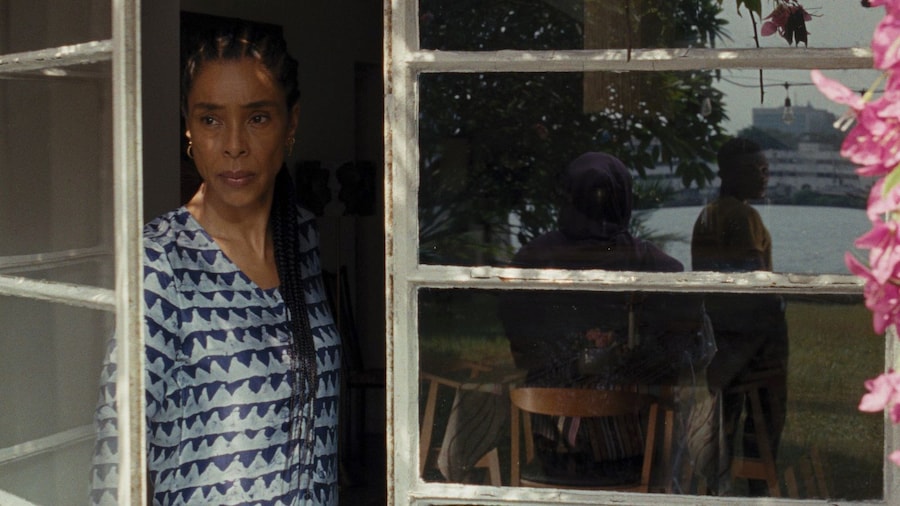
Filmmaking twins Chuko and Arie Esiri open up on their striking new take on a literary classic, a standout at this year’s Cannes Film Festival
With Eyimofe (2020), Nigerian twins Chuko and Arie Esiri turned a piercing lens on working-class lives dictated by circumstance. The main characters in their new film, Clarissa – an ambitious new telling of Virginia Woolf’s Mrs Dalloway – are upper-middle class to a tee, yet their lives in some ways seem even less their own.
For Clarissa (Sophie Okonedo) and her social milieu, there’s a disconnect between thought and deed that’s grown into a chasm over the years. We meet her in the midst of planning a party at her home in Lagos, where she lives with hubby Richard (Jude Akuwudike), an upstanding but dull man working a white-collar job for Shell. But when Clarissa hears that an old flame, Peter (David Oyelowo), is in town to manage his late father’s estate, her thoughts drift back to a long summer’s day from her youth, when high hopes for the future and competing desires made for an intoxicating mix. The Esiris’ film flits back and forth between the two timespans, folding a third story into the mix in the shape of Septimus (Fortune Nwafor), a traumatised soldier whose life intersects symbolically with Clarissa’s.
It’s a bold reenvisioning of a modernist classic that drew admiring notices at Cannes, where the film screened as part of the Directors’ Fortnight strand. But the brothers say the decision to move the story to Nigeria was an intuitive one. “Big cities all share a certain DNA in common so it was kind of a natural transposition, really,” says Chuko, who wrote the screenplay, in which the Muslim call to prayer is substituted for the chimes of Big Ben, and Nigeria’s ongoing conflict with Boko Haram stands in for the First World War. “Also the city of Lagos was essentially built and designed by the British, so all the elements of what a British city feels like are there, it just so happens to be in West Africa.”

Like Woolf’s Mrs Dalloway, Clarissa is a member of an aristocratic class that is beginning to fade from view. After independence in 1960, says Chuko, Nigeria’s new ruling classes adopted many of the “mores and attitudes of the British”, a colonisation of the mind the country is still in the process of unpacking. “[Colonialism is] not just a physical occupation of a space; there’s also the mental aspect. And that’s a thing that happens over generations, it doesn’t happen quickly. You’re literally thinking in the language of the former colony. Language is a form of thinking, and it takes a while to want to break out of that, to develop and formulate your own ideas.”
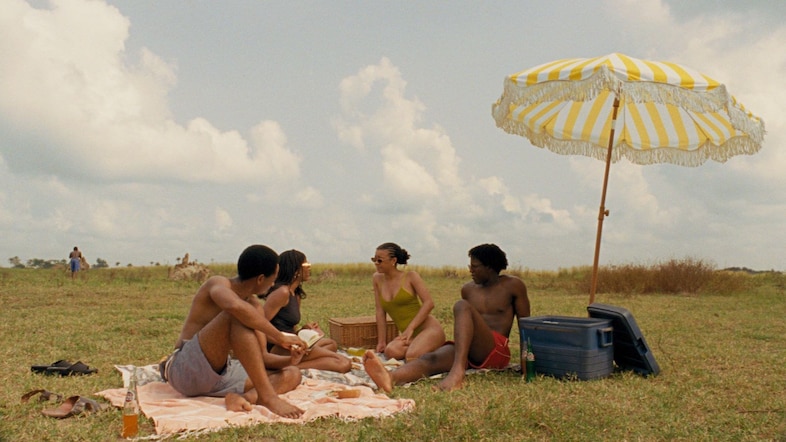
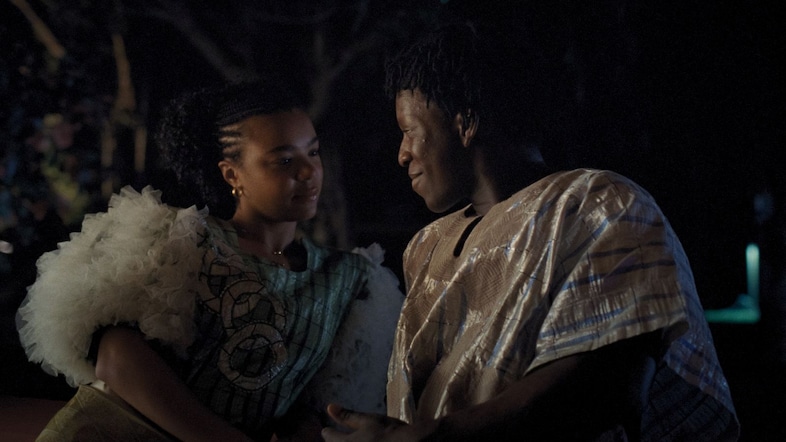
Clarissa may once have harboured such ideas herself. In languorous flashback scenes where she is played by Bridgerton star India Amarteifio, we see her give boyfriend Peter (Toheeb Jimoh) a smart postcolonial critique of his poetry, as Richard watches enviously in the wings. Meanwhile Clarissa is drawn to Sally (The Bear’s Ayo Edebiri), a free spirit who speaks openly against marriage and chides the former for her snobbishness. Sally may be the reason Clarissa cannot commit to Peter, her suppressed desire setting her on the path to a life of quiet conformity with Richard. But the older Sally (Nikki Amuka-Bird) has changed with the years, too; at the party, we learn she is married with kids and has just packed her son off to boarding school.
Chuko and Esiri are well positioned to observe the borrowed social codes that govern Clarissa’s world. Born in Warri and raised in Lagos, the brothers attended private schools in England before studying film at university in New York. (They’re both living in Lagos now.) Arie was expelled from the last secondary school he attended, a turn of events he credits with giving him new perspective on the UK’s deeply class-based society. “I was one of the very few Black students at the school and I always had a very strong sense of when I was being treated unfairly,” he says. “I think that just reached boiling point for me; I lashed out in my own way and they said it probably wasn’t the best place for me to be, and I agreed. It was really only when I got out of that system that I started to see the different levels in which English society works. It also made me appreciate back home, and the things we hadn’t let go of in Nigeria that were remnants of the colonial system.”

Chuko first read Woolf’s novel at the age of 16 and was, by his own admission, too young to understand it. All the same, he was struck by the power of her writing – “It was this thing of, ‘I don’t know what’s happening but something is happening here’” – and kept returning to the text until finally it clicked. “This was in my early thirties, when I was starting to have the same existential thoughts [Clarissa] has,” says Chuko. “I started reading and it was like, ‘Damn, this feels familiar.’ You don’t really care so much in your twenties but when you’re in your thirties you start asking your family all these questions like, ‘What was happening in your life, by the way?’ So I think that was the first time I fully understood the book.”
In adapting the novel, the brothers needed a visual language to match its experimental, stream-of-consciousness style. They talked a lot about Antonioni and Fellini – artists who spoke powerfully to the ennui of the postwar upper classes – and devised a honeyed, tranquil look for the flashback scenes that contrasted with the cooler hues of the present. The stellar cast, meanwhile, is made up largely of members of the Nigerian diaspora, adding another layer of intrigue to Clarissa’s commentary on postcolonial themes. At the film’s premiere the night before we meet, Chuko acknowledged it had been an “emotional journey” for them all. “Cinema is the best way to travel,” he said, as the curtains went up on the film. “We invite you into our homes.”
