
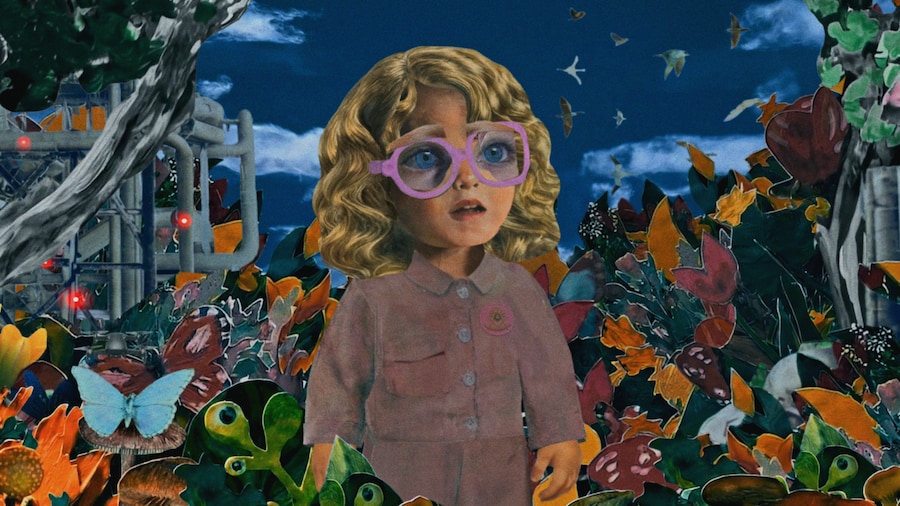
For his first film, the Brooklyn artist teamed with producer Darren Aronofsky on a sublime animated adventure starring his four-year-old daughter, Zia
Dustin Yellin has long considered his artistic practice a form of “frozen cinema” – but for his new project, premiering at Cannes tomorrow and previewed here on AnOther, he sought to bring one of his famous glass collages to life for the first time.
Goodnight, Lamby is an animated short inspired by the Brooklyn artist’s four-year-old daughter, Zia, who stars in the film alongside Paul Rudd and Chris Rock. Produced by Darren Aronofsky’s AI studio Primordial Soup, the short sees Zia embark on a Looking-Glass adventure through one of her father’s works, The Politics of Eternity, after she loses her favourite cuddly toy, Lamby. Influenced by the work of stop-motion animator Jan Švankmajer, Yellin worked on the project with animator Ricardo Villavicencio, who drew on AI tools from Google DeepMind to create a tactile feel sympathetic to Yellin’s own art, and singer-songwriter Maggie Rogers, who contributes original music.
“To a four-year-old, the world is inherently animistic,” says Yellin, who was guided by Zia’s real-life responses to his artworks in shaping the film. “Zia zeroes in on the tiny, absurd physical anomalies in my art – a cutout of a vintage car floating next to a botanical illustration. She loves the physical evidence of the making: things like trapped air bubbles. Children operate via assemblage and collage; their logic is rhizomatic, not linear. They understand intuitively that you can tape a feather to a brick and call it a bird.”
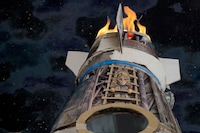
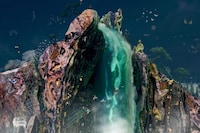
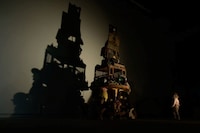
Yellin’s hallucinatory collaged sculptures are a whole universe unto themselves – he cites the likes of Hieronymus Bosch and Pieter Bruegel for the “macroscopic and microscopic simultaneity of their painting” – and Zia’s journey in the film is likewise steeped in a sense of the sublime. That said, Yellin’s goal for the project was to create something his daughter could enjoy. “It’s a visual lexicon safe enough for her to inhabit joyfully, but dense and surreal enough to induce existential vertigo in an adult,” says the artist, who adds that Rudd and Rock brought an “immense, grounding warmth” to this sometimes frightening world.
In Aronofsky, an artist who “operates at the exact intersection of the visceral and the metaphysical”, Yellin found an ideal partner for bringing the project to the screen. The Black Swan and π director founded Primordial Soup last year and attracted some controversy for his own recent ventures into AI-driven filmmaking, but Yellin can envisage a future for the technology that works in harmony with artistic intent. Just like cinema itself, he says, “AI will inevitably alter the architecture of imagination. But I think human beings will always crave the feeling that comes from knowing another consciousness struggled to bring something into existence.”
