
Just premiered at Cannes, Ryusuke Hamaguchi’s epic new film is an end-of-life drama like nothing you’ve seen
In times as fractious as these, is there an argument to be made for cinema as a force for healing? A cineaste at the peak of his powers, Ryusuke Hamaguchi’s return to the Croisette after the spellbinding success of Drive My Car was the source of much anticipation. In truth though, it’s his previous film, the cryptic and beguiling Evil Does Not Exist, that his new drama – his first to shoot outside of his native Japan – resembles most closely, in theme if not in length. (It clocks in at a whopping three and a quarter hours.) All told, All of a Sudden is a moving attempt to press forward with questions of our late-capitalist quagmire that cements him as cinema’s preeminent poet of social conscience.
Marie-Lou (Virginie Efira) is the director of a Paris care home pioneering a new form of care for the elderly called ‘humanitude’ – rooted in her background as an anthropology major, it revolves around simple, practical steps aimed at putting the humanity back in care, emphasising the life that remains in even the most cognitively impaired residents. In doing so, she locks horns with the home’s backers, who enjoy the prestige that the institution offers while keeping a closed fist on the purse strings. This is a source of eternal anguish to Marie-Lou, who herself is on the edge of burnout trying to make it all work. On top of that, she must sell the scheme’s benefits to a team that runs the gamut from enlightened to sceptical and even downright hostile, worried it will entail extra work for them on their already meagre salaries.
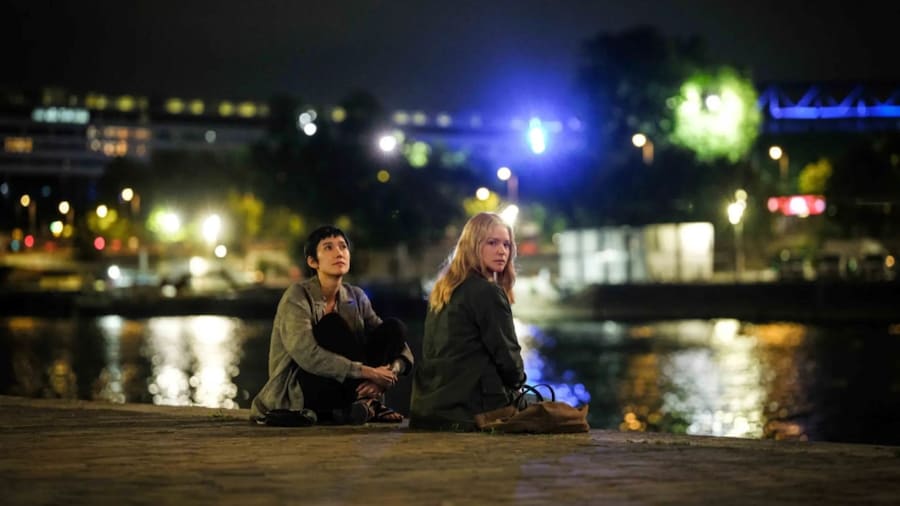
Marie-Lou feels something inside of her shift when she meets a Japanese playwright, Mari (Tao Okamoto), after helping her leading man’s severely autistic son in the park one day. Sensing a connection, Mari invites her to a performance of her new play, an experimental piece on the cruelty of psych wards which argues that life belongs not only to the healthy. In a beautiful moment during a Q&A session at the show’s end, Marie-Lou tells her – in Japanese, which she learned as a student – that her play has “pierced her heart”, and Mari in turn reveals that she is living with stage 4 terminal cancer, a revelation that the French-speaking audience is not privy to. The pair spark up a friendship that sees them share their innermost secrets, while Mari advances an insanely far-reaching but weirdly compelling thesis on the failures of capitalist democracy that the pair put to practical use in developing the care home. (Clue: it involves a literal orgy of foot massages.)
I’d be lying if I said there weren’t moments in All of a Sudden that didn’t drag – the film is talky in the extreme, often thrillingly so, but Hamaguchi’s keenly cinematic eye can feel hemmed in at times by the profusion of long interior scenes. With its defiantly unsexy subject matter, it’s unlikely to prove a hit on the scale of Drive My Car, but for committed Hamaguchi-watchers it feels like a fair exchange for cinema this committed, brave and frankly slightly dotty. By the time the end finally came around, that strangest of things – I didn’t want it to end.
