
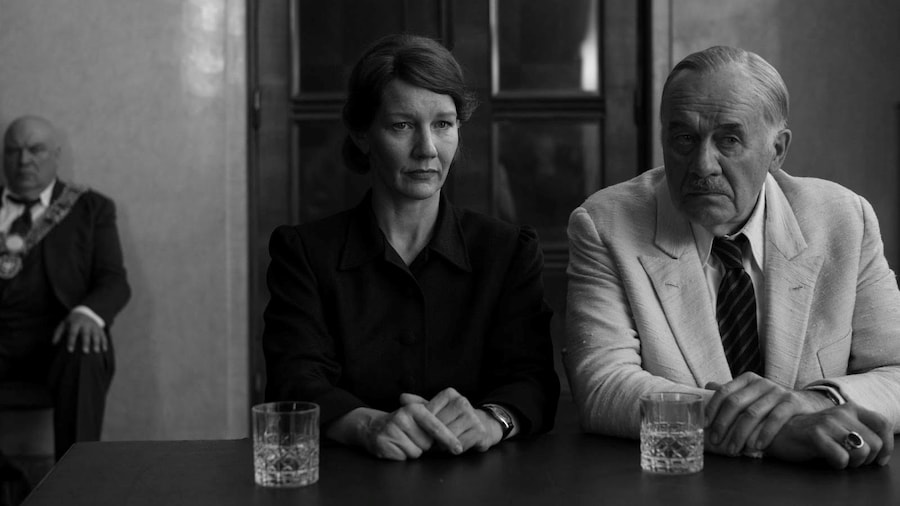
Making its debut at Cannes, the Polish auteur’s elegant new film is a father-daughter drama at the outset of the Cold War
Is there a better actor in the world right now than Sandra Hüller? The German star broke through with her nerveless performance in Toni Erdmann (2016), ascending to a higher plane of artistry with stellar performances in Anatomy of a Fall and The Zone of Interest, both of which premiered at Cannes Film Festival in 2023.
She’s wonderful again in Fatherland, perfecting a stare that is somewhere between pity and bottomless scorn as Erika Mann, the writer, theatre performer and strident anti-Nazi campaigner returned to the ruins of Germany with her dad, the Pulitzer prize-winning author Thomas Mann. It’s another poetic and incisively layered drama from Polish auteur Paweł Pawlikowski, capping (after Ida and Cold War) a loose trilogy of films charting the chaos and “moral confusion” of post-war Europe with the deftest of touches.
The drama unfolds in 1949, when Mann travelled to Germany from his home in exile in the US to accept an award on the occasion of Goethe’s 200th birthday. East and West Germany have been carved up by the Allies; amid mounting Cold War tensions, the author gives speeches in both to emphasise the unity of German culture in this newly divided landscape. Before all that, though, Pawlikowski gives us a prologue: Mann’s son Klaus (August Diehl), in a seemingly terrible state, speaks to Erika over the phone. “They wrecked everything,” he complains bitterly to his sister, “now they want him to ease their consciences.”
Played with gimlet-eyed intensity by Hüller, Erika also suspects that the visit is a terrible idea. But she agrees to tag along in support of her father, setting the scene for a road trip of sorts between West and East Germany in which family and national trauma are as one. (In this much, at least, Pawlikowski’s film is pure fiction; the trip was a source of bitter argument between the pair in real life, and Erika refused to attend.)
The author’s speech in Frankfurt is met with rapturous applause, but a look around the room reveals an uneasy picture. The celebrations brim with society figures complicit in the crimes of the Nazis; in one great moment, Thomas gives short shrift to Wagner’s grandsons, Wolfgang and Wieland, who entreat him to help restore the composer’s reputation by lobbying for the return of the Bayreuth festival. He replies curtly that their mother should be tried in the Hague.
Hanns Zischler – a star of the New German cinema through his work with Wim Wenders – gives a fine performance as Thomas, his solemn conviction in the trip’s importance sliding into uncertainty as events unfold. Ultimately, though, the film belongs to Erika. It’s her eyes we are invited to see through, her disgust palpable as she surveys the crowd of dignitaries while remarking to a journalist friend, “Just imagine what they were up to five years ago.” Her impatience with the trip comes to a head with a devastating piece of family news that reveals her father’s coldness on the issues closest to home, Erika berating him for the pomposity of his “Olympian wisdom and elegant phrases”.
There is history here, too, that is only really hinted at by Pawlikowski’s film, beautifully rendered in the same Academy aspect, black-and-white photography that cinematographer Łukasz Żal brought to Ida and Cold War. A Weimar-era bohemian who poured her creativity into fierce political engagement, it was Erika who, when Thomas moved to the US at the onset of the war, encouraged him to broadcast speeches to the German people via the BBC. Thomas, for all his avowed hatred of the Nazis, still clings to the idea that there is something inherently noble in the German “soul”; Erika sees only horror. It’s her commitment that Pawlikowski seems to admire most, and is the heart and soul of this film, a moving family drama and timely inquisition into the uneasy relationship between art and politics.
