
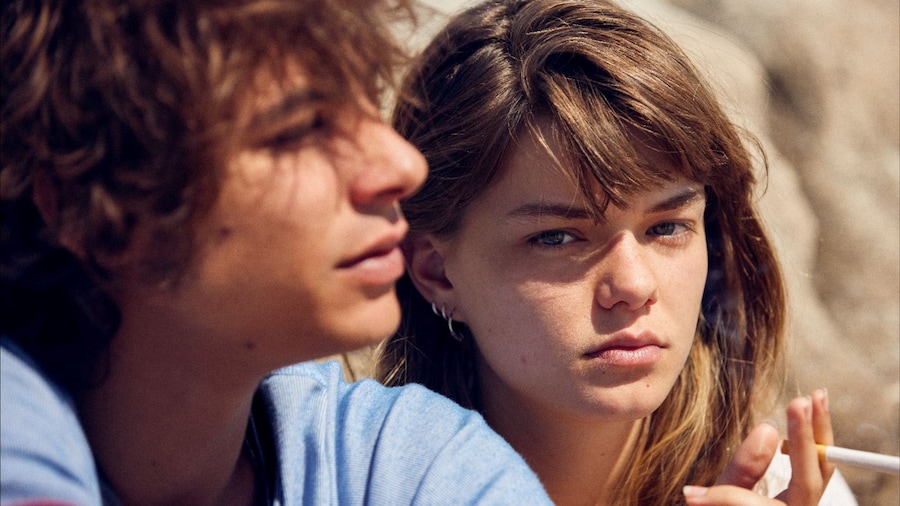
In the semi-autobiographical new drama, an orphaned teenager uncovers truths about her parents’ past on her journey to becoming a filmmaker
“Memory is complex,” Carla Simón explains to AnOther. “You don’t remember what really happened. You remember the last time you remember what happened.” Three films into her career, the 39-year-old director is already closely associated with childhood recollections. Her 2017 debut, Summer 1993, was a semi-autobiographical coming-of-ager about a six-year-old girl who, like Simón, loses both her parents to Aids. After winning a Golden Bear in Berlin for 2022’s Alcarràs, itself inspired by her youth growing up on a peach farm, Simón has delivered a semi-follow up to Summer 1993 with Romería, a 2004-set drama about an 18-year-old girl whose parents also died of Aids. “I was frustrated that I couldn’t reconstruct memories about my parents,” says Simón. “This film made me realise I could make it up. Cinema gives you that opportunity. These are now my memories.”
Simón was three when her father died, and six when her mother passed from the same illness. After her mother’s funeral, Simón lost contact with her paternal family. Named after the Spanish word for “pilgrimage”, Romería is loosely based on trips Simón herself made at 18 (to Madrid) and 29 (to Galicia) to reunite with biological relatives on her father’s side. In the film’s telling, Marina (Llúcia Garcia) is an inquisitive teen who wishes to study filmmaking in Barcelona. To do so, she requires her parents’ death certificates, which results in her visiting relatives she can barely remember if she’s met them at all. In Vigo, Marina is greeted with pleasantries by some, but an overt lack of warmth from others; the younger cousins have been instructed not to swim in the same water as someone whose parents died of Aids.

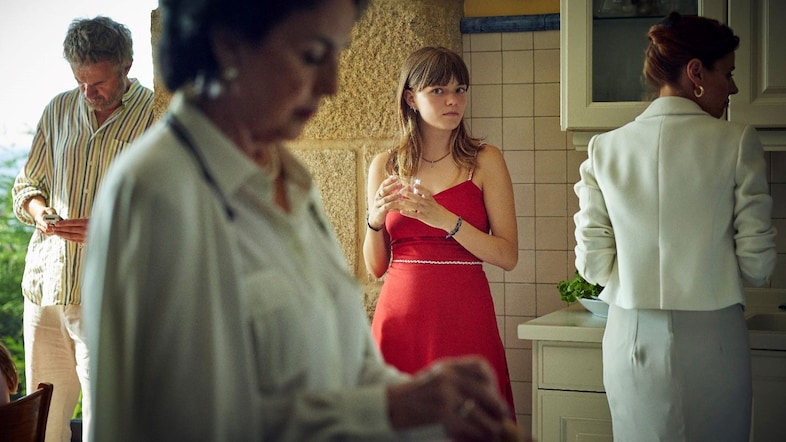
While Simón is keen to stress that the script is largely fiction, she also admits the screenplay started with the discovery of letters written by her mother to friends. “I just have a few pictures of my mother and father, and one video of each,” says Simón. “But my mum’s letters give me more information about her, because I can hear how she talks, how she sees the world, how she relates to drugs, friends and work. It’s a generational portrait of the youth in Spain in the 80s.”
The end of Franco’s dictatorship in 1975 saw the launch of “La Movida”, a countercultural movement in Madrid that offered a rebellious, hedonistic release for Spanish youths who were previously raised in a conservative, Catholic society. As a result, drug use rapidly increased. “The freedom came with a dark side,” says Simón. “A lot of young people got hooked on heroin, and then suddenly Aids came. In Spain, everyone knows someone who died of Aids or heroin. It was hard for my family to accept that their son got hooked on heroin and died of Aids. They stopped talking about it. That’s why it was difficult for me to know what really happened.”
As Simón based Romería on surviving members of her family, she allowed them to read the script before the shoot. An uncle symbolically cameos in the film as the notary who signs Marina’s papers. “Family members saw the film and found it healing,” says Simón. “But a lot of it is made up.” Even so, Romería possesses richness and texture in each scene due to specificities that come across as deeply personal to Marina. The character reads letters from her mother (actual messages written by Simón’s mother), shoots Super 8 footage of her surroundings (foreshadowing Simón’s own film career), and visits the sunny locations of photos capturing her parents living out their wild youth (all tenderly shot by famed cinematographer Hélène Louvart).

Adding to the film’s sense of reality is that Simón once again cast non-professional actors in nearly every role. In the lead, Garcia was selected from 3,000 hopefuls who auditioned in person. The tricky part: in a third-act twist, Garcia plays both Marina and her mother. “Some girls were only good for Marina, and some were only good for the mother,” says Simón. “They had to do both. I asked Llúcia what she’s afraid of, and she said that people don’t know what she’s really like. She lives with the image of an innocent girl, but she knows there’s something stronger inside. That’s when I knew she could be the mum.”
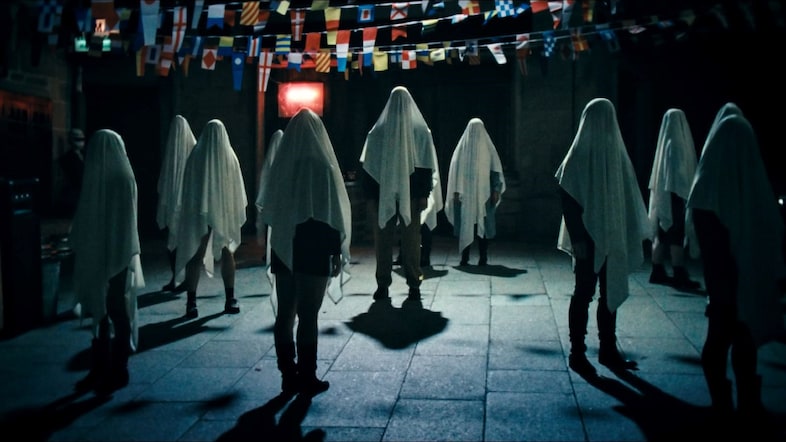
In what feels like a live-action Studio Ghibli sequence, Marina follows a cat at night to a rowboat that magically transports her to 1984. In the lengthy dream scene – or a film within a film, as Simón puts it – Marina meets young versions of her parents on a rooftop. Garcia, essentially, is conversing with herself, while the father (Mitch Martín, an actor earlier seen playing a cousin) whispers, “Marina, you see, we weren’t dead. They just hid us away.” Nevertheless, Simón shoots the time-travel element as if it’s a grounded drama, just with the added rush of romance from Marina’s parents whose naked frolicking on the beach is in stark contrast to the negative portrait given by Marina’s grandparents.

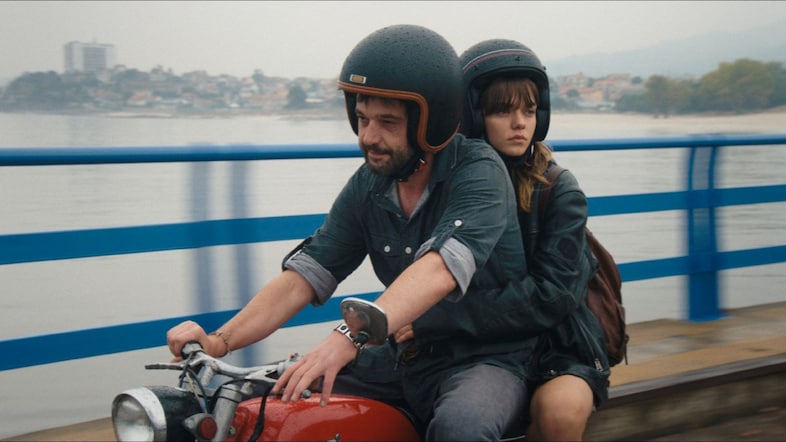
“When I try to imagine my parents, I can’t do it,” says Simón. “When I was writing these parts, I realised that the imagination works through things you’ve already seen or know. It made sense that Marina would also be her mum, because everyone tells her that she looks like her mum, and that her dad would be the cousin she just met. Because she can’t imagine her parents, she uses the images she already has. Everything in the imagined section is from things she’s been told. It couldn’t be too dreamy. It was important that she was conscious and building her own narrative.”
Simón, then, is entering genre territory with her filmmaking, and her next feature is a flamenco musical. “I’ve done films about my family,” she says. “Now I want to discover new worlds. Flamenco musicals in Spanish history were conservative and associated with Franco. I want them to evolve in cinema.” The filmmaker adds that, as a newish mother, she now feels like she’s in the middle of two generations: an artistic shift is required. As Romería was inspired by the director’s mother’s letters, is she excited for her children to one day devour her own correspondence with journalists? “I’ve never thought about that,” she says with a laugh. “I always knew I’d be leaving them my films. But yes, they’ll be able to read and watch my interviews!”
Romería is out in UK cinemas on 8 May.
