
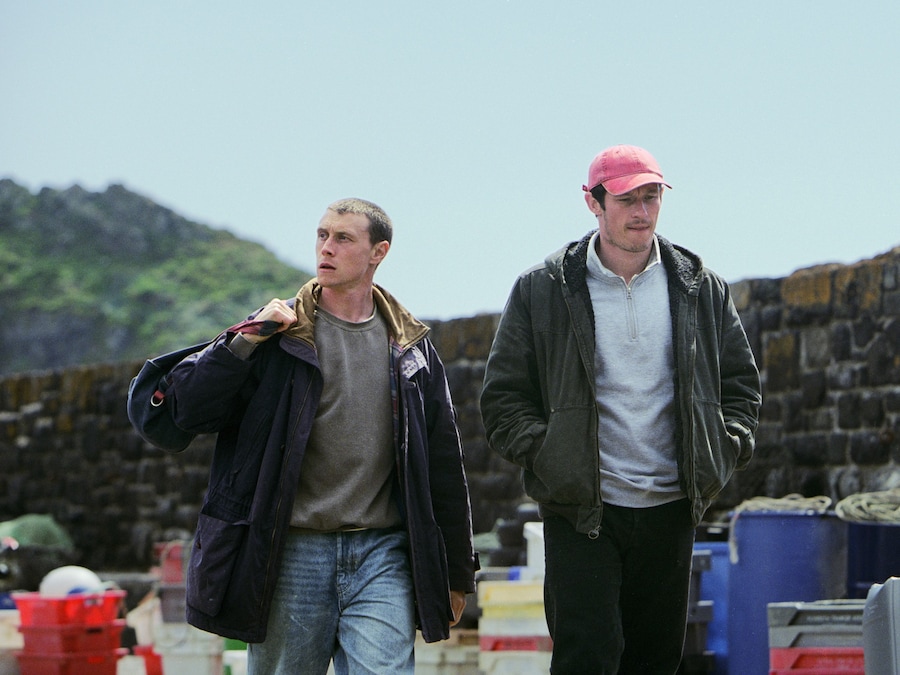
Tragic, funny and perplexing in ways that are difficult to put into words, Rose of Nevada unites, among other genres, a ghost story and a time travel sci-fi drama
When Mark Jenkin scooped a Bafta for Outstanding Debut with Bait in early 2020, it felt like the arrival of a fantastic new voice in British film. That was only half true. Jenkin is actually the last thing from an overnight success; he has been actively toiling as a director, writer, editor and cinematographer since the turn of the millennium. Jenkin’s labours are evident in his feature films – since Bait, he’s directed the acclaimed folk horror Enys Men, and now the genre-resistant Rose of Nevada.
The Cornish director’s filmmaking process is a rarity – he shoots analogue on a hand-cranked 16mm Bolex camera, edits concurrently, and records sound after the fact. It might sound arduous, but for him, it’s practically a walk in the park. “As long as I’ve got something to put in front of the camera and there’s enough light, then you can make a film,” he says on a couch in the BFI’s green room. “People say, ‘Oh, it must be so complicated to make a film.’ It’s bullshit. It’s the simplest thing in the world to make a film. I don’t understand how you capture lightning in a bottle but in terms of getting something on to a negative and something into the camera, it’s really simple.”


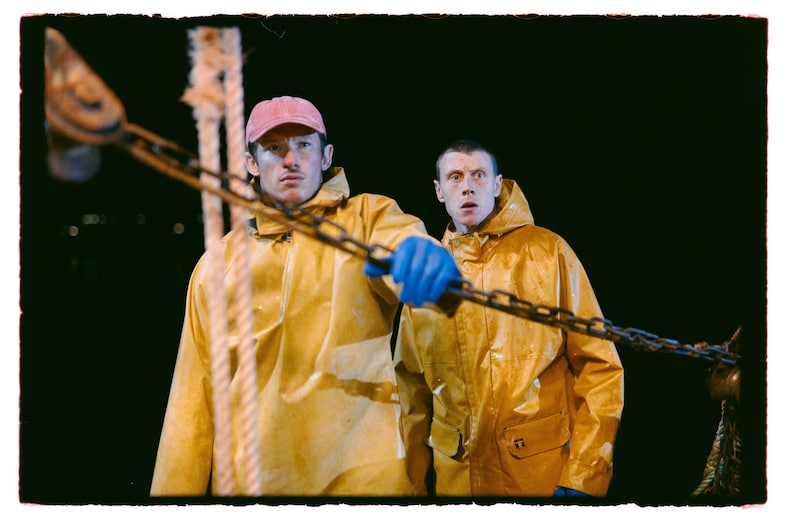
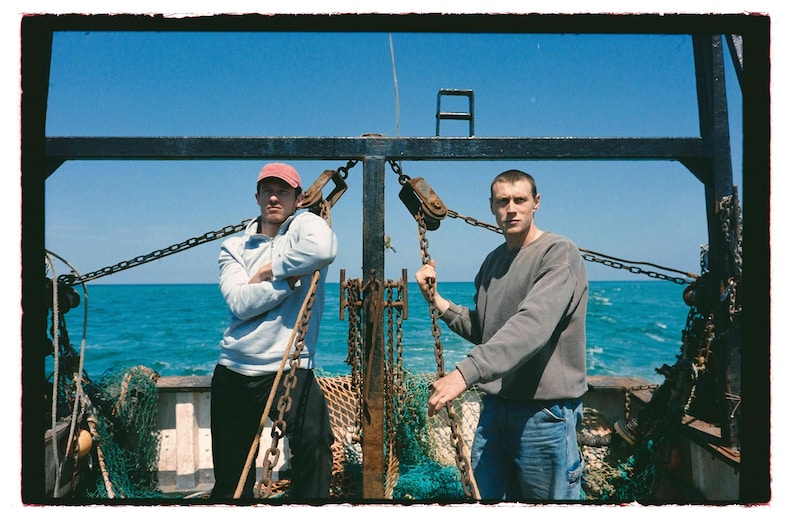
Lightning in a bottle is exactly what Jenkin has been consistently producing. His films feel utterly unique and easily stand among the best Britain has produced this century: Bait, a fable about the threat of modernity on a Cornish fishing village; Enys Men, an opaque folk horror; and now Rose of Nevada, a fable about the threat of the past on a Cornish fishing village. George Mackay and Callum Turner play two young men, unmoored in life, who take a job on a trawler and become trapped in a time loop. It’s a bewitching cinema experience: tragic, funny and perplexing in ways that are difficult to put into words.
Rose of Nevada orbits ideas about memory and the difficulty Britain has with letting go of its past. Having seen it twice, seven months apart, it’s a very different film on rewatch, reconstructing itself each time. Jenkin himself is fresh from viewing a test run of Rose of Nevada’s 35mm print in NFT1. I mention the idea that memory isn’t a recollection of a specific moment or event; it’s the brain fuzzily remembering the last time it remembered. “That was the first time I saw Rose of Nevada since Venice, and a lot of it came flooding back,” he says. “Not from, as you say, when we made it or when I edited it, but from watching it in Venice.” He pauses. “Film is a weird art form because it’s all about memories. I’m writing a film right now that’s set in the 70s, but it’s all about what I’m thinking about at the moment. The earliest anyone is going to see it is in four years’ time. I do think that’s the magic of film, that it’s all past tense straight away.”
Rose of Nevada unites, among other genres, a ghost story and a time travel sci-fi drama – so what were the key texts that influenced Jenkin? Enys Men was notably inspired by Jerzy Skolimowski’s bizarre, sinister The Shout. “Well, for me and my generation, Back to the Future is probably the definitive time travel movie.” Wait, Rose of Nevada was directly inspired by Back of the Future? “Yeah, probably! Certainly, Back to the Future was something I was wary of borrowing from.”

During lockdown, when he was researching the film, Jenkin decided to study quantum physics. “I thought I’d get a handle on it so I could write a time travel movie and go all Chris Nolan on it. Then, within about half the introduction to The Beginner’s Guide to Quantum Physics, I thought ‘fuck this’ and ordered the complete boxset of Quantum Leap.”
With Bait taking place in a fishing community and now Rose of Nevada returning to the same territory, what is it about fishing that draws Jenkin back? “I live right in the heart of it: my studio is in Newlyn, one of the biggest fishing ports in the UK. Fishing will be romanticised when it’s gone but it suffers from being romanticised at the moment.” Fishermen in particular have always been figures of interest for Jenkin. “Without meaning to sound patronising, they’re amazing raconteurs. Visually, the way they have to dress is incredible. I love their whole world but I don’t fully understand it and it’s a constant work in progress for me to understand how these communities work.” Jenkin believes he has a duty in his films to deromanticise the world of fishing: “It’s still the most dangerous civilian job you can do. It’s loud, it’s dangerous, repetitive, claustrophobic, and I wanted to put that on screen.”
Bait sees a community on its last legs, while Rose of Nevada sees it virtually extinct. Given that one was produced before Covid and the other at its peak, did this affect Jenkin’s way of thinking? “Somebody said to me the other day that my films are about community, and I thought, ‘I’m not sure that they are,’” he says. “But the more I considered it, the more I realised I clearly am preoccupied with community. It became very important to me during lockdown, when our national leadership was so terrible, and the local community became everything.”

There are neat, seemingly unintentional parallels between the two films, Jenkin admits. “In Bait, it was one person recognising that something was changing in the community and it needed to be addressed before it was lost. In Rose of Nevada, it’s past that point – the community is gone, there’s no common purpose. Nobody goes to the pub any more. The post office has become a food bank. So I’m clearly preoccupied by it, but half the time it takes people pointing it out to me to realise what I’m doing.”
Jenkin sees this different approach to the same themes as signs he’s matured as a filmmaker. “I think because of the structure of Rose of Nevada, I was able to highlight those things in a much subtler way. It wasn’t as didactic as Bait.” Indeed, it was important to him that we first witness the food bank in contemporary times before we discover that it was once the local post office. “The normalisation that, as the sixth largest economy in the world, we need food banks is the shocking thing.” But Jenkin insists that depicting this stark decline of Britain wasn’t by design. “It was done accidentally. That was never my intention. But when we go back in time, we’re reminded of what we’ve lost.”
Rose of Nevada is out in UK cinemas on April 24.
