
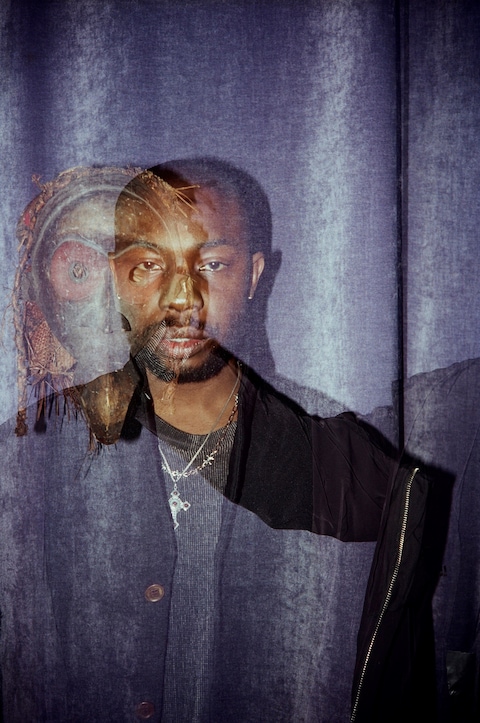
Drawing on his Nigerian and Texan heritage and the weight of a personal history, Kanu tells us about his first commercial furniture collaboration with Knoll, which will be presented at Salone del Mobile later this month
“For an artist, there’s really only one pursuit,” Dozie Kanu tells me, laughing slightly before landing on the word: “Dopeness. If my only goal is to make the most fire work possible, with no monetary motivation, no desire for recognition, everything else falls into place.”
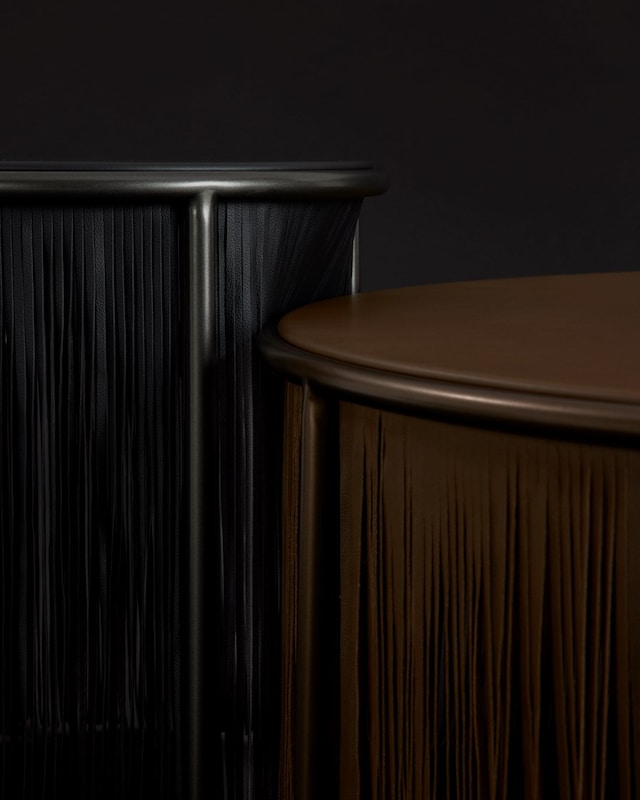
Kanu is speaking over Zoom from his studio in Portugal about his first commercial furniture line in collaboration with Knoll, the American company whose roster has previously included Eero Saarinen and Mies van der Rohe. The collection comprises a coffee table, console, and side table, available in two colour-ways of bronze and a dark grey manganese, with taut leather surfaces, rounded steel rod edges, and floor-length tassels that draw on Kanu’s Nigerian and Texan heritage. The collection will be the focal point of Knoll’s presentation at this year’s Salone del Mobile. And it is, remarkably, exactly what it looks like it isn’t: a mass-produced object that carries the weight of a personal history.

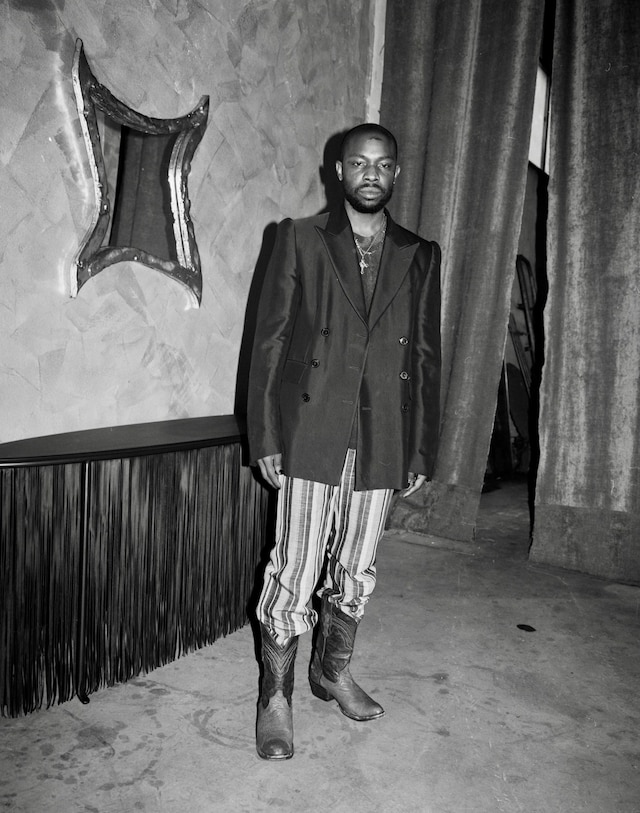
“Growing up in Texas with Nigerian immigrant parents, I was not fully accepted by the Black community … it created a feeling of displacement. And that feeling is everywhere in my practice. Questioning whether an object belongs in the space it is in, or whether it needs to be categorised as this or that. All of that becomes relevant,” he says. Working from his studio near Lisbon, Kanu assembles collected objects and found materials, from rusted metal, discarded furniture, concrete, burnt-out wood and wheel rims, into new configurations. His practice has always orbited the tension of what happens to an object when you strip away its function, or burden it with one it was never meant to carry. In a solo exhibition at the east London gallery Soft Opening in 2018 (the same year he won the Hublot Design Prize alongside Formafantasma), he showed an electric chair constructed in white marble, splintered into three parts and presented on separate plinths. The work recalled the history of capital punishment in his home state of Texas. The object looked serene, perhaps because marble is the material of monuments and memorials, but here it was deeply unsettling. That instinct – to make something that reads one way on the surface and means another underneath – is what he brings to the Knoll collaboration, too.
“When I was first approached with the project, I actually designed a completely different collection. But Jonathan Olivares [the creative director of Knoll] looked through my work and pointed out what he felt could translate well within the Knoll archive. And it just so happened there was this one-off stool I made for an installation at Performance Space New York.” The stool was fitted with blood-red leather tassels designed to tighten its top so the object could double as a drum. “I chose to let the tassels hang,” he explains, “That shifted it away from being an instrument and closer to Texas culture.” The fringed leather of Texas cowboy culture that shaped his childhood and the dramatic sweep of dried-leaf skirts in African masquerade ceremonies both converge into his furniture pieces. Laid over forms within the language of high-end furniture, the tassels carry an autobiography. “It’s not screaming ‘identity’ or ‘autobiography,’” Kanu says. “But the best thing I can do is make what I know.”

Running alongside his Knoll debut, Kanu has a show at the ICA Milano in collaboration with the Nicoletta Fiorucci Foundation. The gallery is split in two; one half presents an installation by the late Marc Camille Chaimowicz in tribute to Jean Cocteau, and the other is Kanu’s installation of a structure built from reinforced cardboard. Its walls are inscribed with the word haptic, meaning touch or feel. But what Kanu is really reaching for is invisible touch, the ways we are informed and shaped by things that never physically contact us, such as migration, ancestry, and the generational histories that arrived before we did.
The tension between making as an artist and as a designer is central to how he works. “For me, function serves as a learning mechanism. It attracts people who might be outside the art world. They recognise these objects. And over time, even if at first they’re simply drawn to the form, they can discover the hidden messages, the political or socioeconomic layers.” He is also a musician, having recorded an EP called Shirtlifters with performance artist Matt Hilvers, and is in the late stages of developing a feature-length film. “I consider myself an exhibition maker,” he says. “Which allows every aspect of my artistic expression to culminate in one space.” And you can feel that in how he works within a continuous spectrum of ideas, similar questions refracted through different mediums, each project informing the next.

Our conversation drifts toward cinema and architecture, which Kanu describes as “the most demanding forms of artistic expression that exist. And the fact that there’s so much capital involved in realising ambitious projects within those spaces makes it much more difficult for Black consciousness to feed into those modes of expression. So in a way, every exhibition feels like a tiny step toward proving to myself that I can operate within architecture and cinema.” The tables arrive in Milan this April, three set pieces for a scene Kanu has been directing his whole life. Pull up a chair, as the show has already begun.
Salone del Mobile takes place in Milan from 21-26 April 2026.
