

The Bronx-born star gives a lovely, soulful performance in Jim Jarmusch’s new film about strained family connections. Here, they talk frankly about some dramas of their own
Indya Moore’s performance in Father Mother Sister Brother, the beguiling new film from Jim Jarmusch, shimmers with warm authenticity. The director’s 14th feature is a tight triptych of unconnected stories that come together to say something profound about family ties. The first vignette follows a strange encounter between an evasive father (Tom Waits) and his aloof children (Adam Driver and Mayim Bialik), while the second centres on Charlotte Rampling’s emotionally unavailable mother. When her daughters (Cate Blanchett and Vicky Krieps) arrive for their annual catch-up over afternoon tea, no one says what they really think.
In the third vignette, Moore – a former AnOther Magazine cover star – and Luka Sabbat play a sister and brother who return to their childhood home in Paris after the death of their parents. Though their predicament is sadder than the film’s other characters, theirs is the most hopeful story. Moore’s Skye and Sabbat’s Billy no longer live in one another’s pockets, but their sibling bond has endured. “They have a confident distance from each other,” Moore says, speaking over Zoom from their home in New Jersey, “whereas I think the other characters struggle with a little bit of anxiety around being close to one another”.

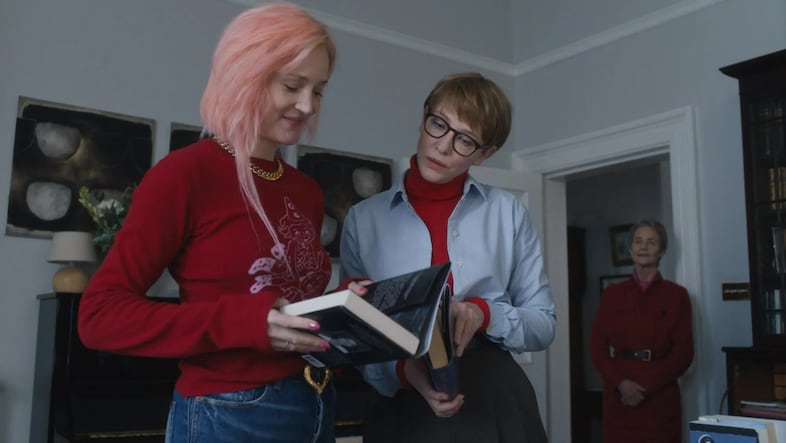
As Skye and Billy sift through old photos of their parents, who led an adventurous and loving life, they reminisce with unselfconscious affection. “They’re not forcing each other to be there, and they’re not ‘working on their relationship’, right?” Moore says, leaning into the camera. “They’re there because they love each other and probably because they had an [emotionally] rich childhood. Even though they may have been [physically] apart for quite a long time, we can tell that they were previously so connected, which the story seems to credit to the fact [that] they’re twins.”
Moore, who broke through in 2018 by playing resilient sex worker Angel Vasquez-Evangelista in the groundbreaking LGBTQ+ series Pose, channelled their own grief into Skye’s. While they were filming Father Mother Sister Brother in early 2024, they were also using their profile to draw attention to the plight of genocide survivors in Palestine. “I was interfacing every single day with people who were trying to evacuate Gaza,” Moore says. “I was seeing images of people’s wounds, of children who were severely hurt, and I had to reckon with the weight of that on my body. I was grieving, I was angry and I was scared – and I hate to admit when I’m scared.” The actor adds that they received “total support” in their advocacy efforts from Jarmusch, the dean of US indie cinema whose oeuvre ranges from contemplative comedy (2005’s Broken Flowers) to offbeat gothic horror (2013’s Only Lovers Left Alive), and their talented co-star Sabbat. “I’m so grateful, because that’s what allowed me to bring Skye to life, despite the weight of what I was carrying.”
Since Pose ended in 2021, Moore has appeared in the brilliant queer indie film Ponyboi and a big-budget fantasy series, The Sandman. They’ve also appeared in campaigns for luxury brands including Ralph Lauren, Louis Vuitton and Calvin Klein. But unlike many actors, they don’t give short, cautious answers that skirt around difficult topics. In fact, many of their responses unfold over several minutes and ping thrillingly between the personal and the political. Moore hates being called an “activist” but does strive to serve as an “advocate” for causes including Palestine, the dismantling of white supremacy and LGBTQ+ rights. Moore is trans and non-binary, and uses they/them and she/her pronouns.


Growing up in the Bronx, where Moore entered the foster care system at 14, they considered a future career in psychology. (“I was just so moved by the work of my therapists and thought it would be really beautiful to help people.”) They also dreamed of doing pioneering work in biotechnology. “I wanted to find a way to help trans women, because I grieved not being able to have a child. I hated the idea of me having a child in any other way than [through a biological] pregnancy,” Moore says, before pausing again. “It’s not something I talk about very often, because people mock the experiences of trans people all the time. But I thought that I would be able to go to school to study biotech and one day help trans women to grow their own wombs.”
Building an acting career seemed like a pipe dream, Moore says, “because as a trans person, you know your access to society and culture is going to be limited”. But while they were working as a background artist on Baz Luhrmann’s musical TV series The Get Down, Moore met Jose Gutierez Xtravaganza, a legend of New York’s queer ballroom scene. Xtravaganza encouraged them to audition for 2017’s Saturday Church, a musical fantasy film loosely based on a real-life LGBTQ+ outreach programme, and Moore landed a role opposite their future Pose co-star Michaela Jaé Rodriguez. “There wasn’t really a meaningful depth to my desire to act at the time,” Moore admits. “I just wanted to be a star.”
A year later, Moore was cast in Pose, a moving and exuberant drama series about the chosen families of the New York ballroom scene. Memorialised in Jennie Livingston’s seminal 1990 documentary Paris Is Burning, this scintillating subculture has long provided a safe space and creative outlet for queer and trans people of colour. And when Pose premiered in June 2018, it made history by featuring more trans actors in series-regular roles than any show that came before it. “When Pose happened, things shifted in a way that became a little bit sobering,” Moore says. “I remember praying to God when I [got] that job. I said, ‘Please support me in using this visibility and celebrity to be of service to people.’”

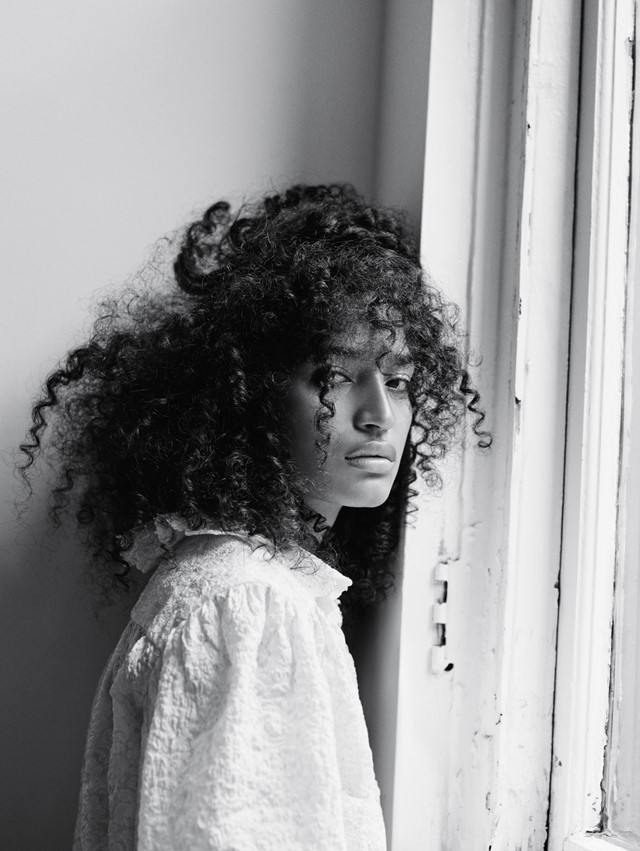
Pose was a big hit that picked up a string of Emmy nominations, but it ended in 2021 after three seasons. My final question, about the show’s legacy, yields Moore’s longest and most complex answer of all. “We created a really beautiful programme, and I think it would have continued for longer if we had all been able to rise to the moment in harmony,” they say. Moore doesn’t mention tension between anyone in particular – in fact, they underline their love for each of the show’s key players one by one. But they do suggest that being shadowed on set by a personal bodyguard – a necessary precaution because Moore was being stalked by an ex – may have put a wedge between them and their castmates.
“Before I die – which I hope is a long way off, because I’m only 31 – there are a few things I would like to see,” they say. “One of them is for us all to sit down together to see each other fully and just love each other, really. That’s the thing I wanted the most, and maybe I didn’t do the best job at contributing to that kind of environment [on set].” Not for the first time, Moore pauses to recalibrate. “Our legacy ultimately is the theme of the show,” they say. “It’s humanity, love, family and imperfection, and the desire to do better and not just take advantage of one another.”
Father Mother Sister Brother is out in UK cinemas now.
