
Accused of “wokeism” by Albert Camus’ daughter, the prolific auteur’s new film dives deep into the taboos at its heart
Despite directing 24 films in 27 years, François Ozon still can’t get all his projects greenlit. After 2024’s When Autumn Falls, the 58-year-old French auteur wrote an original screenplay consisting of three stories, the second of which would have starred Benjamin Voisin as a suicidal man struggling with the “absurdity of the world”. Financiers, though, balked at the uncommercial prospect of a triptych. Reflecting on rejection, Ozon showed the script to friends who noticed that the middle section reminded them of Albert Camus’ 1942 novella The Stranger. “So I read The Stranger again,” Ozon tells AnOther in March, in a Holborn office. “I realised that Camus was so much better than me in his description of this type of character.”
So Ozon, a provocateur who switches between genres and time periods with ease, has written and directed his own black-and-white version of The Stranger, remaining faithful to the source material while applying some signature twists of his own. As in Camus’ existentialist classic, Ozon’s film follows a stoic Frenchman, Meursault (Benjamin Voisin), who kills an unnamed Arab man on a beach, yet receives sterner judgement for not crying over his mother’s recent death. However, Ozon applies a 2026 reading that fleshes out the Arab characters and includes newsreel footage to contextualise France’s colonialisation of Algeria. So much so, the novelist’s daughter, Catherine Camus, lamented the director’s alterations to the story as an attempt to “satisfy wokeism”. (She did say that she liked the film overall.)

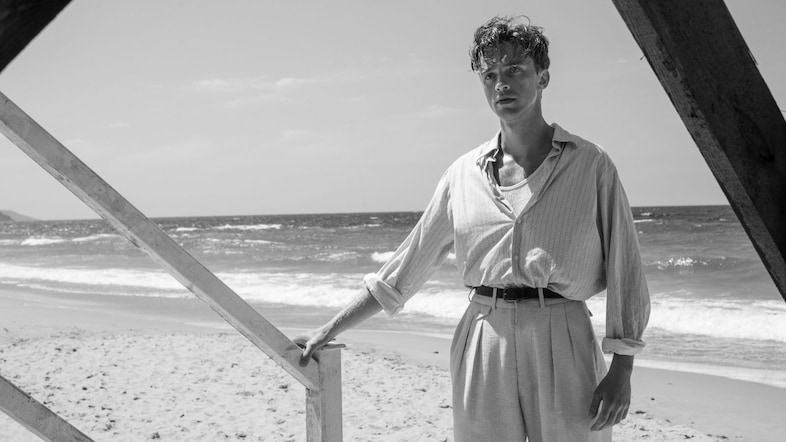
“I knew I’d be criticised for my choices,” says Ozon, mostly speaking in English but occasionally using an interpreter. “So many people have read the book, and when you read it, you’re a director who imagines the scenes in your head. But it’s my vision of Camus. He wrote the book in 1939, before the Second World War. It was a time of colonialisation. I had to explain that to an audience of today because, in France, it’s taboo to speak about the French Algeria.”
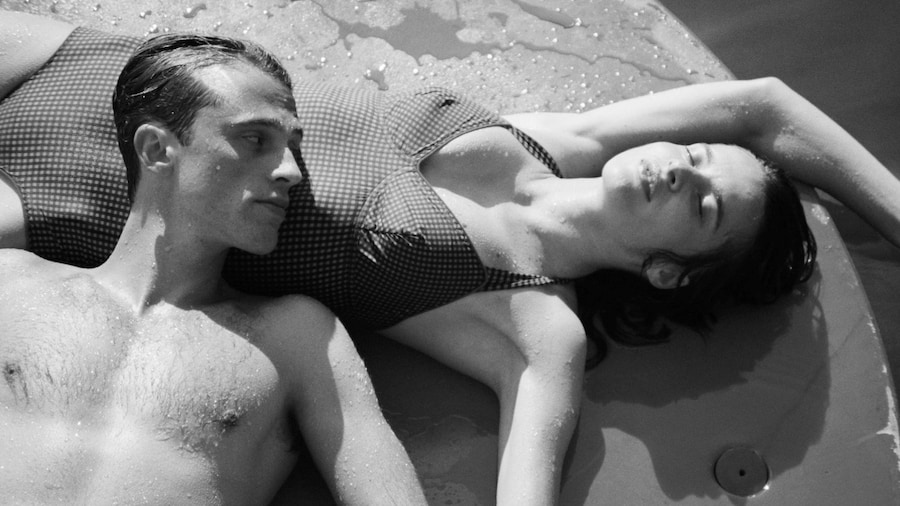
Cast by Ozon in the youthful romantic drama Summer of 85, Voisin reimagines the character of Meursault as an icy, taciturn riddle whose blankness offers intrigue or frustration, depending on your reading. Even in a brief romance with a former colleague, Marie (Rebecca Marder), Meursault maintains an emotional distance from those around him. Comparisons could be drawn to Ozon’s other memorable enigmas like Marine Vacth in Jeune et Jolie, Ludivine Sagnier in Swimming Pool, or indeed the young killers of Criminal Lovers. Ozon himself points to Michelangelo Antonioni. “I said to Benjamin and Rebecca, ‘I want you to be as beautiful as Alain Delon and Monica Vitti in L’Eclisse,’” says Ozon. “They said, ‘OK, we’ll try.’”
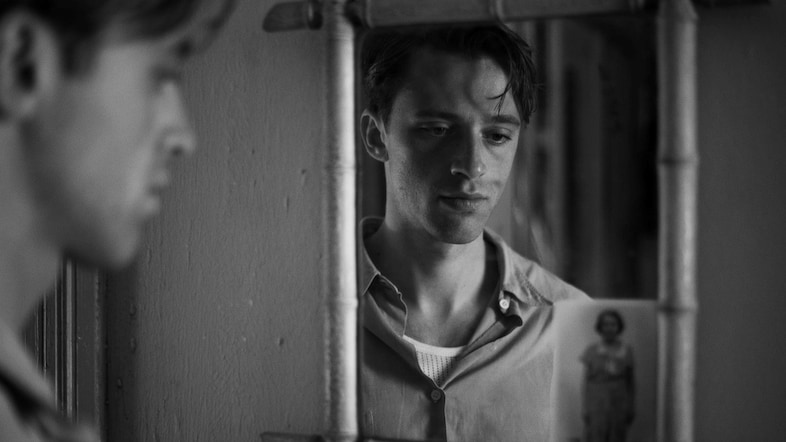
Since its publication, The Stranger has inspired multiple theories about the motives of both Meursault as a character and Camus as an author. Towards the end, though, Meursault explodes into a rage at a chaplain, explicitly telling him that life is “absurd” and death is inevitable. “Meursault is like a white page for you to project what you want,” says Ozon. “The last scene with the priest is important for me, because he’s suddenly able to express what he feels. Without this moment, I wouldn’t have made the film.” Were the themes discussed with an actor who’s otherwise supposed to give little away with his face? “I asked him not to act. It’s a challenge, because [Benjamin is] the opposite of Meursault: he’s charming and seductive. In the end, he was totally depressed, which was good for the film.”

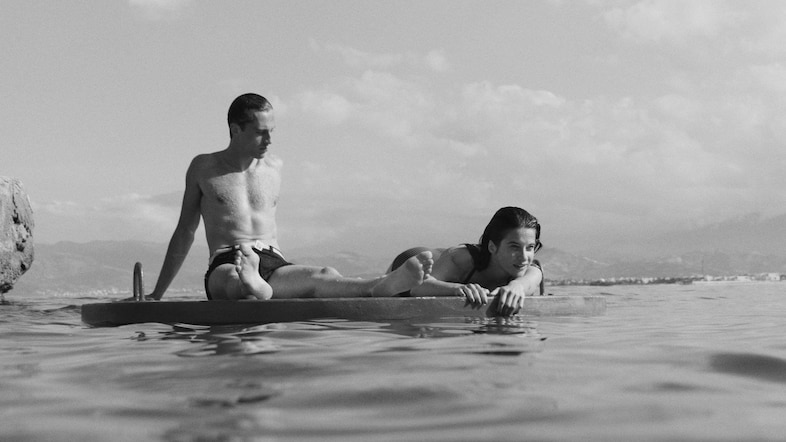
Meursault’s emotional outburst with the priest is not only key to Ozon’s vision, it scuppered his initial attempts to adapt the novel as a silent movie with intertitles for any dialogue. “I wanted to express everything with Meursault’s eyes,” says Ozon. “He doesn’t speak much for the first hour.” The director does, however, shoot the film in black-and-white, as he did with his 2016 period romance Frantz. The reasons range from the artistic (“the book is full of colours, but I wanted to show the reality of what Meursault sees”) to the practical: it’s cheaper to recreate a period-accurate Algeria when it’s not in colour.
Ozon teases that his next film will be an original screenplay with a 12-year-old boy as the protagonist. In recent years, I note, he’s been revisiting his youth: The Stranger was a set text he studied at school, while Summer of 85 is an adaptation of Dance on My Grave, a novel he read as a teenager. Moreover, both films end on songs by The Cure, who were Ozon’s first-ever gig. As the credits to The Stranger kick in, so too does The Cure’s Killing an Arab, a 1980 song told from Meursault’s point of view. Is it true that Robert Smith writes his emails entirely in capital letters? Ozon believes so, but gets his phone out to verify. At this point, the director realises that Smith still hasn’t seen the film, and makes a mental note to invite the singer to tonight’s London premiere.
Killing an Arab has proved controversial enough that Smith now sings “kissing an Arab” or “kissing another” when performing the song in concert. “People didn’t understand the lyrics, and the extreme right in America used the song for the wrong reasons,” says Ozon. “Robert Smith said it was a mistake to use that title, and maybe it could’ve been called The Stranger. When I asked him if I could use it, he was happy for the song to be used within the context of the film.” Ozon’s adaptation of Dance on My Grave was originally titled Summer of 84 – it was renamed to Summer of 85 at the request of Smith, who pointed out that the end credits song, In Between Days, came out in 1985. Did Smith have any other conditions for The Stranger? “No,” says Ozon. “Because I didn’t call the film Killing an Arab.”

In the novel, the murder victim is simply “the Arab”. In Ozon’s film, though, he’s given a name, Moussa, which is borrowed from Kamel Daoud’s 2013 novel The Meursault Investigation, an imagined retelling of The Stranger by Moussa’s brother. Likewise, Moussa’s sister is now named Djemila. “It was important to develop the female characters because in the book, they don’t really exist,” says Ozon. “All the men in the story are toxic. One beats his dog, one beats his wife, and another kills an Arab because of the sun. The women have a better understanding of the tension between the two communities.”
Ozon explains that a literal retelling of the novel wouldn’t interest him, and that the rights will be in the public domain in seven years’ time, anyway. “I hope many people will make their own version of The Stranger.” So the director adds a scene at the end where Djemila visits Moussa’s grave, the piercing sun pointing towards a name written in Arabic. “[Catherine Camus] would have preferred I finished the film like in the book,” says Ozon. “But for me, it’s stronger to finish by giving a voice to the Arab characters.”
The Stranger is out in UK cinemas now.
