
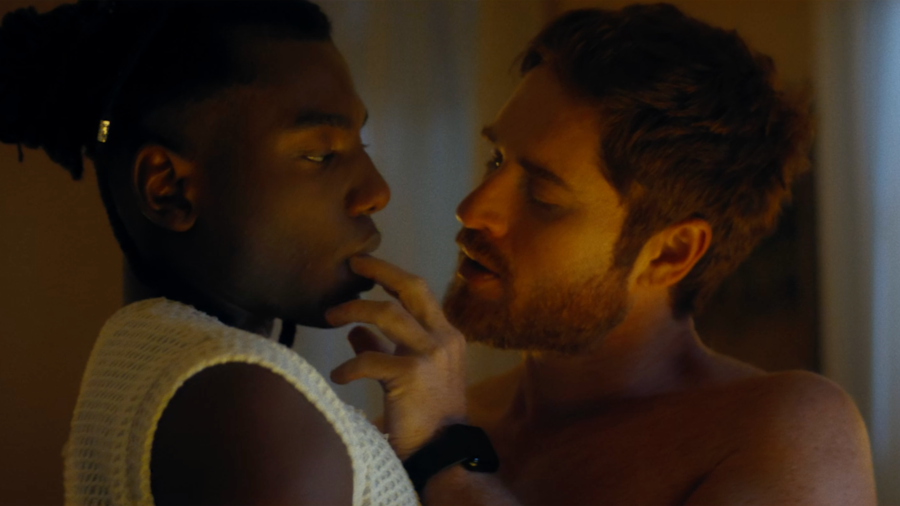
Brazilian directors Marcio Reolon and Filipe Matzembacher reveal the kink-filled classics that inspired their bold and timely queer noir
The evening before they began filming Night Stage, their daring and transgressive new erotic thriller, directors Marcio Reolon and Filipe Matzembacher held a movie night for their cast. On the bill: Basic Instinct, Paul Verhoeven’s iconic 1992 romp about a successful crime novelist (Sharon Stone) who may or may not have murdered her rock star boyfriend. “Some of the cast hadn’t seen it before, but they got really into it,” Matzembacher recalls. “It’s such a playful film where desire plays an important role, which really inspired us when we were making Night Stage.”
The illicit thrill of hidden desires definitely propels Night Stage, a riveting queer noir about an up-and-coming actor Matias (Gabriel Faryas) and an aspiring politician Rafael (Cirillo Luna) who begin hooking up in public spaces. Throughout, the directors draw parallels between the literal theatre where Matias is starring in an experimental play and the sexual theatre of a cruising spot in Porto Alegre, Brazil, where the film is set. “That duality was very interesting to play with,” Reolon says, “because they’re both situations where the gaze means a lot. At a cruising spot, the main way you communicate is by looking at someone.”
Night Stage isn’t just kinky and twisty; it also provokes timely questions about the way queer people compartmentalise their desire in order to thrive – or at least get by – in an overwhelmingly heteronormative world. Rafael is clear from the start that he can only tick off his career goals if he remains in the closet, while Matias begins to downplay his sexuality when he lands a role in a high-profile TV series.
“We’re exploring the myth of assimilation,” Reolon says. “These characters believe they will be embraced by society and achieve a neoliberal idea of success as long as they ‘behave’, but that will only last for as long as they’re profitable.” Speaking over video call from Berlin, where they live, the directors select five films that influenced their very modern and thoroughly unjudgmental erotic thriller.

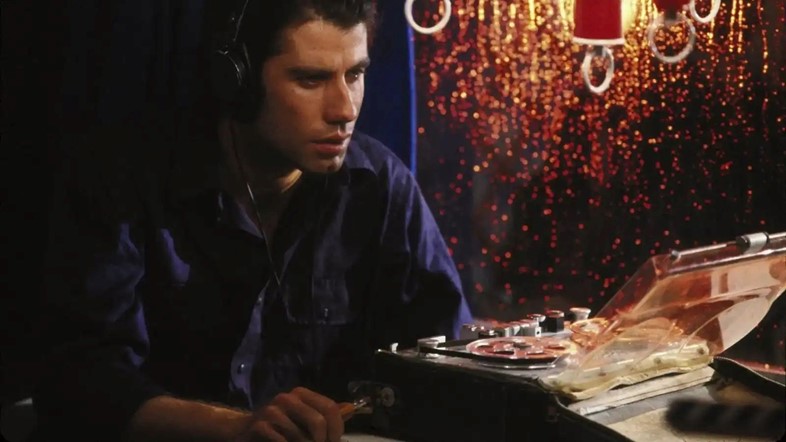
Blow Out (1981)
Filipe Matzembacher: “Brian De Palma is one of our favourite directors. He has a very strong eye regarding desire and there’s a sense that you, as the audience, are part of the sexual game that this film is creating. That’s something we found really enjoyable to play with in Night Stage.”
Marcio Reolon: “Our previous films were more naturalistic and grounded, but we wanted to move away from that [style] with Night Stage. For example, in our previous films, you wouldn’t really notice the soundtrack because it was almost diegetic. But in Night Stage, we wanted the music to be more over-the-top, which is something De Palma does in a very brilliant way.”

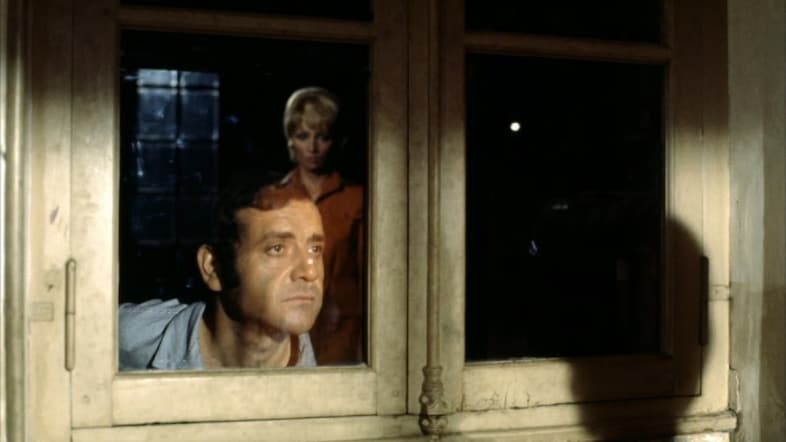
Le Boucher (1970)
MR: “We like how [director] Claude Chabrol deals with the logic of obsession in this film, but also how he makes it a sort of slow-burning thriller. That’s something we wanted to do in Night Stage: to create a film that, little by little, starts to descend into a thriller, even though there are hints from the beginning.”
FM: “There’s also a very direct influence close to the end of our film, when Rafael delivers a monologue about this possible life that he and Matias could lead if they ‘behave’ and embrace assimilation. Le Boucher has a similar monologue close to its end, which was very interesting to us.”

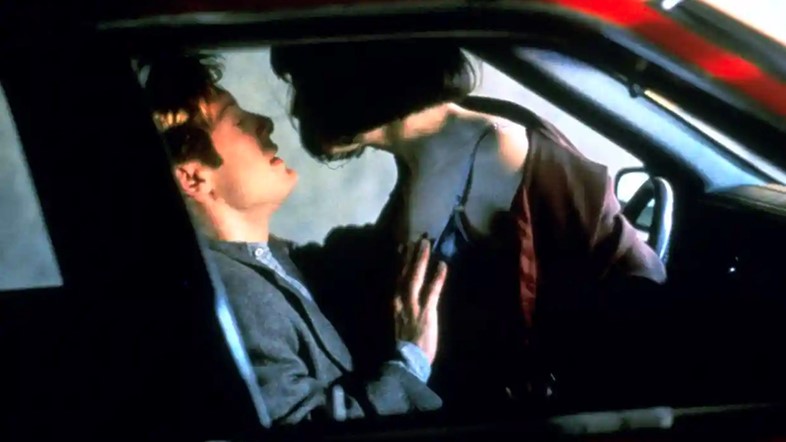
Crash (1996)
FM: “This David Cronenberg film is so fascinating because it’s about how machines – cars – become extensions of these horny human bodies. The cars become a part of the characters’ sexual game. I think there’s a connection with Night Stage because, in our film, the public spaces where the characters hook up become a part of their sexual game.”
MR: “They’re both films that don’t judge the kink of the characters. In most films that portray a kink or fetish, there’s a moment where [the director] starts to judge that fetish instead of trying to criticise the society that oppresses the characters. But Cronenberg doesn’t do that in Crash, which was very inspiring to us.”

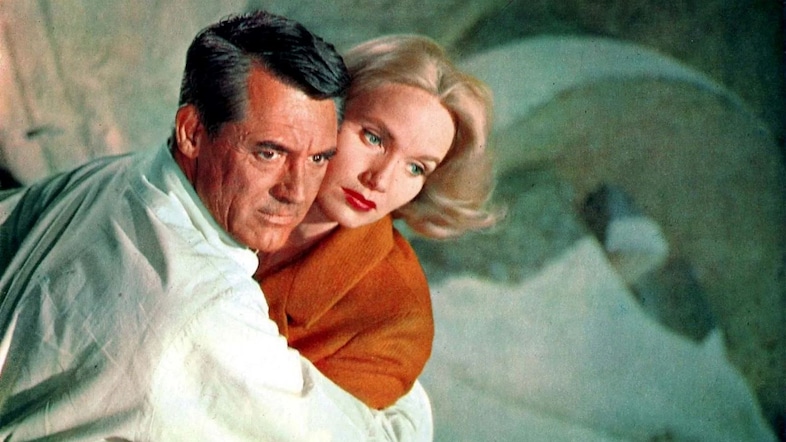
North by Northwest (1959)
MR: “Hitchcock is an obsession of ours. We rewatched quite a few of his films while making Night Stage, but we really connected with North by Northwest, especially in terms of staging and mise en scene. There’s even a couple of shots in our film that directly reference North by Northwest. For example, when Matias and Rafael first meet, they’re on opposite sides of the road with Rafael sitting in his car – that’s a direct homage to a scene in Hitchcock’s film.”
FM: “What Hitchcock does super-well is to let the audience know that something bad is about to happen, but without letting the characters know. That’s a very exciting experience for the audience and we definitely tried to create a few moments like that in Night Stage.”

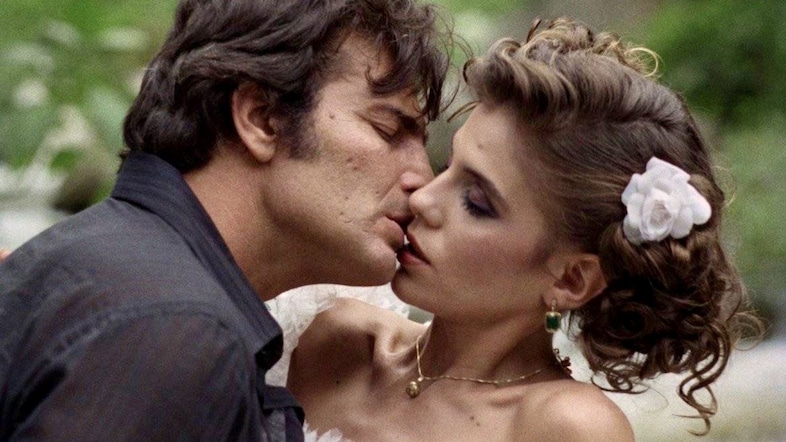
República de Assassinos (1979)
FM: “This brilliant film by Miguel Faria Jr is a queer noir that dialogues with so many elements in our film: the playfulness, the desire, the overall thriller vibe. And it has one of the greatest femme fatales in Brazilian cinema history, who is also a trans character.”
MR: “República de Assassinos talks about the birth of an extreme far-right group in Rio de Janeiro, but it’s told from the perspective of many different characters, some of whom are queer. I think the noir and thriller genres represent our times very easily because we are living in a moment where desire is being punished, but also where corruption and violence are very prevalent. Even though this film is nearly 50 years old, it still feels so contemporary.”
Night Stage is out in UK cinemas now.
