
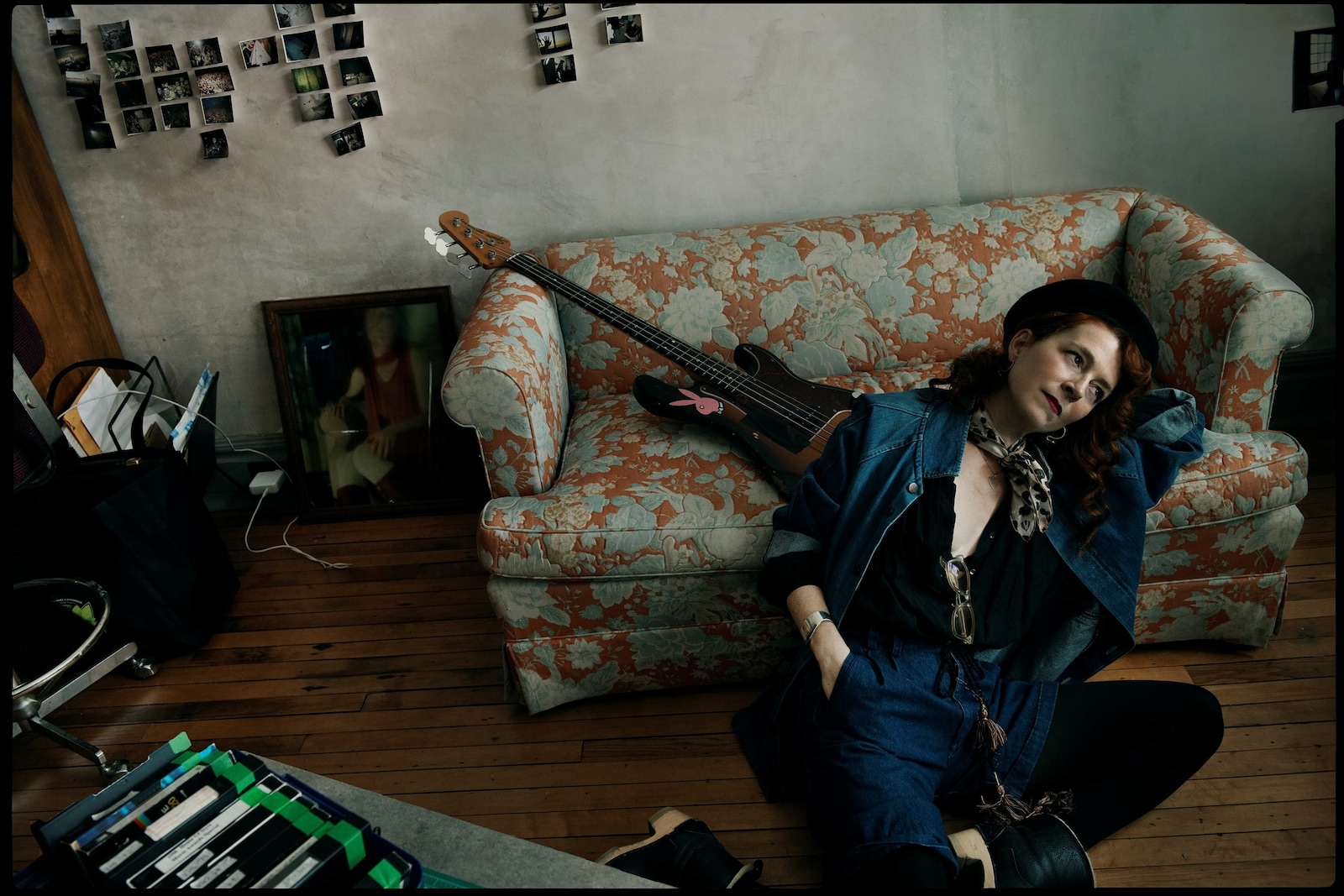
Melissa Auf der Maur is back-to-back with interviews for the release of her memoir Even the Good Girls Will Cry, a searing chronicle of her years at the heart of 90s alternative rock, first as the bassist in Hole, then in the Smashing Pumpkins. But the famously poised redhead, who was drafted in to replace Hole’s bassist Kristen Pfaff weeks after she tragically died of an overdose, and mere months after front-woman Courtney Love’s husband Kurt Cobain died by suicide, has a particular fondness for AnOther. The magazine became a kind of haven at a time when “the whole industry of music and fashion and culture was merging,” she now says, against a backdrop of images from her upcoming book of photographs from the era.
The memoir begins with Auf der Maur's first performance with Hole at the 1994 Reading festival, when Love led an epic, cathartic set to 65,000 fans. Auf der Maur's preternatural calm in this moment sets the tone for her ensuing trip through the decade, interspersed with behind-the-scenes photos, drawings, and fascinating letters that Love wrote to her, including one on the beauty myth that should be required reading.
Grounding the anecdotes about this indelible moment in pop culture are also moments of deep heartbreak – for the musicians in thrall to drugs, and for Auf der Maur's beloved father, Nick, a journalist whose alcoholism provided her with a unique understanding of addiction’s toll. Indeed, her protective instinct reared as soon as she met with Love – her “wild child sister” on whose upcoming record she sings. “Melissa from Montreal”, as Billy Corgan once dubbed her, now lives in Hudson, New York, with her filmmaker husband Tony Stone – together they run the Basilica Hudson art space. The book is dedicated to Auf der Maur’s teenage daughter, River, “and all the girls”.

Laura Allsop: How did you go about the process of filtering your memories, diaries, photographs and even your father‘s articles to write the book?
Melissa Auf der Maur: The meat of the book was entirely written from memory. Even though I was a chronicler, an obsessive documentarian in diaries and photography, I didn’t use any of that to write the book. But I credit being a documentarian and photographing and constantly journaling for why I think I remember it so well. I was highly aware at the time that very radical, difficult things were happening, and if I didn’t get it down, I would forget. So I was working constantly on reflection and looking at my place in this giant whirlwind.
But it was very easy to write. For days on end, it just came out, like a waterfall of life that had been dammed up for way too long. I needed so badly to get rid of it. I needed to unpack this stuff, because I kind of went running from the 90s and didn’t look back for at least ten years. Then when I became a mother, I started to look back, and I really just wanted to do it for my daughter.
LA: Did you have any memoirs in mind while writing?
MADM: I like real life, so non-fiction has always been my thing. I read a ton of memoirs [while I was writing]. Still, the memoirs that hold the most alive inspiration for me are Sally Mann’s book Hold Still about her photography, and then, of course, Just Kids by Patti Smith – those were worlds that I related to. A girl trying to find herself in photography; a woman trying to find herself in counterculture, music, love and destined relationships. What’s cool about Mapplethorpe and Patti – these are just like-minded, kindred spirits trying to find themselves at that coming of age moment. I’ve been really excited that two women artists I admire so much released, in the same year, follow-ups to their hit memoirs, which are in many ways more interesting to me. Because it’s not the things they’re most known for, their big successes or biggest relationships, but the quiet things inside that also made them who they are.
LA: Your writing about addiction is very gracious and nuanced. It’s something you have first-hand knowledge about, given your father’s alcoholism. How did you approach that side of the writing?
MADM: Being very respectful and careful but knowing that the parts that affected me are my story to tell. I really wanted to be able to bring a person on a journey, for anyone who has been an addict or been in a relationship or in a family with an addict, something that helps move it along, where you can protect yourself while also taking care of those people. But it was also, most importantly, part of my reframing of Courtney [Love]. My wanting to frame addiction through the lens of a daughter of an addict, and then as a friend who has lost people to it, and then as a woman who replaced a talented, amazing bass player … I wanted to show how I struggled living with that, but also to give a kind reframing of the lack of compassion the world had for Courtney. My protection of her was instant; that’s one of the reasons I joined the band, other than her undeniable, fearless power and her determination to survive.
“I was highly aware at the time that very radical, difficult things were happening, and if I didn’t get it down, I would forget” – Melissa Auf Der Maur
LA: Your depiction of your relationship with Courtney is really refreshing. It reminded me of stories about complex female friendships, books by Elena Ferrante or Edna O’Brien.
MADM: Maybe in my later years I will read more fiction about complex female relationships! But if there’s one thing I’m incredibly attuned to, it’s my complex female relationship with Courtney. Even right now, in 2026, the fact that we are both poetically, accidentally, coming out from 15 years of hibernation – I am so thrilled that we get to do it at the same time, in our different ways, and we get to continue to learn from each other and show those who are interested how women grow and how they grow together. In her documentary, which will come out this year, they capture that quite well, how we came to be creatively and what we ended up representing.
LA: Was there anything in the process of writing that surprised you?
MADM: Courtney’s letters. The perspective of 25 years was illuminating – the level of her instincts on me. The Courtney letters shed great new light on our friendship. Just going to London and singing on her record last year, and being in the vocal booth and hearing her voice and feeling mine wrap around hers – I didn’t realise how much I missed it. I missed being in her musical presence. That was something that surprised me, based on the fact that I went running from the 90s as fast and furiously as I could. Seeing her nobility was one [thing that surprised me]. The hardest – that was my father’s death. It took me 20 years to unpack my father’s complex life and complex death, and that’s a big part of why I was writing the book.
LA: There’s such a huge resurgence of interest in the 90s. Looking back, what do you think is its particular romance?
MADM: It’s what makes us human – it’s human connection. It’s as simple as the pre-Machine Age, where non-calculated magic happens. That’s how you found your passion, that’s how you found your love – pre us being locked into too many layers of possibilities. I like limitations. Even as a photographer, my whole thing was: do not crop a photo. Whatever I saw in the camera was what I got. All the songs I’ve ever written are on four tracks, because I don’t want endless tracks. I want a limited time and space. And finding magic in the limited, analogue world is what we are missing and what we are threatened with losing. That’s why I was so excited to put this book out – to be an ambassador to analogue ways, because it is all in us.
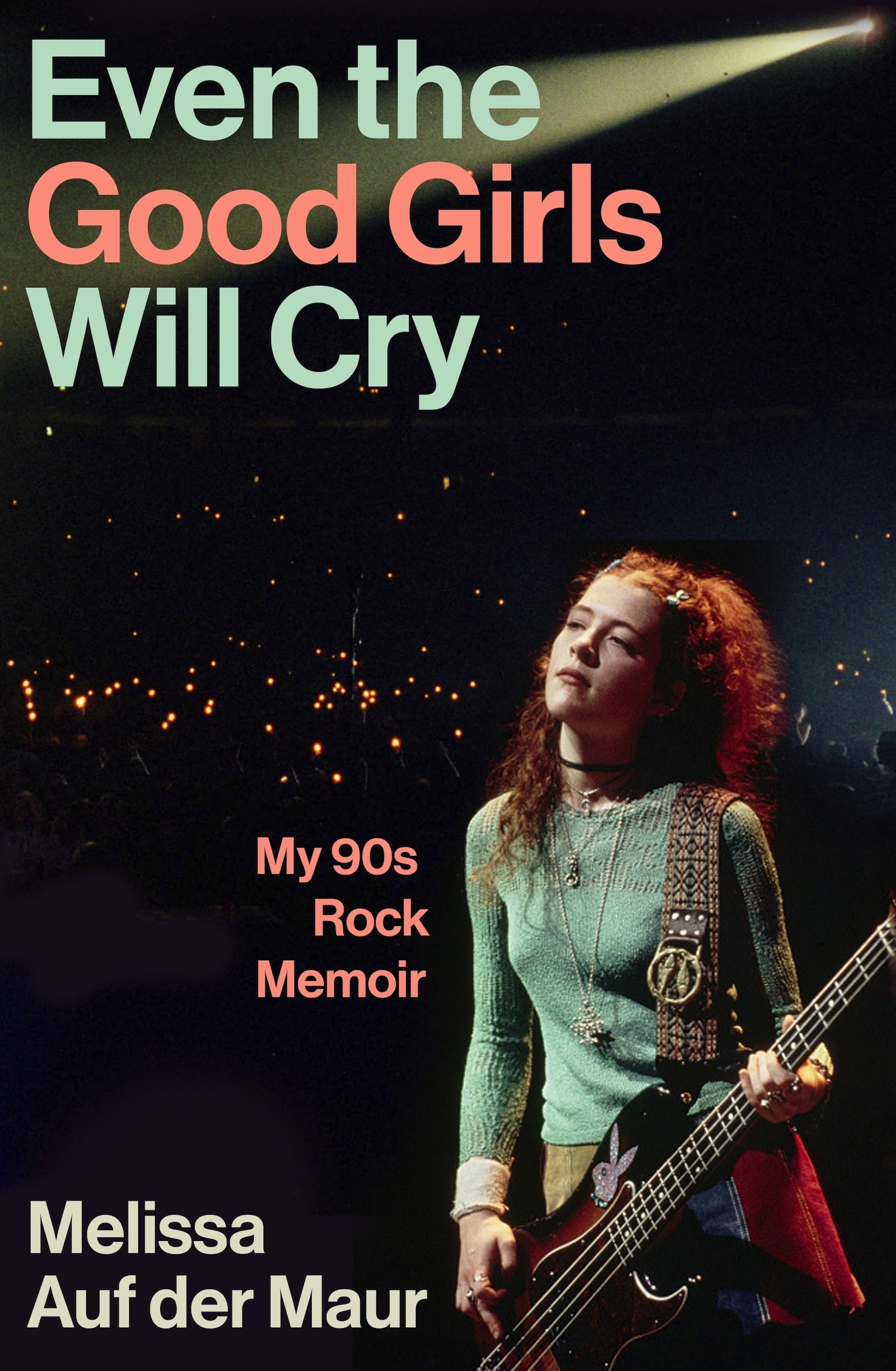
Even the Good Girls Will Cry: My 90s Rock Memoir by Melissa Auf der Maur is published by Atlantic Books and is out now.
