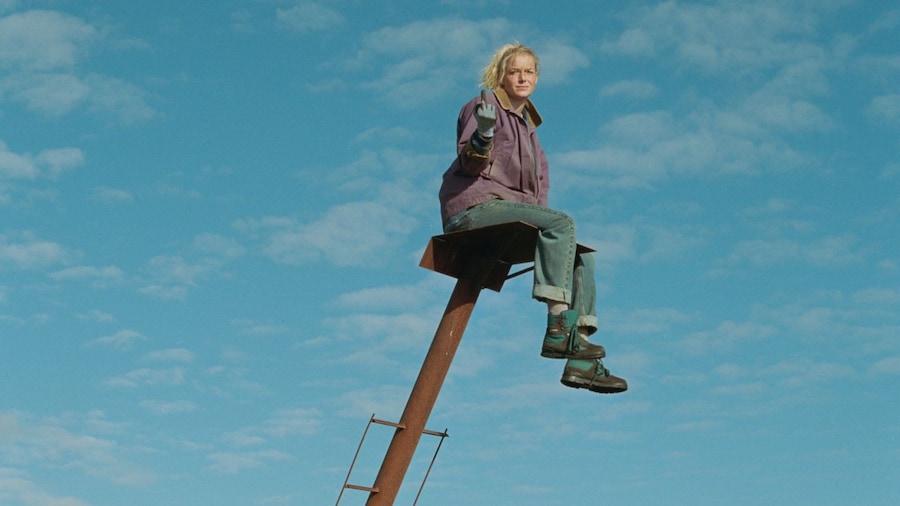
Hlynur Pálmason brings offbeat poetry to his tale of an Icelandic couple in the throes of separation, full of warmth and good humour
The Icelandic filmmaker Hlynur Pálmason has a habit of talking to himself when walking around nature. On long drives to Reykjavík, he will imagine an entire film in his brain, going through it scene by scene, fixing the details as he goes along. “Sometimes I’ll drive for three hours and completely forget myself,” the 41-year-old tells AnOther during the London Film Festival. “Your surroundings affect what you make.”
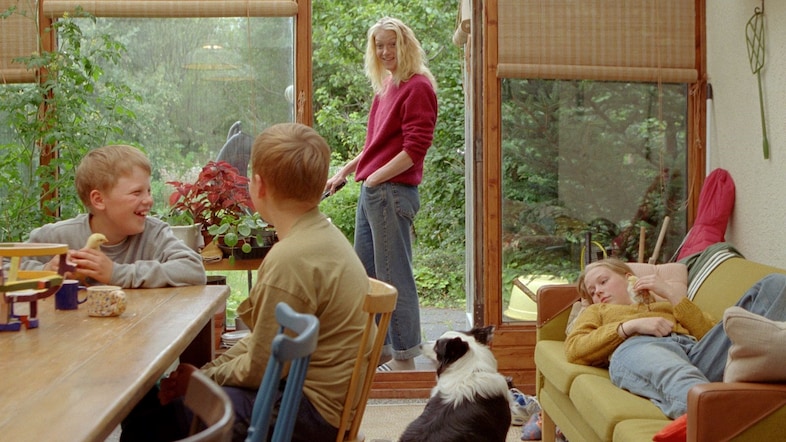
That’s especially true for Pálmason, an auteur who frequently shoots in Iceland with family members and even, in 2019’s A White, White Day, his own house. Likewise, Pálmason’s latest film, The Love That Remains, is a comedic family-drama that unfolds in the cold, unforgiving landscapes of southern Iceland that he knows intimately. Anna (Saga Garðarsdóttir) and Magnús (Sverrir Guðnason) are facing a separation that, like the weather, is bitter but occasionally warm. Their three children are played by Pálmason’s actual kids. Even the dog, Panda, is Pálmason’s own dog. To my surprise, Pálmason didn’t go through a separation himself. “I make personal films, but I’m not trying to mirror my own life,” the writer-director says. “I use my emotions. We started the film in 2017, and your life seeps into it.”

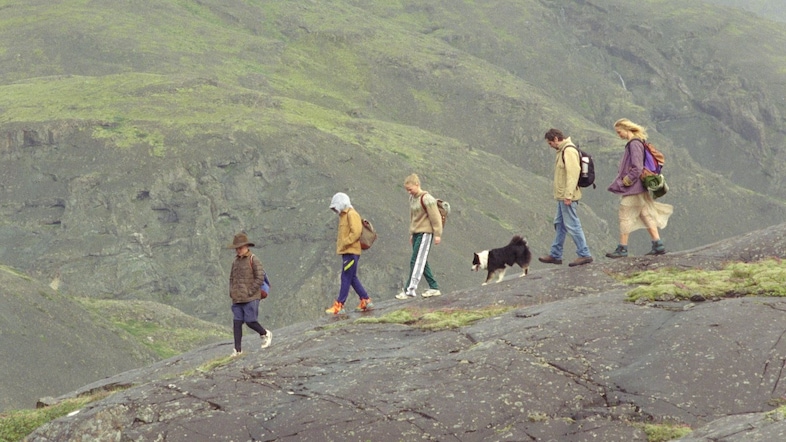
While The Love That Remains isn’t a comedy in the laugh-out-loud sense, it’s frequently funny, especially in comparison with Pálmason’s previous film, Godland, in which a Danish priest treks through snow and mountains in 19th-century Iceland. “I had a feeling when we finished Godland that the next film would be very free, crazy, funny, contemporary and warm,” he says. “And it became that.” Across snapshots of the family’s life, humorous vignettes include Anna’s disastrous date with a mansplaining art curator (she imagines his plane crashing), and the nonplussed reaction of a son receiving an arrow through the chest. Whereas Godland strives for realism, The Love That Remains attains surreal poetry, not least when Magnús has a nightmare that he’s pecked to death by a gigantic rooster. In another scene, a suit of armour amorously comes to life.
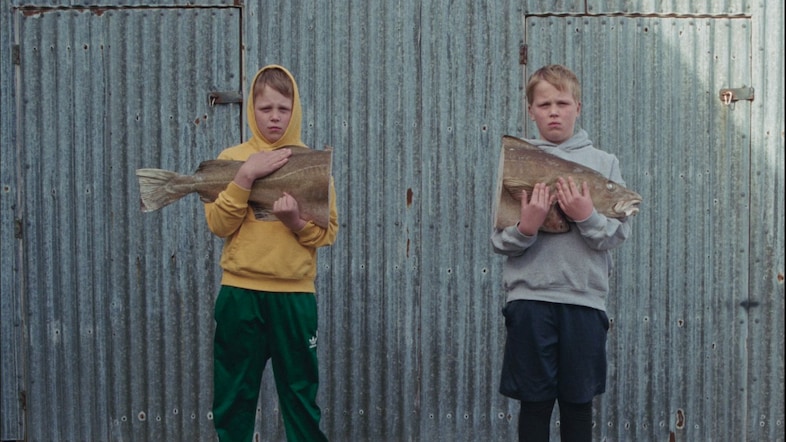
“The absurd scenes work because you believe it’s a real family,” says Pálmason. “You can therefore push the other things further. And then it’s moving towards first-thought impulses. There’s a raw truth to these impulses. It’s why David Lynch is one of my heroes.” In the edit, Pálmason also operates by instinct. “Magnús works in the sea, and Anna works on the land. It’s not because of any symbolism. It’s just that cutting from the sound of an ocean to the sound of a landscape is stimulating. You cut from fish coming out of the ocean to metal and rust. I’m trying to create an emotional experience.”

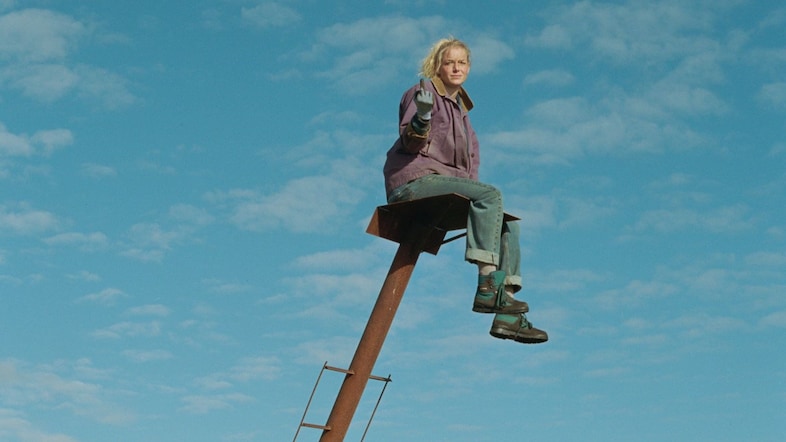
On land, Anna is an artist whose studio’s roof is ripped apart in an early scene that was shot before Godland. Working outdoors with gloves and several layers of clothing, she, like Pálmason, draws creative inspiration from her surroundings: rocks, wildlife, stretches of hills beneath a glorious blue sky. As well as an excuse to showcase Iceland’s cinematic terrain through long, static shots, these scenes visualise Anna finding independence. In contrast, Magnús, the one who’s sour about the break-up, is a fisherman who spends weeks away at sea with frustrated, argumentative men. A jaw-dropping sequence involves Magnús floating in the sea, away from a boat and nearby land, screaming for forgiveness from his family. Amazingly, it’s based on a real practice.
“I spent three summers documenting fishing boats when I was studying in Denmark, trying to survive financially,” says Pálmason. “I knew Magnús would be one of those fishermen, because I knew them personally, even playing basketball with them. They told me about jumping into the ocean, and waiting for the next boat. But we fictionalised it so that the next boat never came.”

During the shoot, Pálmason noticed on a radar that something bigger than a seal was swimming underneath Guðnason. “After 15 minutes, because we used the whole film roll, we told him, and he was like, ‘Are you crazy? It could have been a whale or a shark!’” If he’d been eaten by a whale, though, wouldn’t that have been brilliant for the film? “Yes,” he says, laughing. “I would have had to get the family to understand he would’ve wanted it in the film.”
Across his filmography, Pálmason has captured the passage of time and Iceland’s unwieldly weather through scenes filmed across several months, sometimes years. And, like Tom Cruise’s approach to action stunts, his time-lapse montages grow more ambitious with every project. Two years before principal photography, the director and his three children built a dummy figure out of discarded materials and bought bows and arrows off eBay. For years, Pálmason filmed his kids as they shot at the target, culminating in a mesmerising, minute-long montage. An expanded version exists as a separate 62-minute film called Joan of Arc.
Even as we speak, Pálmason has started filming his next feature, On Land and Sea, which he estimates will take another two years. It’s why, on The Love That Remains, Pálmason is the cinematographer, not his regular DP, Maria von Hausswolff. “I was beginning to shoot something every week, and we couldn’t have Maria come to Höfn, where I live, for five years. She has her own life and family in Copenhagen. I had already filmed 40% of it, so it would have been weird if she came to film the rest.”

Pálmason’s productivity, he admits, also stems from low budgets: he literally can’t afford to take a break between films. However, he’s adamant that AI is not a solution. After all, the thrill of Pálmason’s films is the authenticity of the landscapes, the handmade quality of the sets (in all his features, characters literally construct buildings by hand), and that they’re all clearly shot on celluloid.
“I was filming a landscape, and I just wanted to capture time passing by, and to see the seasons,” he says. “Just the landscape. Nothing else. Someone said, ‘Just do VFX.’ But then I wouldn’t have done it. I would have jumped over the process of being there – of filming it, capturing it and having my time with it. Duane Michals, a photographer, said it really well: it’s the difference between reading 100 love stories, and falling in love. I’d rather fall in love.”
The Love That Remains is out in UK cinemas now.
