
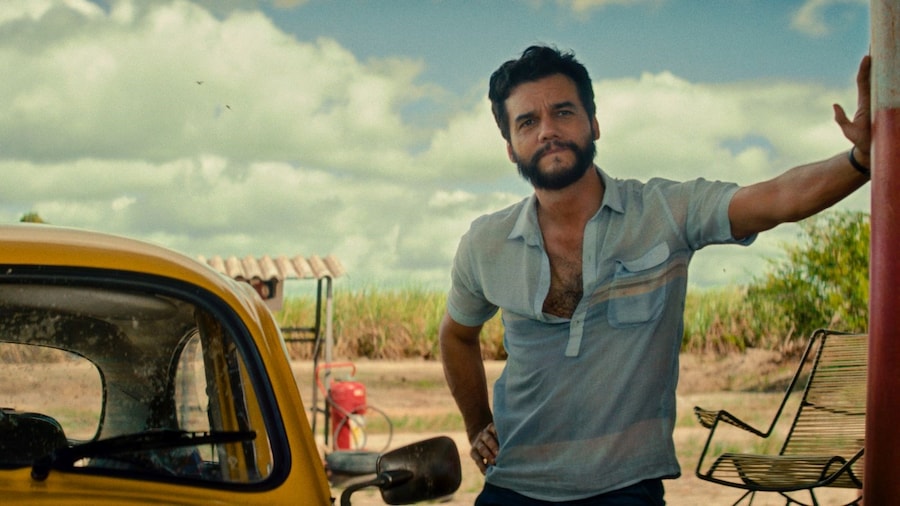
The Oscar-nominated star is outstanding as a man marked for death in The Secret Agent, a simmering political thriller about historical crimes that nods to Brazil's current flirtation with the far-right
Wagner Moura makes no bones about what in the world makes him angry. The star of The Secret Agent, and first Brazilian to be nominated for a best actor Academy award, is the face of the fury and compassion coursing through the simmering political thriller from Kleber Mendonça Filho, set amid the Brazilian military dictatorship of the 1970s.
“My temperature in life is more explosive when it’s about injustice,” Moura tells me when we sit down to talk at the London Film Festival in October, months before the Academy chose its nominees. “I’m more like fuck you, kind of thing.” In the film he plays Armando, a widowed technology expert evading persecution from corrupt officials and loathsome hitmen. In 1977, he sneaks back to Recife under the alias Marcelo to reunite with his son before fleeing the country. “[Armando] couldn’t be like that because he has his son to take care of. He’s being more stoic because he’s been suffering, he lost his wife and [has endured] so many injustices, but there is an ultimate thing that matters more than himself, which is his kid. I think that’s a very important thing.”
Before The Secret Agent, Moura was familiar playing cops, criminals and spies wedded to their specific historical and political moment. His stardom in Brazil was launched with José Padilha’s controversially badass Elite Squad films; he played Colombian drug lord Pablo Escobar for two immensely popular seasons of Netflix’s Narcos; and in Olivier Assayas’ mostly forgotten period espionage film Wasp Network, Moura played Juan Pablo Roque, a Cuban exile in Miami who worked as a spy for the Castro administration.
But with The Secret Agent, Moura is gifted his richest character yet – principled, withholding, melancholic and immensely charismatic – and his performance meets the high threshold set by Mendonça Filho’s script, which pairs 70s paranoia thriller influences with the kind of sly, charged reflections on Brazilian history and identity that also marked earlier films like Aquarius and Bacurau. Armando’s piercing stare and guarded physicality hooks us from the opening scene – a macabre, absurd interaction at a gas station on the road to Recife – and subsequent scenes with his projectionist father-in-law (Carlos Francisco), young son Fernando (Enzo Nunes), and resistance leader Elza (Maria Fernanda Cândido) tease out his wounded but resilient sense of justice.
Although Moura and Mendonça Filho had previously discussed making the film, the actor says The Secret Agent emerged from the presidency of far-right populist Jair Bolsonaro, whose administration attacked political critics, journalists and artists, including a subsequently overturned conviction against former and current president Luiz Inácio Lula da Silva. Both Moura and Mendonça Filho were affected by Bolsonaro’s anti-art policies, which led them to a story about Brazil’s historic dictatorship with one eye cautiously cast to the future.
“How [do] the values that you have go from one generation to another?” Moura asks. “I think this film is about how to stick with your values when everything around you is saying the opposite of what you think, especially when you are talking about a dictatorship or an authoritarian regime.”

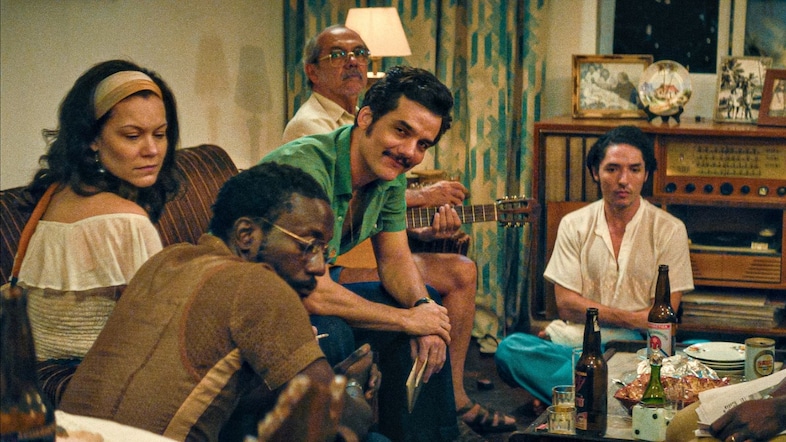
The Secret Agent mirrors the relationship between Armando and Fernando by featuring distorted sets of fathers and sons, but it also cuts to archivists in the present day who are trying to piece together the fragmented historical moment. “This is a film about memory, because Brazil is a country where we are now solving our problem with memory by making our democracy stronger,” Moura explains. “After the dictatorship, we had something called the Amnesty Law that basically forgave all the torturers and killers. So therefore Bolsonaro was a possibility because we didn’t have memories of the horrors.”
Armando is an archivist of sorts, too, as he uses his temporary job at an identification records office to search for his mother’s elusive birth certificate. “The fact that this character is looking for a document that would prove that his mom existed says so many things about social difference in Brazil. When you see Bacurau, it’s a film about an entire city that basically didn’t exist in the eyes of the Americans and rich Brazilians. There are layers there about this mother who didn’t exist, because many Brazilians don’t exist. He’s trying to find some proof.”
It’s a tough field, but no actor in the running for Oscar gold is as admiring of his director as this one – hardly a minute passes without Moura praising Mendonça Filho’s vision and attention to detail. “Kleber has this thing in his films [where] he manages to transport you to a very familiar feeling,” he says. “Although I was a kid during the dictatorship, the feeling that he creates with the costumes and the music, it made me [think], ‘Oh, man, I’ve been there.’ My father, for example, used to wear that kind of T-shirt with buttons, and he would open up his chest and put the cigarette pack in his left pocket, just the way my character does. All those cultural details informed a lot of how the character should move.”

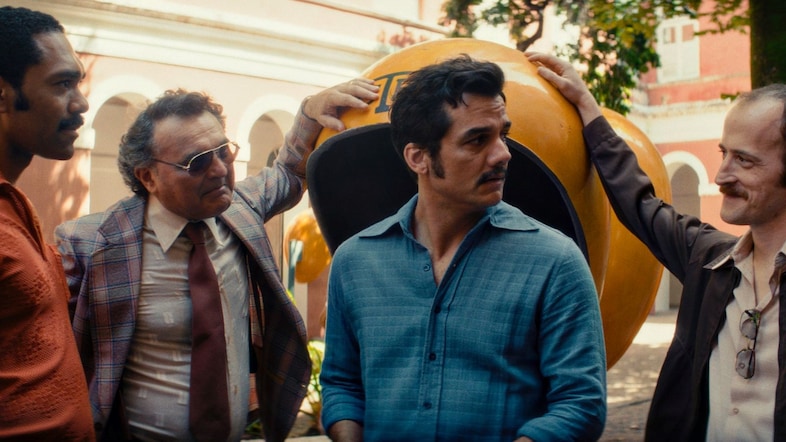
The Secret Agent is peppered with American cultural references, including a memorable screening of The Omen at one of Recife’s renowned movie palaces – a cultural institution previously honoured by Mendonça Filho in his documentary Pictures of Ghosts. These pop-culture crossovers have a political edge: “We grew up listening to American music and watching American TV and films, and that was also part of American colonialism towards South America,” says Moura. “All the coups d’etat that ended up in military dictatorships were supported by the US and the CIA. So those things were not there by chance. But there were also many Brazilian cultural references in there that I love to see, especially things related to carnival.”
Moura brings up the Brazilian carnival again in our final moments, after I ask about a scene where Armando lets his guard down in front of other Brazilians persecuted by the dictatorship. “It’s very connected to the previous scene, where he discovers that there are hitmen looking for him. He goes downstairs, and he embraces his [father]-in-law. When he opens the door, carnival is going on. He just gives himself to the carnival.”
Moura is still moved by the role the celebration plays in Armando’s internal transformation. “That’s one of my favourite scenes in the film, which is a very Brazilian thing, like, ‘Let’s think about this after carnival.’ It says a lot about life too, about all of us, because we’re going through shit and then … It’s a mix, right? We go through difficult stuff, but there’s always a place where you can laugh about yourself.”
The Secret Agent is out in UK cinemas now.
