
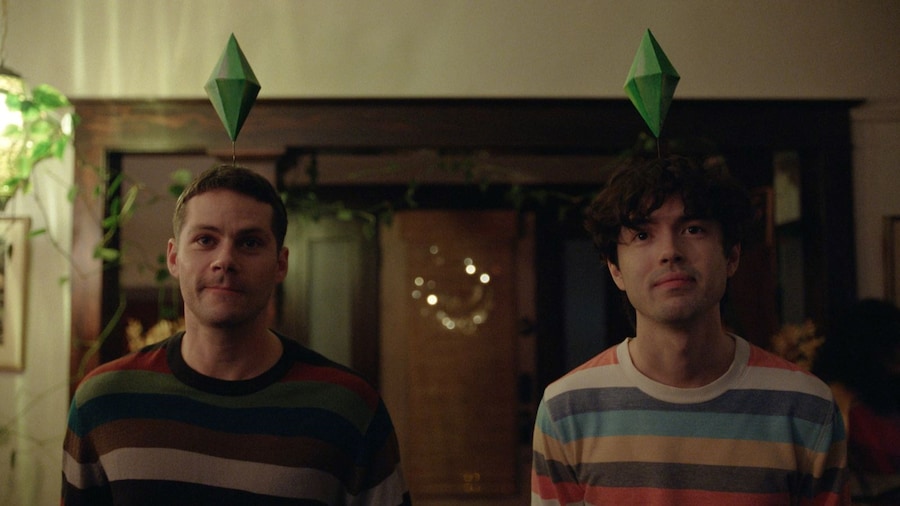
In his perfectly poised second feature, actor-director James Sweeney spins the surprising tale of a dangerous bromance between two men who connect at a twin bereavement support group
Twins have long held a fascination for filmmakers. You find them scattered across film history in every genre, from Freudian thrillers (The Dark Mirror, Dead Ringers) to goofy comedies (Big Business, Jack and Jill) to a whole host of horrors (from The Shining to Sinners). Writer-director James Sweeney is the latest filmmaker to explore this uncanny bond with his second feature, Twinless.
The film initially centres on Roman (Dylan O’Brien), a hoodie-wearing lump who often confuses his idioms (at one point, he describes himself as “not the brightest tool in the shed”). His suave, more accomplished brother, Rocky (also played by O’Brien in flashback), has recently died, and Roman attempts to process his profound grief by joining a bereavement support group for twins who’ve lost their siblings. There, he meets fellow mourner Dennis (played by Sweeney). Like Rocky, Dennis is gay and sharp-witted, and he and Roman quickly form a friendship, bordering on co-dependency. To say more might ruin some of Twinless’s twisted pleasures, but let’s just say that Dennis isn’t quite who he seems.
Growing up as a “military brat” in small-town Alaska, Sweeney always daydreamed he might have a secret twin out there. “I definitely fantasised about running into my long lost twin in a forest somewhere, thinking that would be the thing that would make my life a lot easier,” says the 35-year-old filmmaker, now based in Los Angeles. His interest in twins even extended to dating one at one point, and it was around then that he became acquainted with the idea of twin bereavement. “I do remember thinking, ‘This is the saddest thing I had ever heard’, because the idea of a twin, or I should say, my childhood fantasy of a twin, was the perfect best friend. So the idea of losing that really haunted me.”
Sweeney wrote the first draft of Twinless over a decade ago, well before he burst out of the indie scene with his 2019 debut feature, the whipsmart screwball comedy Straight Up. O’Brien became attached in 2020, and since then, he’s emerged as one of Hollywood’s most versatile young actors. At the beginning of the decade, however, he was best known as the heartthrob from Teen Wolf and the Maze Runner franchise. What gave Sweeney an inkling that he could convince as both the introverted, soulful Roman and the rakish, debonair Rocky?

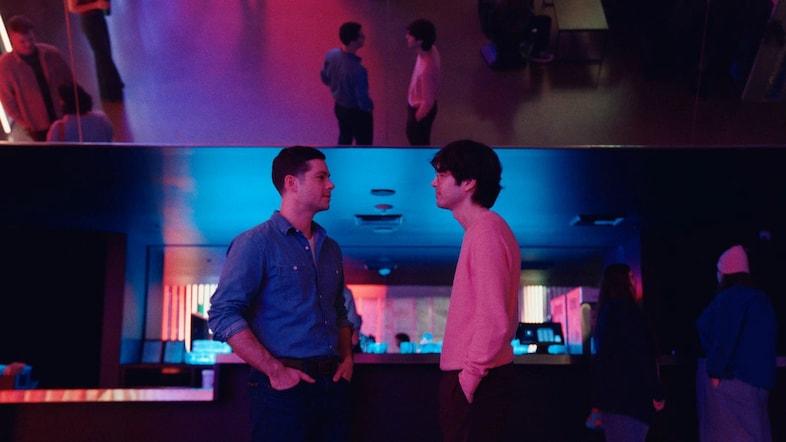
“As an actor, I know how limiting preconceived notions of what your range can be,” explains Sweeney. “So back then I thought Dylan might be someone who was hungry to show a different side of himself.” Sweeney wasn’t completely sold initially (“I actually had an easier time imagining him as Rocky rather than Roman”), but whatever doubts he had melted away at their first meeting. “As soon as we talked, I felt seen as a writer. I realised Dylan understood every emotional beat shift for both characters, and that’s kind of all you can ask for.”
Twinless is a bittersweet delight, with a sly narrative structure that regularly pulls the rug from under you. One of its chief pleasures is how deftly its mood pivots, skipping almost imperceptibly from devastating to menacing to hilarious and back again. For Sweeney, this swirling tone was essential. “To me, life is a multi-genre project, so it makes sense when you’re tackling something as layered as grief, to try to paint with multiple colours.” Sweeney’s filmmaking is also more formally daring than your average American indie director, with a strong sense of composition and style in each shot. It’s no surprise, then, when he cites Brian De Palma, modern cinema’s most bravura director, as a key influence. “My cinematographer [Greg Cotten] and I did watch Sisters a couple of weeks before pre-production started in earnest, but I use De Palma as an influence just because I’m a huge fan. He’s somebody who employed split screens and split diopters, which work well with the theme of duality, but he’s also just a master of subjectivity, which is something we try to play with in Twinless.”


In terms of performance, O’Brien’s dual turn has received the lion’s share of the film’s acting praise, but Sweeney is no slouch either. Perhaps the reason he’s been receiving less attention is that Dennis is a much harder character to like. “The whole question of likability, I struggle with it,” admits Sweeney, “because it's something I struggle with in my personal life. How much do I want to be liked? And how important is that to me?” He reckons Dennis’s questionable behaviour becomes more understandable when viewed through the lens of queer alienation. “For most queer people, historically, internalised shame has had a ripple effect on how we behave; it’s sort of inescapable. I think Dennis’s loneliness is really what drives his desperation and his snark. I know people like that, and I relate to it.”
Sweeney suggests that people’s mileage with Twinless, how much they root for Roman and Dennis’s friendship, might say more about them than the film. “I think [Twinless] is really going to hold up a mirror to people’s relationship to forgiveness,” he says. Ultimately, Sweeney’s aim was to tell a very human story, and that requires showing warts and all. “Humans are inherently flawed,” he says, “and to me, there’s something hopeful about watching flawed people make incremental progress towards figuring their shit out.”
Twinless is out in UK cinemas now.
