
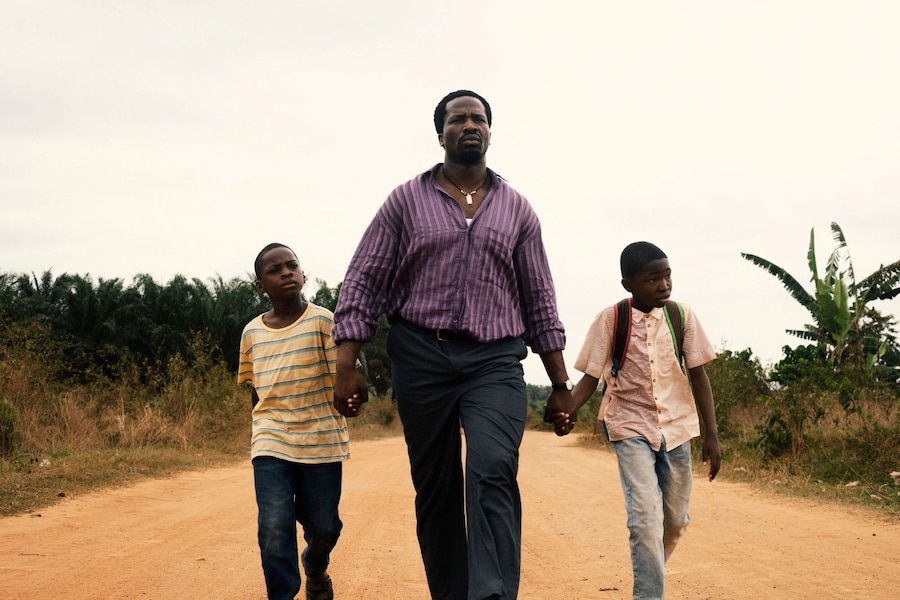
Akinola Davies Jr’s first feature is a magical portrait of two boys’ love for their father, full of tender feeling and regret
Some years ago, Akinola Davies Jr received a short story written by his brother Wale, who was then living in Nigeria and working as a screenwriter for TV. The result of a writing exercise, Wale Davies’s story was titled My Father’s Shadow. “He sent it to me, really unprompted,” Davies Jr remembers. “I cried, as you can imagine, because our father passed when we were really young. I would have been 20 months and I think he would have been about three years old.” That story would become Davies Jr’s Bafta-nominated debut feature My Father’s Shadow, a magical portrait of two young brothers enjoying a rare day out in Lagos with their beloved, enigmatic father, told from the boys’ perspective.
The initial story had some of the elements of the Cannes prize-winning film they would eventually make (Wale Davies served as executive producer as well as co-writer). These involved scenes of the brothers playing, and a vivid, fever-dream sequence set on the beach. “I tend to think in pictures, I’m not the best reader,” Davies Jr says. “Maybe that’s just a cop-out, but if I don’t get pictures when I’m reading something, I probably don’t persist with reading it. I think what I really enjoyed from my brother’s writing was that I could see it straight away.”


Nodding to films like Bicycle Thieves, Shoplifters and Mandabi, My Father’s Shadow begins with brothers Remi and Aki (newcomers and real-life brothers Chibuike Marvellous Egbo and Godwin Egbo) playing outside their otherwise empty rural home. There’s a rustle in the trees surrounding the house, a shift in the atmospheric pressure: the brothers go inside to find their father Folarin, ordinarily absent, suddenly home. Their mother is out and Folarin (Sope Dirisu) needs to head back into Lagos. After the boys complain that they never see him, Folarin agrees to take the boys into the city with him as he attempts to collect some unpaid wages. It is over the course of this single day in Nigeria’s largest city, set during the election crisis in 1993 when the results were abruptly annulled by the country’s military leader, that the boys get to see their father outside the family context, as a man at large in his metropolitan world.
“A lot of our understanding of who our father was is constructed from external people, our mother being one,” says Davies Jr of the film’s semi-biographical elements. “Whenever we would go out into Lagos growing up between those ages we would meet people who knew our father, and we’d get a reverberation or a story back of who he was.” Similarly, Remi and Aki build a new picture of their father through his interactions with colleagues, friends and a mysterious waitress. “Your parents, outside of the structure of a family relationship – they’re complete people, and they have friends and nicknames,” he says, of the moment we realise that our parents are individuals in their own right, with flaws as well as strengths. “They have all these things maybe you’re not cognisant of, but the more you spend time with them, you start to pick up.”
The brothers filmed on location in Lagos, shooting parts of the city still intact from that period, staging others and using archive footage, too. Beyond its historic sources, certain, specific memories informed the film’s hypnotic mix of texture and tension. “The film is also rooted in a memory me and my brother have, of us playing on a bed with our dad,” Davies Jr says. “Now, we don’t know if it was fabricated. We don’t know if our mum told us or we picked it up from our other siblings, but what matters is that we feel like we have it, and that’s how we wanted the film to be.”

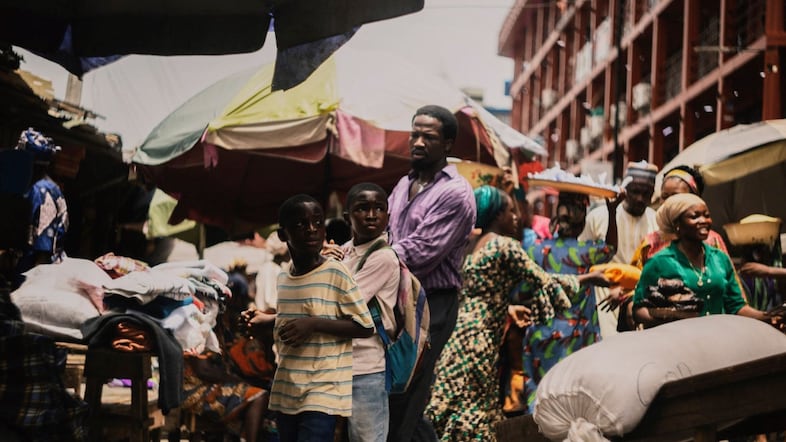
Another significant memory Davies Jr has is of the day the election results were annulled. He remembers being pulled out of school in Lagos, and “the way that day spiralled out of control”. In the film, talk about the election, and rumours of a horrifying event at a military base known as Bonny Camp, trail the trio as they navigate their day. But being children, the boys are more interested in enjoying their father’s company, buying ice-cream, and coming to terms with Folarin’s role as breadwinner and why it necessitates his absence from home. A long, mesmeric scene on the beach leads to an understanding between father and sons, before the clock draws them back into the push-and-pull of the day.
A meeting of innocence and experience, My Father’s Shadow is less a coming-of-age than a coming-to-terms, specifically with the ideas we have about our parents. Watching the film, “I was like, damn, I wish I had this,” Davies Jr says. “I really wish this was something I had. But equally, I live it through the film.” The film’s beauty emerges from the sense of it being a cherished memory, constructed out of the remnants of the past and a yearning for what might have been. Indeed, when Folarin appears at the film’s start, it’s almost like a visitation, while elements of the natural world seem to vibrate with possibility.
“There’s wind, there’s water, there’s insects, there’s animals, there’s birds, there’s so much in the periphery, and that’s us trying to honour nature,” Davies continues. “That allows us to do this kind of woven thing with what the story is – how Folarin arrives in the film, how he leaves.” More subtle than merely magical, he says, “If you are more attuned to a certain type of frequency, there is a lot of spirituality within that.”
My Father’s Shadow is out in UK cinemas now.
