
As Nouvelle Vague is released, Richard Linklater talks about his homage to the making of Jean-Luc Godard’s Breathless, and why making it was more emotional than expected
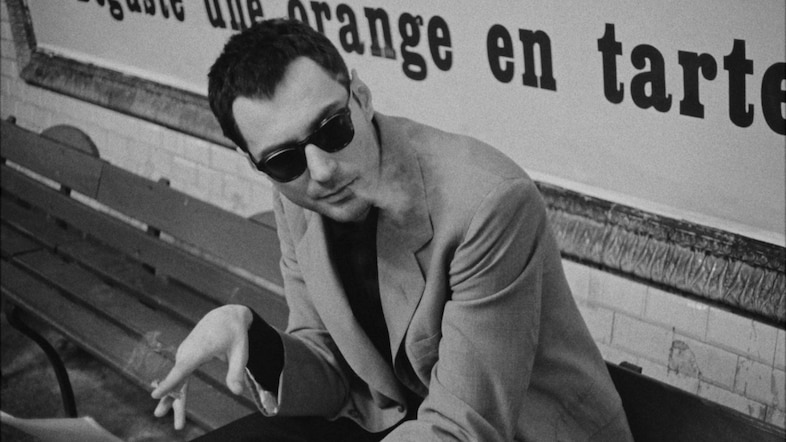
Early in Nouvelle Vague, Richard Linklater’s breezy, black-and-white homage to the making of Breathless, there’s a shot of François Truffaut’s The 400 Blows reflecting in the sunglasses of Jean-Luc Godard – a man who famously (almost) never removed his prescription specs, even in the cinema. His mates Claude Chabrol, Éric Rohmer and Truffaut have all had their chance to direct, and now Godard is champing at the bit. “This film is really about a community,” explains Linklater when we speak over Zoom. “It’s not just the making of one film.”
The result of this revisit to 1959 – the script co-written by Linklater’s long-term collaborators Holly Gent and Vincent Palmo – is meticulously researched, unapologetic fanfic about a radical, francophone and deeply cool coterie of filmmakers. Over the course of six months, Linklater and casting director Stéphane Batut scoured for uncanny likenesses for the time’s movers and shakers, including everyone from Roberto Rossellini to Agnès Varda, who are each introduced with a title card. A swaggering Aubry Dullin was discovered for the role of Breathless lead Jean-Paul Belmondo, while the abrasive first-time filmmaker is played by a haughty Guillaume Marbeck.
Resurrecting the Cahiers du Cinéma crowd made “not just me, my whole crew [cry],” says Linklater. “My script supervisor was like, ‘Why is this so emotional?’ Even the Cahiers du Cinéma people who visited that day [cried] ... They’ve moved around a lot, but the office we were recreating from that time period, they know it.” Of those who appear, only The 400 Blows’s child star, Jean-Pierre Léaud, and Godard’s assistant editor (“in an old folks home – my script supervisor went and interviewed her”) are still alive.
As an American, the Before Sunrise writer-director was initially wary of taking on the revered French filmmaker as a subject. Godard, who died in 2022, also loathed the Louis Garrel-helmed biopic about him, Redoubtable. “People ask me, ‘What would Godard think, or any of them think?’” explains Linklater. “I would say, how could they watch this and not have a little smile on their face? It’s a great moment, not only in cinema history, but their lives … It was fun to go back before the pettiness of a long life and the accumulation of slights and hurts.”

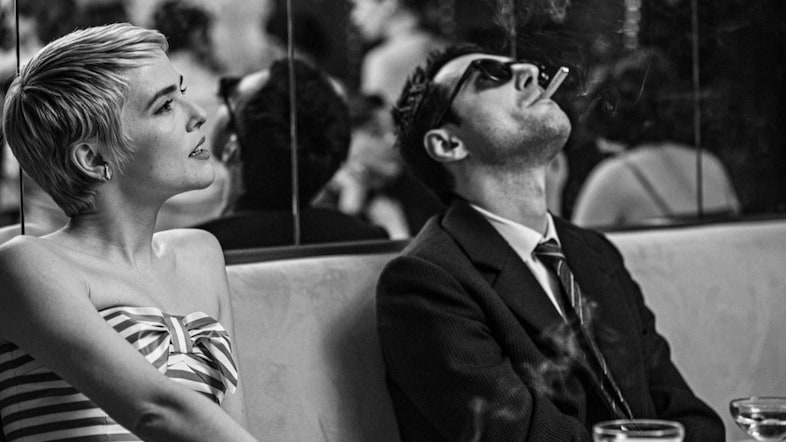
Shot in a brisk 30 days almost entirely with equipment dating back to 1959 (the camera used to film Breathless even cameos), Nouvelle Vague channels the charming insouciance of the period, from marinière to chic cafes to curling cigarette smoke, while taking stylistic cues from Jacques Rozier and Truffaut. The result is a cinematic time portal. “This film is specifically not very Godardian,” insists Linklater. “I’ve read where people say, ‘Oh, he does jump cuts’. I don’t do jump cuts … They’re annoying and they don’t really work, except in Breathless.”
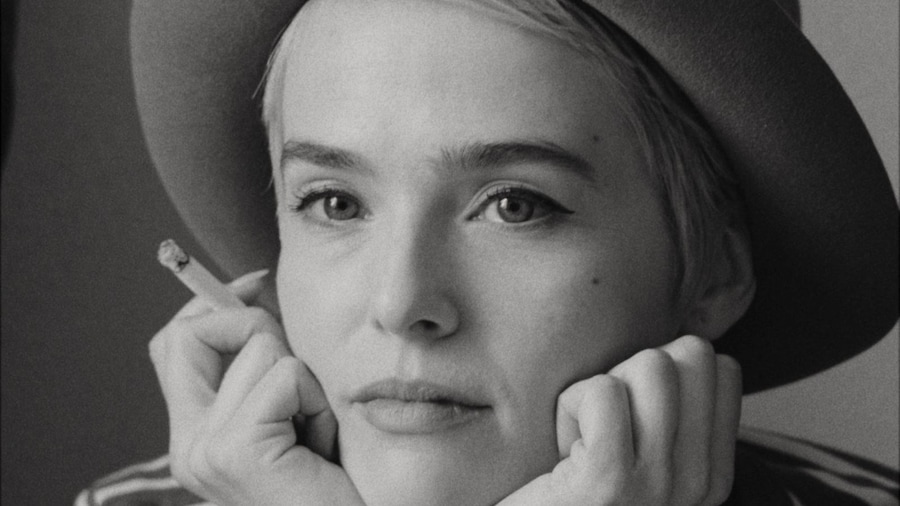
Zoey Deutch was cast as Jean Seberg back when Linklater worked with her in 2015 on Everybody Wants Some!!. “It was pretty analogous dropping her into a film with a bunch of unknown young French actors,” says Linklater. Deutch only needed a blonde pixie cut. But here, he adds, “the difference is that she wasn’t alienated from the process.”
Tensions simmer between Godard and Seberg, as the American star becomes increasingly exasperated with his laissez-faire approach. Despite being known for laid-back ‘hangout’ movies like Dazed and Confused and Slacker, Linklater’s own process involves extensive preparation and planning (the entire Nouvelle Vague cast rehearsed for several weeks in English). So, he could relate to Seberg’s frustration: “I appreciate Godard almost on an anthropological level, how different his cinematic brain is … Godard is not going for realism of any kind. His characters are mouthpieces for him. They’re not typical humans. They don’t have pasts or futures. They’re very in the moment.

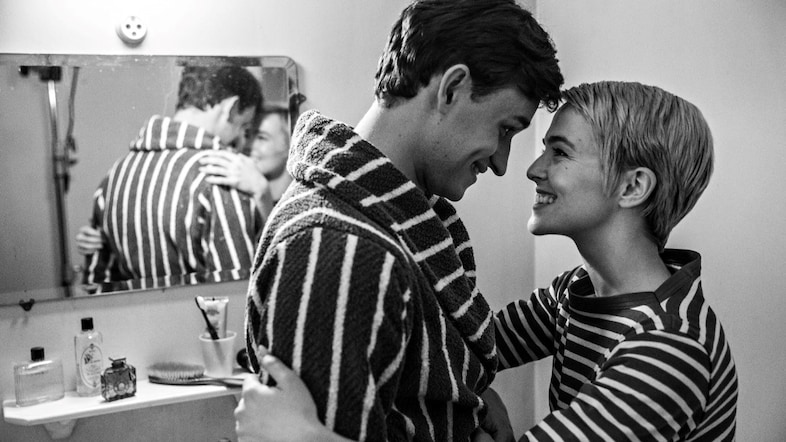
“The reason I think he’s a good subject for a film is because he’s just so damn different. I see Breathless as even more of a miracle as a film, the more I got into it, reading camera reports, knowing what they shot in one day, how many takes they did. I give Belmondo and Seberg a lot of the credit.”
Despite those troubles on set, Linklater’s drama has a real sense of joie de vivre. Godard is on the cusp of an illustrious career ahead and a revolutionary chapter in film history. Making Nouvelle Vague was like returning to his 28-year-old self, says Linklater. “It sounds weird to say you relate to Godard, because he makes himself unrelatable, largely. But I could completely relate to his situation making a first-time film. You’re excited, enthusiastic, but you’re also sitting on a bedrock of insecurity. You find yourself trying to explain your unexplainable film to the people you’re working with. A lot of directors are pretty insular, kind of neurodivergent weirdos, and it’s hard to communicate with a big crew and people who are asking you a lot of questions.”
Linklater says he hopes the film will inspire the next generation of budding filmmakers, but – having previously expressed concerns about tech spelling disaster for indie filmmaking – what are his thoughts now on the future of cinema? “There’s some notion of purity with cinema,” he says. “I don’t think it was ever pure … The Lumiere brothers were engineer-type guys. So I’m not so doomy about technology.” If Godard were still making films today, Linklater suspects it may be another part of his toolbox: “I just want technology to be our friend. We don’t want to be its subject.”

Off the back of shooting Nouvelle Vague – a biopic about a career’s beginnings – in spring 2024, Linklater was set to direct the Lorenz Hart biopic – about its end. The two films became unintentional companion pieces. “Ethan [Hawke] asked me, ‘Are you tired? Are you going to be okay?’” recalls Linklater. “And I’m like, ‘Man, I feel great after Nouvelle Vague, in fact, I feel energised. And then Blue Moon was the killer. It was tough subject matter. If Lorenz Hart’s the end and Jean-Luc Godard’s the beginning, I’m glad I went in the correct order.”
Nouvelle Vague is out in UK cinemas now.
