
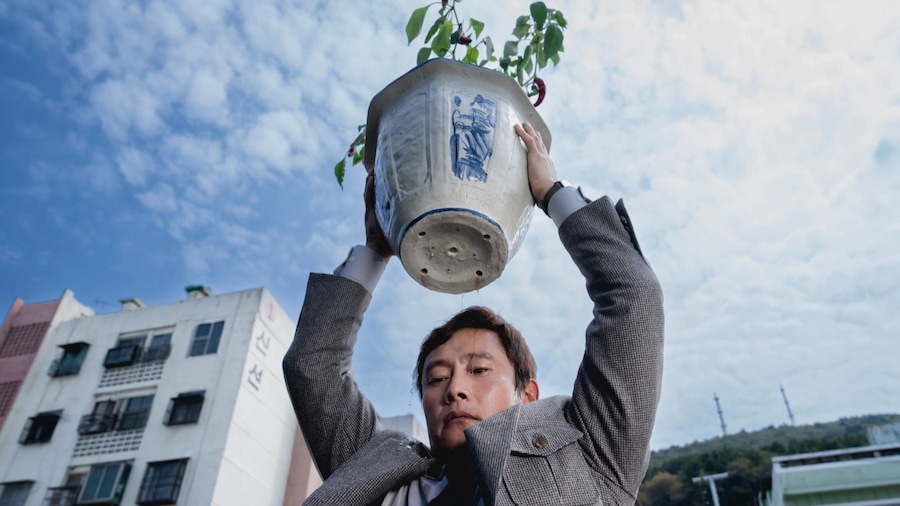
The South Korean auteur Park Chan-wook and Lee Byung-hun, the lead actor in No Other Choice, sit down with AnOther to discuss the making of a melodramatic masterpiece
There’s a show-stopping scene in No Other Choice – Park Chan-wook’s sensational new black comedy about a laid-off paper-mill veteran who goes to desperate lengths to secure a new job – that has lived rent-free in my head since its screening at the BFI London Film Festival in October of last year.
At the narrative midpoint, pathetic protagonist Yoo Man-su (Lee Byung-hun) – also a hobbying horticulturist with a bonsai mag subscription – arrives at the home of a man he deems a rival for one of the only paper jobs on the market. He wields a pistol concealed inside several oven gloves, intending to kill vinyl enthusiast Goo Beom-mo (Lee Sung-min) as a means of levelling the playing field. But at the crucial moment, he’s rendered impotent by his own absurd ploy; succumbing to a sudden empathy for his double, having discovered that Beom-mo’s wife is cheating on him.
Beom-mo’s himself is slumped in a helpless, drunken stupor in the midst of this farce, and has incorrectly identified Man-su as his wife’s lover. He crumbles as he questions whether her infidelity is the result of his own failure to secure a new paper-mill job. The scene erupts into a melodramatic spectacle – as two anguished men cry and shout about their bad backs and expert credentials until wayward wife Lee A-ra (Yeom Hye-ran) drops a line that encapsulates the film to a tee: “Losing your job is not the problem,” she yells. “The problem is how you deal with it!”
It’s a film that director Park has been longing to make for some time, having first read Donald E Westlake’s 1997 horror-thriller novel The Ax two decades ago. “I’ve been telling friends about this for all those years,” he tells AnOther, suited and composed in a London hotel on the morning of the film’s UK premiere at the Royal Festival Hall. “Regardless of where they’re from, or what year it was, they would always say it was very timely subject matter – which was why I always had the confidence in it.”
With an ever-dwindling global job market a permanent fixture during times of AI displacement and corporate consolidation, the story certainly rings true in 2026. But by painting the tale as a black comedy, “you can make it bitter and depressing but audiences can also laugh along,” quips lead actor Lee Byung-hun, sat beside the director in a loose-fit hoodie.
One element that amplifies this quality in the aforementioned scene is Park’s bombastic choice of music, which has surely got to go down as one of the needle-drops of the year. Whereas cuts by the likes of Sam & Dave and Sanullim singer Kim Chang-wan skilfully colour the film elsewhere, the volume-boosted use of Cho Yong-pil’s overblown prog-rock epic Redpepper Dragonfly during Man-su and Beom-mo’s confrontation magnificently elevates the scene into the realm of preposterous melodrama.

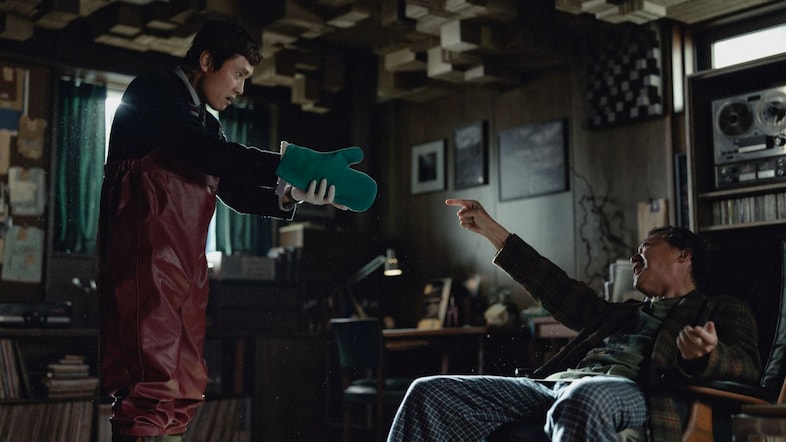
“It had to be an undeniably good song,” says Park of the cue. “But it also could not go well with the scene.” To the Korean public, the director explains, Cho Yong-pil’s fame is on par with The Beatles – “he’s a musical hero to me”. With that analogy in mind, No Other Choice’s centrepiece moment is almost akin to watching a duel set to Octopus’s Garden. “The song is so different to what’s going on visually, there’s an absurd irony to it,” Park continues. “It’s a sentimental song, and when you pair it with the violent chaos going on, it had the effect I was looking for.”
Indeed, every detail in No Other Choice makes it feel like a directorial masterclass – from the rich, rural setting and autumnal colours to the superimposed shots, dissolve transitions and ambitious camera angles (beer-tankard-vision, anyone?). But it can’t be denied how much Lee brings to the film in the lead role. Though probably best recognised today as one of the main antagonists of Squid Game, Lee previously turned heads in the west for his roles as a mob enforcer in A Bittersweet Life, and as a serial-killer-hunting cop in I Saw the Devil. His role in No Other Choice defies any pre-ordained expectations.
As sacked-off paper worker and pig farmer’s son, Man-su, Lee plays a man coloured by nods to his faltering masculinity – from shaky-kneed job interviews and group therapy sessions to persistent toothache. He’s introduced in the opening scene proudly grilling eel (a supposed aphrodisiac) in a Hawaiian shirt and shorts. He’s your classic cringey dad, sporting one of the most magnificently lame moustaches put to screen in recent years. It all serves to highlight just how limp his LinkedIn larping really is.


“We had two different references [for this look],” says Lee. “One was Mads Mikkelsen. But when we did costume testing, we chose the one like Steve McQueen, with the curly hair closely stuck to the head and the moustache. It’s a very rare appearance to see in Korea,” he continues. “With the Hawaiian shirt on top, I wondered if I looked like some kind of drug lord.” Needless to say, Man-su does not.
The role was a challenge for Lee, who previously collaborated with Park on his 2000 breakthrough, Joint Security Area – about North and South Korean soldiers who form an unlikely friendship – and on the 2004 horror short Cut. “Man-su is an ordinary family man who gets fired, and makes an extreme decision to try and find employment again,” he says. “[The confrontation scene with Gu] was the biggest hurdle, because the audience would initially empathise with Man-su, but then wish they hadn’t as he decides to act … It was challenging to perform this in a way that could be convincing for the audience.”
Lee’s triumphant performance landed him a Golden Globe nomination for Best Actor, with the widespread praise echoed by his director. “He’s become a better actor as he’s gained deeper insight into mankind and society,” says Park. “In our industry, you think about certain reactions to certain situations – but he always tries to break out of these cliches with the reactions he comes up with.”


The actor is similarly full of praise for his director. “He’s even sharper and more clear,” says Lee of working with Park a third time around, “whether it’s with the lighting department or the camera angles, the props or with the actors. He’s detailed in his vision for what he wants to do. And as an actor working on this project, I am constantly surprised and discovering new things in it. He’s holding so many things in his mind. It constantly astounds me.”
With Park himself now tipped for nods at the Baftas and the Oscars after the film already competed for the top prize at Venice in September, the two men are poised for a big awards season ahead. “It would be a mark of honour for me,” says Park, when plied with the question of Academy recognition. His lead actor, meanwhile, takes a page out of the book of the axed paper-mill veteran of the movie itself. “If we’re up for the Oscars,” says Lee, “I’ll gladly take a look – at the list of competitors that we might be eliminating.”
No Other Choice is out in UK cinemas from 23 January.
