 2025)

As his new exhibition opens at Somerset House, the revolutionary choreographer talks about AI, and why he wants people to experience the emotional and spatial possibilities of their own bodies
Wayne McGregor is a revolutionary force within contemporary dance. The Royal Ballet’s resident choreographer challenges the conventional limits of the body, working across three decades with pioneering technology and in collaboration with kindred innovators from parallel fields, such as Max Richter and Gareth Pugh. Infinite Bodies, his expansive exhibition at Somerset House in London, includes experimental installations that play with sound, light and artificial intelligence. The show invites visitors into interactive moments, experiencing the emotional and spatial possibilities of their own bodies.
Throughout this and his nearby 360-degree virtual performance On the Other Earth at Stone Nest, McGregor frequently reaches towards alternate realms, from the digital to the ethereal and galactic. “Our internal life is both fantastical and literal,” he tells me, considering the duality of the everyday, in which we can simultaneously hold together ongoing practicalities and vast imagination. “This is a great capability of human beings, that we have different ways of experiencing and touching the world.”

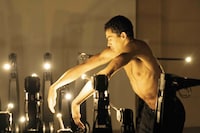
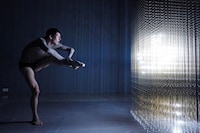
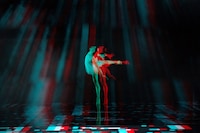

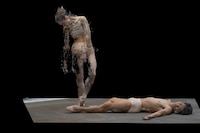
It has been a busy year for McGregor, who recently returned from Venice, where he is artistic director of the dance department for La Biennale di Venezia. His latest visit was for Coro, a live performance at the historic Teatro La Fenice, which blends contemporary dance choreography with Luciano Berio’s sprawling 1974 choral masterpiece. He is also preparing for the celebrated Woolf Works to return to the Royal Ballet in January, fusing the writing of Virginia Woolf with an original score by Richter.
Since taking the role at the Royal Ballet in 2006, McGregor has pushed back against the conventions of traditional performance. He famously avoids singular focus on overly literal aspects such as character and story. “These things are very concrete and absolute. Our physical existence is not like that; it’s messy, creaturelike and other.” Numerous pieces at Somerset House invite an intuitive or collaborative relationship between the body and technology. In Future Self (2012), for example, an installation by Random International comprised of 10,000 LED lights responds to visitors’ bodies as they pass by. AISOMA (2025) invites participants to dance in front of a screen, their movements interpreted and built upon by an AI-powered tool trained on McGregor’s archive.
Within these pieces, visitors become more than spectators. He describes the AI tools and machines in the show as “boundary objects”, which can free up instinctive movement. “These have been my experiments in physical thinking or physical intelligence for 20 years,” he tells me. “But they’ve been invisible perhaps to the theatre audience who would go and see one of my shows. For me, one of the great honours of having this exhibition at Somerset House was being able to bring that thinking together.”

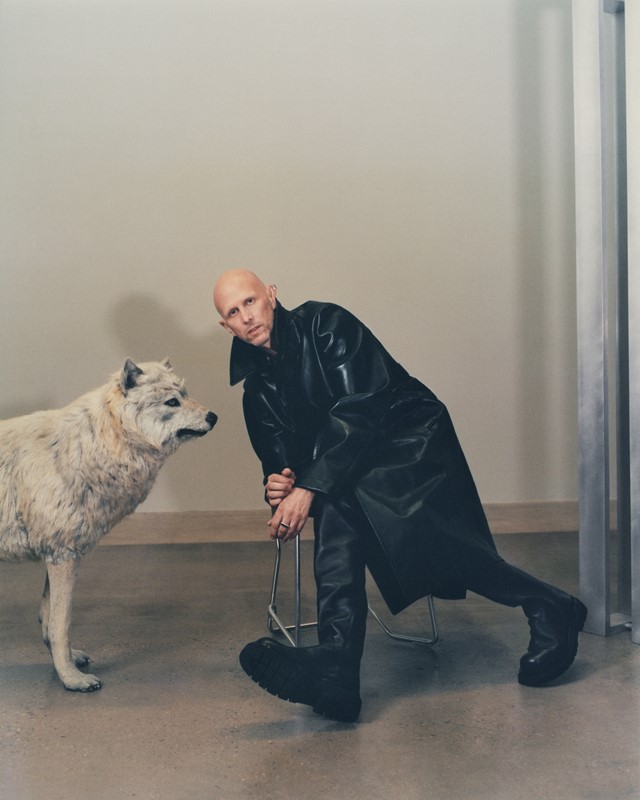
McGregor levels out the senses, taking the primary focus away from the visual to create a fully embodied experience using sound and immersive design. “We’re walking heads,” he jokes. “But the influence of the acoustic image when we’re walking down the street is as important as the visual; we’re just not attending to it. By shifting your attention to the acoustic image, the sensation in your body is recalibrated. That in itself is magical, your ability to shift attention through different dimensions of experience.”
On the Other Earth has this effect. It lasts for almost an hour, with the audience surrounded by a circular screen. They are free to wander about as three-dimensional dancers and cosmic shapes jump out, float overhead and sometimes cut through their physical bodies. McGregor is keen for this work to create a sense of presence. “We’ve been working for a long time to get a digital body to feel as much as possible like it has an intimate kinesthetic empathy to it,” he says. “Like the experience I have in the studio when I see the dancers so close, see their toes gripped to the floor, the expression on their face, and the sweat.”
While technology and AI are often blamed for taking us out of embodied reality, McGregor is optimistic that these tools can reconnect us with our physicality. He sees the last decade as having “miniaturised” the world, with flat, two-dimensional images viewed on small screens. His hope is that tech will become more environmental, immersive and haptic. “The screen is going to be everywhere, which will demand that we respond in different ways. I really do believe that technology and AI will help us expand back to full presence.”
 with No One is an Island (2021))
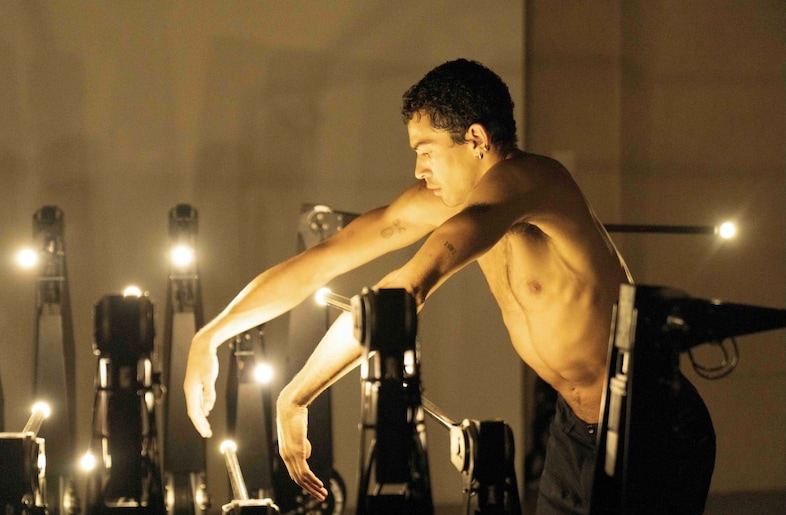
He is one of several highly successful creatives encouraging artistic use of AI, rather than writing it off. “In many ways I am AI optimistic, but with healthy scepticism,” he considers. “It is important to sort out artistic rights and generative AI, which I’m not as involved with; issues like replacing actors with AI. But that’s also not the whole of AI … What can it do that I can’t? I’m not worried that’s going to stop me because only I, with this somatic system that thinks in real time in a complex way, can make the decisions I make. So I think of AI as being slightly outside of myself, giving other possibilities that will inform what I do. That’s exciting.”
Never one to rest on his laurels, McGregor is now eyeing up the possibilities of quantum science, starting a research residency at Oxford in the new year. He is intrigued by the idea of interoception and exploring how our emotions shape behaviour. “I think our interoceptive or chemical self would be really interesting to look at from a quantum point of view,” he tells me. “I’ve just got an instinct that the meeting point of quantum, chemistry and interoception is really interesting. I’m going to spend time meeting people in Oxford who are doing brilliant things!”
Infinite Bodies by Wayne McGregor is on show at Somerset House and Wayne McGregor: On The Other Earth is showing at Stone Nest in London until 22 February 2026.
