
The Bafta-winning star reflects on her role in Ronan Day-Lewis’s darkly poetic debut, her boundary-pushing career, and the film industry’s pushback against post-#MeToo change
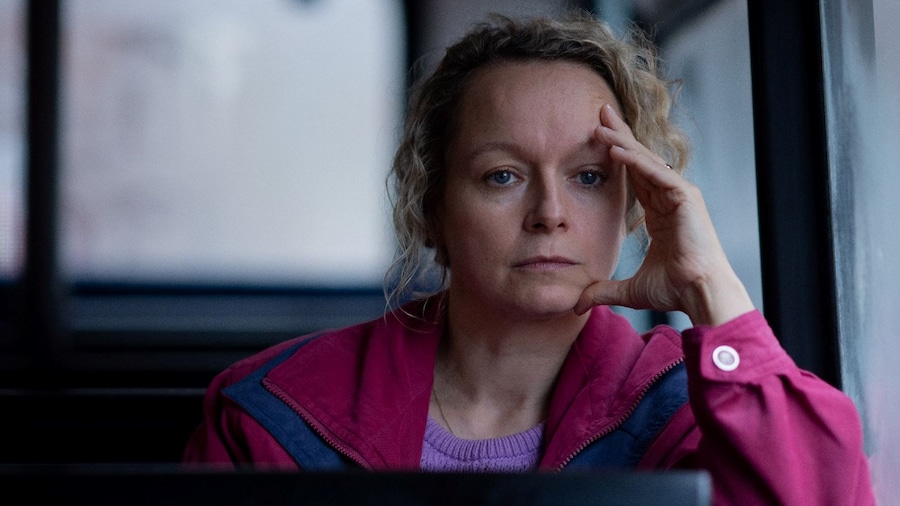
On film and in real life, Nessa is a character Samantha Morton knows inside out: a military wife she plays with a brooding, crackling energy in Ronan Day-Lewis’s debut feature Anemone. Her earlier role in Oren Moverman’s The Messenger – as a young mother informed that her husband has died in action – was one which resonated with her deeply, since her stepfather and brother were also in the army. “But,” says Morton, “this was different because it’s British, and these were things that I had a 100% absolute direct relationship with.”
Morton envisions Anemone as “a beautiful poem about subject matter that is incredibly heavy”. That thematic territory spans abuse in the church, 1980s English and Irish military history, PTSD and homelessness. Morton excels as Nessa, an emergency services operator estranged for 20 years from her husband Ray Stoker (a gut-punching comeback performance from Day-Lewis’s father, Daniel). After suffering a trauma, Ray has retreated into the wilds of northern England, abandoning his wife and son, Brian (Samuel Bottomley). Without his father, Brian is struggling, and so his uncle (Sean Bean) is sent to coax Ray out of the woods. There is an apt parallel in Day-Lewis junior enticing his father back to the screen, following his claims that he would quit acting in 2017.
Co-written by the three-time Oscar winner and his son, it’s a father-child drama in more than one sense. On screen, paternal absence is portrayed like a psychic gash, while the off-screen dynamic between the real father and son is almost palpable through the lens. For Morton, who has also worked with her daughter (Esmé Creed-Miles on Mister Lonely), family relationships on-set are “a bonus, because you have a shorthand way of communicating, full of love and kindness, and that’s what we all want at work. We want kind people to not shout at us and be bullies.”
Day-Lewis Jr enlisted Morton after seeing her magnetic turn in Lynne Ramsay’s murky and mesmerising odyssey Morvern Callar, as a supermarket worker who discovers her boyfriend has died by suicide, using his credit card to swap rural Scotland for Spain. Conversely, Morton was drawn to Day-Lewis’s background as an artist: “I love his paintings, so I was really excited to see visually what he might do as a filmmaker.” Sure enough, Anemone leans into the arresting landscapes of a constellation of UK shooting locations, seasoning its gritty drama with aesthetically striking magic realist touches, such as fatally large hailstones plummeting from the sky.
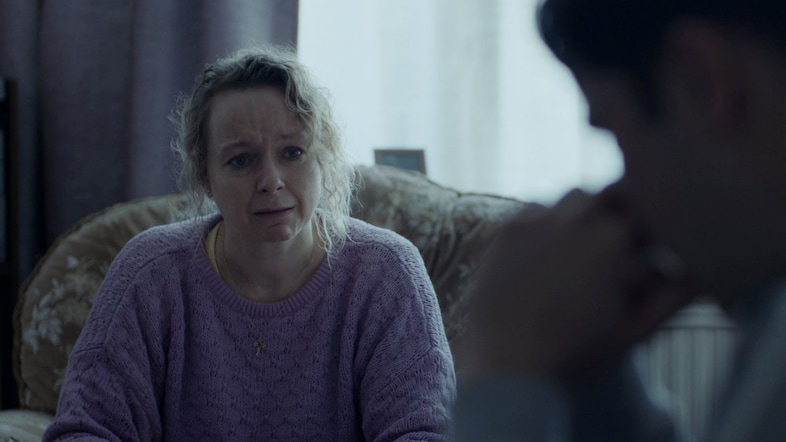
Morton proved herself a maverick at navigating minimal dialogue in the likes of Minority Report and Sweet and Lowdown, but Day-Lewis’s film pushes this to the extreme. She shoulders the thunderous emotion of Nessa in gestures as slight as eating a bag of crisps, or standing listlessly in the kitchen of her suburban home. In turn, she and the director took a less-is-more approach to discovering her character. “Sometimes there are actors that need a lot of conversation,” says Morton. “I find that it becomes like noise. I always like to do a take and then [for] a director to say if they’re happy. It’s like cooking. You’ve got your stock, then a director can add or take away.”

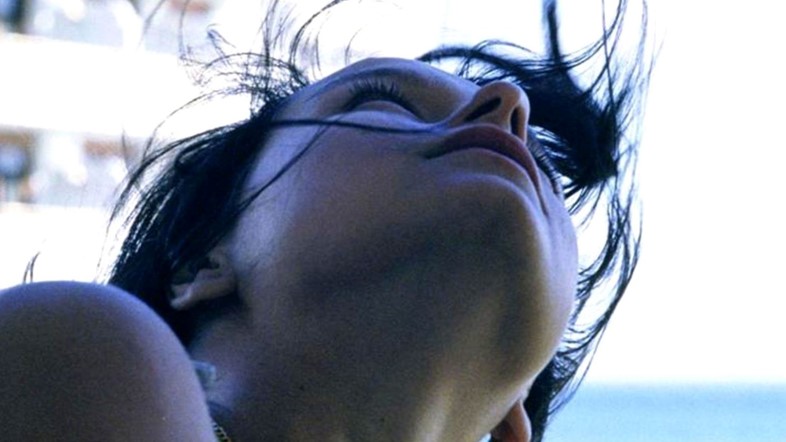
Playing knotty, often uncompromising women – nearly always outliers in society – has been the bedrock of Morton’s acting career, earning her a host of awards and a 2024 Bafta fellowship. But before her enigmatic role as Morvern Callar, there was Iris in Carine Adler’s Under the Skin, another character making unpredictable decisions also propelled by grief. Shot in the 1990s, it became an ur-text for the messiness of female sexuality, capturing Iris’s masturbation and liaisons on her own terms. “I didn’t appreciate at the time how radical and militant that was,” says Morton. “You’ve got a female writer, director, female producer; it was just unheard of then.” Unlike Lars von Trier’s Breaking the Waves, which Morton says is an ostensibly similar release – following a new bride’s non-monogamous sexual awakening – “I would rather be in a film where a female is telling her story.”
An Emmy-nominated turn in Tom Hooper’s Longford (2006) followed, for which she grappled with the part of the “Moors Murderer” Myra Hindley. She turned down the role multiple times, but “it wouldn’t go away”. Eventually, the story appealed as an indictment of the way female criminals are reviled by the press, as opposed to men. “[Men] are a bit like Chumbawamba – fall back down, we’ll get you up again,” says Morton. “When women fall, it’s like, ‘Yeah, you stay down there.’”
Raised on a cinematic diet of Merchant Ivory films and Luchino Visconti, Morton constantly finds herself “hungry” for the kind of cinema that better represents the “people I know and love”. This has been epitomised by her struggle to get the second instalment in her trilogy on the UK’s care system, The Unloved, greenlit. (The first won a Bafta after its premiere in 2009.) “We have a lot of men making decisions about who can and cannot make films,” she explains of the hold-up at Channel 4. “Those institutions that are publicly funded to nurture female filmmakers [should] not just talk about it. I won the Bafta for my first film. If I can’t get through the door …?”

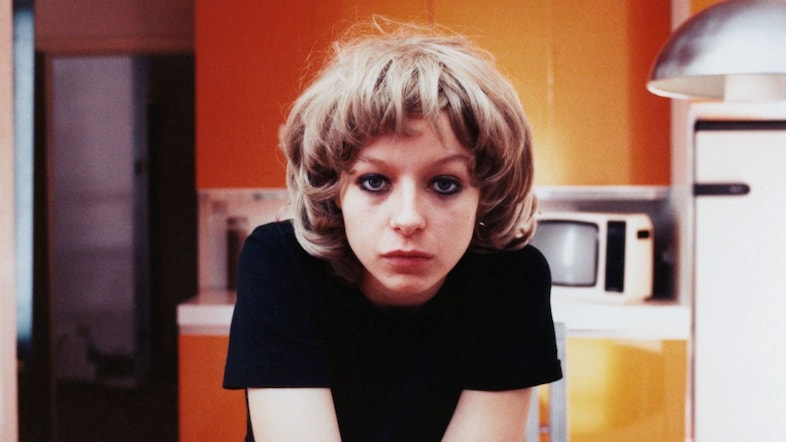
It’s one of several of the industry’s problems Morton speaks passionately and incisively about. She is outspoken about the dire treatment she experienced aged 17 on the set of Band of Gold from male producers and crew, where she constantly felt “shellshocked, actually, because [I might have] done a rape scene that day, or [been] forced to do nudity”.
Her last film, She Said, chronicled the New York Times’ reporting on Miramax boss Harvey Weinstein’s crimes; eight years after the #MeToo scandal broke, abuse continues by “many very powerful people that are still working to this day”, says Morton. “I’ve seen it change, then I’ve seen it roll back again.” And the industry’s flimsy response to the crisis in Gaza shows “we are living in times that are so deeply affected with evil”. Back in 2009, she called for a boycott of the BBC when they refused to air a Disasters Emergency Committee appeal for Gaza – “when the BBC has no qualms about advertising Twitter, Facebook and TikTok every day on their newsfeed – free advertising for these multi-billion dollar corporations”.
Alongside activism for the likes of NSPCC, does acting offer a vent? “I get headaches, lots of lines to learn, lots of early mornings, very quick lunch breaks. It’s really stressful, but it’s what I can do. I don’t know if any of it’s cathartic, it’s probably more triggering,” she chuckles. Instead, she seeks solace in religion and music. “Before [I did] Under the Skin, I gave up acting, moved to Bali and started writing poetry,” Morton recalls. “I got really into Zen Buddhism, and I learned how to self-care. I was raised a Catholic, so I know about deep prayer and saying the rosary and finding comfort in my relationship with Jesus Christ, which isn’t cool to talk about, but it was incredibly restorative.”

In the pipeline is what is already set to be one of next year’s biggest releases, Christopher Nolan’s The Odyssey. Morton is also one half of the synth-pop group Sam Morton, along with XL Recordings’ Richard Russell, and a film is underway to accompany her latest album Daffodils and Dirt. “It honestly felt like something lifted when I made the music, because I’ve never done anything [so] personal,” Morton reflects. “It’s just completely as if I’ve coughed up my soul and I’m really proud of it. Like Trivial Pursuit, it’s a little bit of pie for you.”
In the meantime, she hopes that smaller, independent films like Anemone – crucial for the representation of ordinary people – aren’t crowded out by blockbusters. “Art sometimes needs to look within,” she says. “Multiplexes are filled with films written by committees and algorithms, and soon to be starring AI actors. [But] we’ve always needed to tell our stories.”
Anemone is out in UK cinemas now.
