
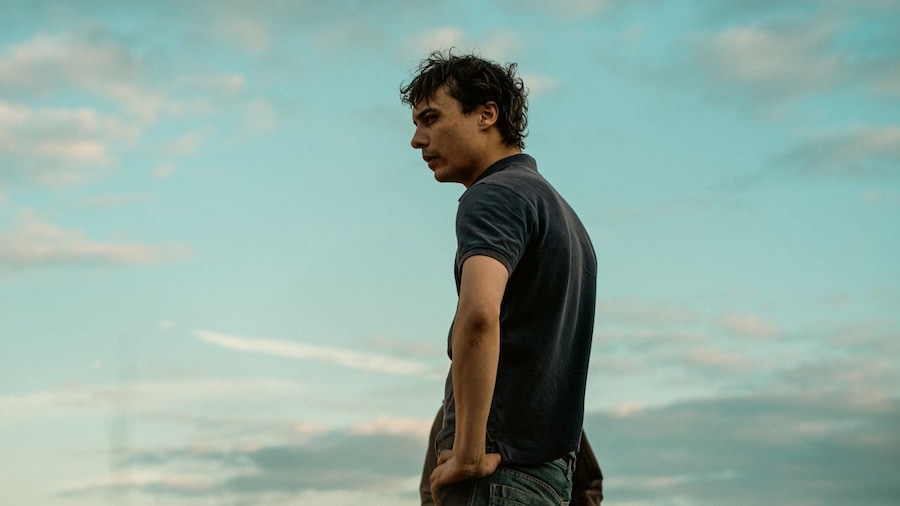
First-time director Harris Dickinson and actor Frank Dillane reflect on their vibrant character study Urchin, a homelessness drama with a magical-realist twist
I first interviewed Harris Dickinson in 2017 when Beach Rats, his feature-film-acting debut, was just about to hit UK cinemas. Under the direction of American indie filmmaker Eliza Hittman, the British actor gave a subtle yet searing performance as a gay teenager struggling to come to terms with his sexuality. “It’s so important that films which shine a light on people’s struggles are made,” he told me then. “Anything that can help to keep moving society forward and open minds through cinema.” At the age of 21, Dickinson’s passion for film and storytelling was already tangible. Making Beach Rats, he said, “confirmed to me that [filmmaking] is what I want to do for the rest of my life”.
Fast-forward eight years, and I’m interviewing Dickinson once again, this time for his directorial debut, Urchin, alongside fellow Londoner Frank Dillane, the film’s brilliant lead actor. Urchin is a remarkable achievement that would no doubt make Dickinson’s younger self proud. Written and directed by the now 29-year-old actor, who also plays a supporting role, it tells the gripping and frequently gruelling story of Mike, a young unhoused man in London who commits an act of violence and, upon his release from prison, attempts to build a better life for himself.
“I wanted to do a really acute character study without too much plot,” Dickinson explains of the writing process, which he began six years ago. “It was a really delicate balance,” he adds, perched companionably next to Dillane on a sofa in a London hotel room, “because I knew I didn’t want to make something that was about the institution – there have been versions of that done well – so I was trying to find a new way into it.”
Urchin’s key themes – homelessness and the cycles of hope and despair, of addiction and sobriety, that so often accompany it – are ones close to Dickinson’s heart. He has worked with various homeless charities in recent years, and through that work “really started to understand how many people in that community were incredibly vulnerable and in need of support – let down by society and the system.” He decided to set the film in his local area of east London, basing the script on the things he saw happening around him and regularly consulting with advisors from probation services, mental health support and prison reform in his quest to better understand Mike’s world.

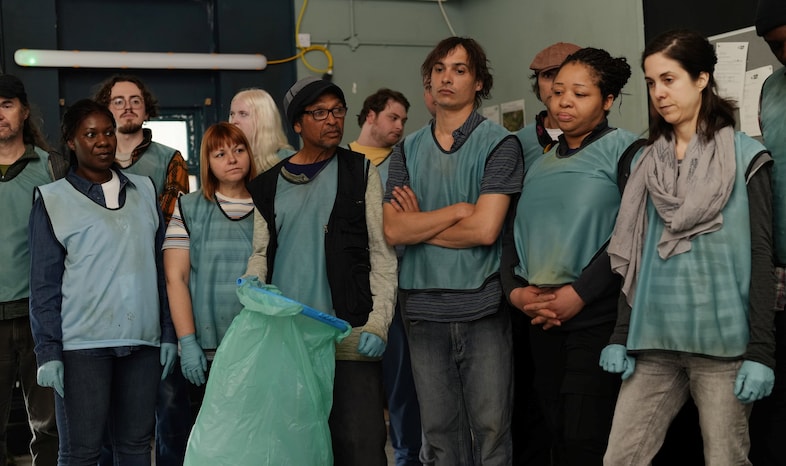
The result is a film that feels on the one hand incredibly true to life – from its moments of perfectly timed dark humour and absurdity to its pin-sharp observations of human flaws and patterns. But it also steers us into magical realist territory: a vast cave in a forest; an old woman who isn’t really there; a stark monastic room; a black hole. (It’s unsurprising to discover that Dickinson’s references range from the social realism of Mike Leigh, Ken Loach and Shane Meadows to the surrealism of Roy Andersson and Sergei Parajanov.) “The surreal parts won’t be for everyone,” Dickinson notes, “but I don’t think there should be any rules around filmmaking, or around telling adult stories in a fable-like way. Fairytales can be dark and be magical at the same time, and I wanted to play with that.”
What was the script like to read, I ask Dillane, whose extraordinary performance as Mike – twitchy, childlike, lost – saw him win the Un Certain Regard award for best actor at this year’s Cannes. “It was so unusual in many ways,” he replies. “There was a certain ambiguity to Mike, a kind of blankness to him. You’d wonder what was going on and then you’d read the stage direction for what he’s just said and it’d be like, ‘He’s not getting along with his real parents.’ So it was like, ‘Oh he’s adopted.’ Then: ‘What is it to be adopted, to go through the foster care system?’”

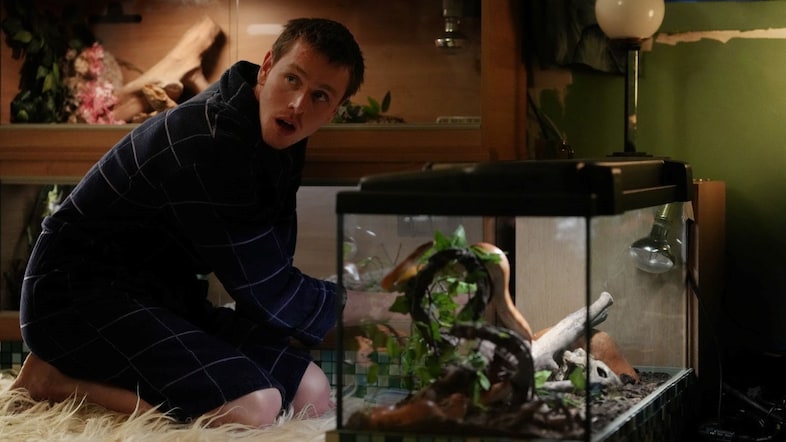
Dillane’s preparation for his role began long before rehearsals – he’d had his own experiences working with the Single Homeless Project charity, and had friends who had lived in precarious circumstances similar to Mike’s. “Harris put me in touch with some other people, and he and I visited a prison together,” he says. “And then there was a certain physical element I wanted to engage in: posture, weight, the world of it. There was so much to get my teeth into; I lived with Mike for a long time.” “I’d get messages late at night being like, ‘Mike’s just given me something! What if we…’” Dickinson interjects, and the two descend into giggles.
It sounds like having a director with so much acting experience – Dickinson has become a household name in the years since Beach Rats, garnering widespread acclaim for his roles in Ruben Östlund’s absurdist comedy-drama Triangle of Sadness and Halina Reijn’s erotic thriller Babygirl – was a great thing in this instance, I note. “Harris was never afraid to go to places,” Dillane agrees. “Or to listen to what I was saying when I was rabbiting on. I felt very able to explore. With Harris, because he’s such a brilliant actor, I felt seen.”

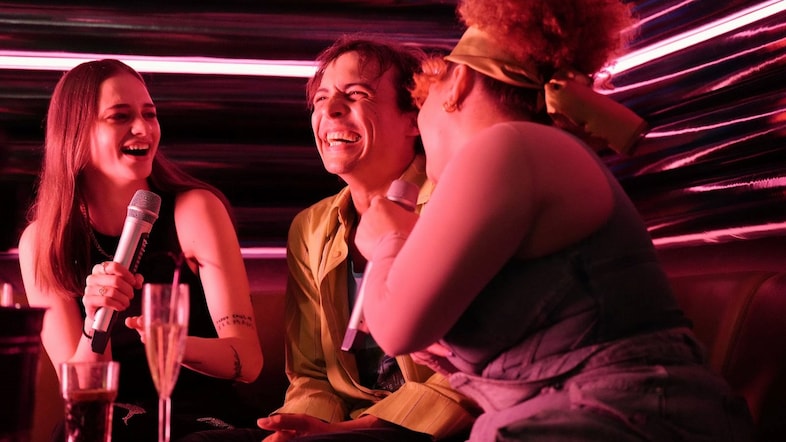
On Dickinson’s part, while he was somewhat “terrified” to step into the directing role, he knew from his own experiences of being directed what works and what doesn’t. “A lot of directors I’ve loved working with have been really good at creating the right atmosphere – if you can do that, it’ll create better work from the entire crew. You need to get people on board, to trust you and share your passion and vision. We all watched a film together every week, we spent a lot of time together before filming. Then on set it’s about instinct and communication.”
Dickinson’s approach is one that requires equal parts effort and trust – trust in his own ideas, experiments and intuition, trust in his cast and crew, and trust in his audience. Urchin is a film that offers no easy answers, points no direct fingers. It simply opens a window onto one person’s struggles, with imagination and compassion.
Urchin is out in UK cinemas from October 3.
