
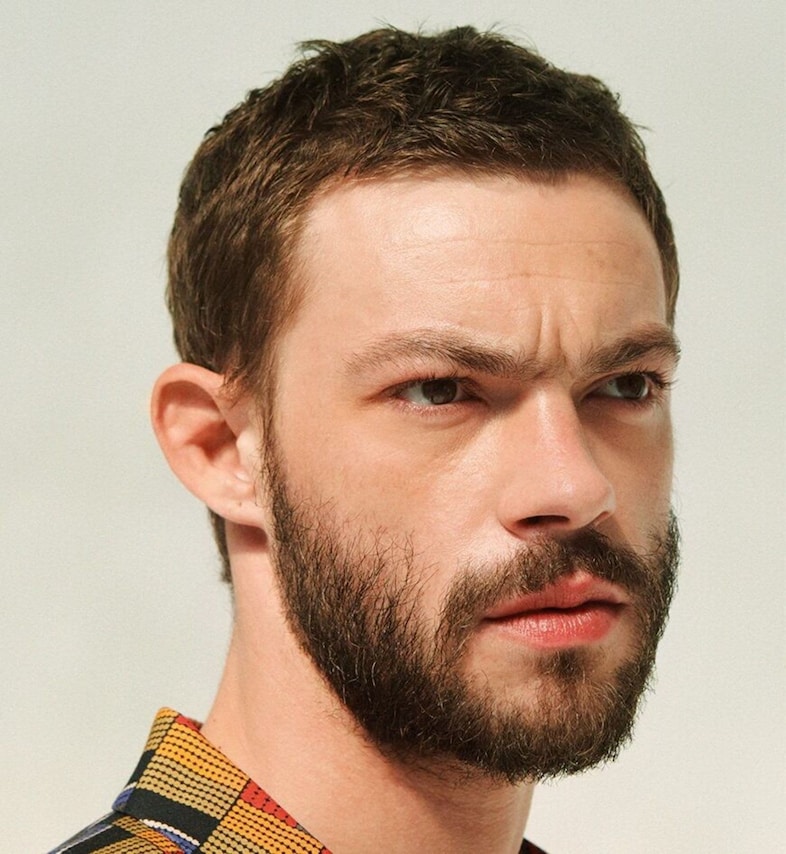
The French actor is riveting in Sophie Dupuis’s captivating queer romance, which explores the dark side of an intense professional and personal partnership
Félix Maritaud says it was easy to build his narcissistic and manipulative character in Solo, a dazzling romantic drama set on Montreal’s drag scene. “I just thought of my exes,” he adds with a playful smile, speaking on Zoom from his flat in the Paris suburbs. Maritaud plays Olivier, an enigmatic Frenchman who forms an intense professional and personal partnership with Simon (Théodore Pellerin), a fellow emerging drag queen with stars in his eyes. “Most of the time, people who are narcissists like Olivier, they don’t know why they’re acting that way,” Maritaud continues. “It’s not really something conscious. He’s closed off so many things in himself that he can’t act other than [by using] violence or manipulation.”

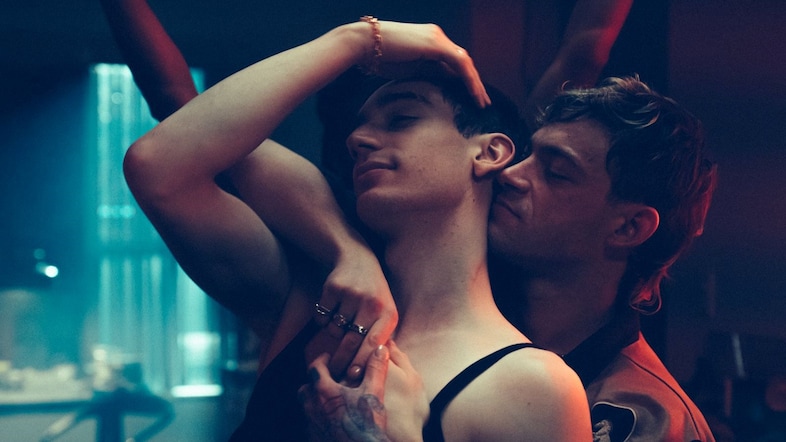
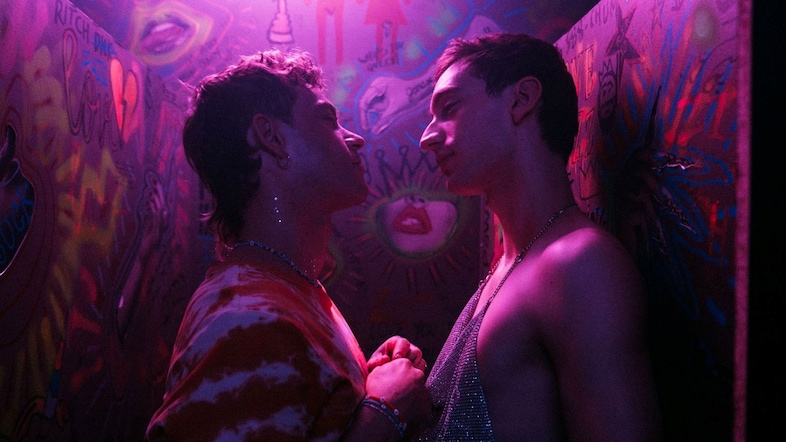
When Olivier arrives at the film’s authentically raucous drag club – “the stage was in a penis shape”, Maritaud notes proudly – Simon is performing old school lip syncs in gorgeous gowns made by his sister Maude (Alice Moreault). Instantly drawn to one another, the two men become lovers, then form an edgy drag duo who bring the house down with an S&M-themed routine. After the show, Olivier negs Simon by criticising his outfit choice, then tells a queen who pays them a compliment: “I’m happy he’s adapting to my aesthetic.” Their relationship only grows more toxic as the film goes on. Simon is thrilled to reconnect with his absent mother Claire (Anne-Marie Cadieux), who left to pursue her career as an opera singer, but Olivier dominates the conversation at one of their meetings. He’s constantly undermining Simon, sometimes subtly, but often overtly and cruelly.
“They’re both really ambitious and craving big, intense feelings,” Maritaud says, musing on what keeps them together. “I think it’s about passion – that’s the only thing that can bring people into a toxic relationship.” The film’s director Sophie Dupuis, who previously made the acclaimed 2018 crime film Family First and 2020’s intimate mining disaster movie Underground, welcomed suggestions from her lead duo. “There’s this moment where Olivier is flirting with a friend of theirs in front of Simon, and as we were shooting this, we said to Sophie, ‘We have to add a kind of intimacy moment between Olivier and Simon. Because otherwise that scene would just be about [emotional] violence.’”

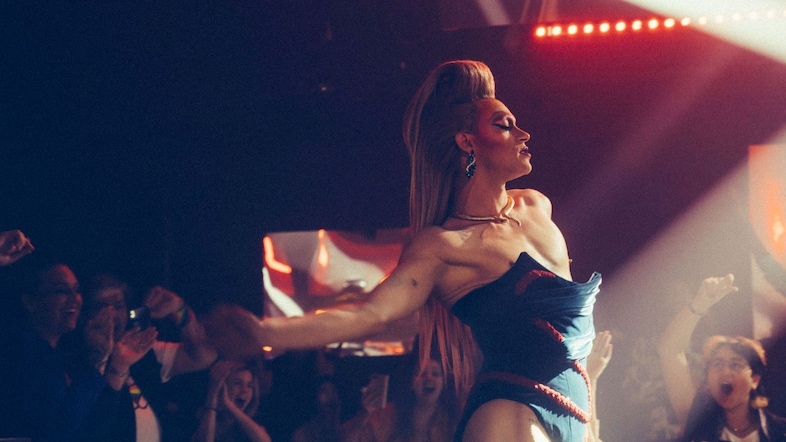
Maritaud, who grew up in Nevers in central France, trained as a dancer during his teenage years. “I can do any Britney Spears routine from back in the day, and Beyoncé taught me how to dance,” he deadpans. But he had never performed in drag before shooting Solo’s dazzling song and dance numbers as La Dragona, Olivier’s fierce alter ego. “It’s really amazing, the effect it has on your definition of gender,” he says. “You know, it’s nice to feel pretty [in drag] – to feel like that girly girl I loved as a little gay boy. But to embody that gives me more strength as a man, too. Like, my masculinity is way more chill since I had that experience.”
Maritaud came to prominence in 2017’s BPM (Beats per Minute), Robin Campillo’s devastatingly brilliant film about AIDS activism in 1990s France. A year later, he gave a heartbreaking performance as an isolated gay sex worker in Camille Vidal-Naquet’s equally affecting Sauvage. This led France’s leading LGBTQ+ publication Têtu to brand him “the new hero of French queer cinema”, but Maritaud said, not unreasonably, in a 2019 interview: “I don’t want to be a gay character all my life [because] I’m gay already.” Today, he stands by this statement, but adds a pretty major caveat – essentially, no toxic straight roles.
“Actually, if the straight roles were interesting, and if straight writers were writing roles that are not using masculinity in a way [I don’t like], sure, I’ll do them. And sometimes I do,” he says. In 2022’s You Won’t Be Alone, a beguiling body-horror film from Goran Stolevski, Maritaud plays a mute man who marries a witch. “But for right now,” he continues, “I don’t want to use my body to further a myth about masculinity that doesn’t conform to what I feel and believe is good for the audience. You know, I don’t want to look like a shitty man.”

Does he feel that queer roles have improved since he broke through in 2017? “Yeah, but actually, the actors playing them are all straight,” he says. “I don’t say it’s a bad thing, but I’m a human rights activist, and I think that narratives should be controlled by the people concerned.” Maritaud believes that in the same way it’s easy for him to play a straight character, it’s not special for a straight actor to play a queer role unless that actor has a somewhat homophobic streak.
But he also believes we gain “a new layer of truth” when queer artists tell queer stories. Solo’s director Sophie Dupuis has said that making the film with “queer people both in front of and behind the camera” helped her to “find and embrace” her own queerness. “Our narratives have been erased by the whole world for a long time,” Maritaud says with an activist’s conviction, “but now we have the power to keep them and share them ourselves.”
Solo is out in UK cinemas on September 19.
