
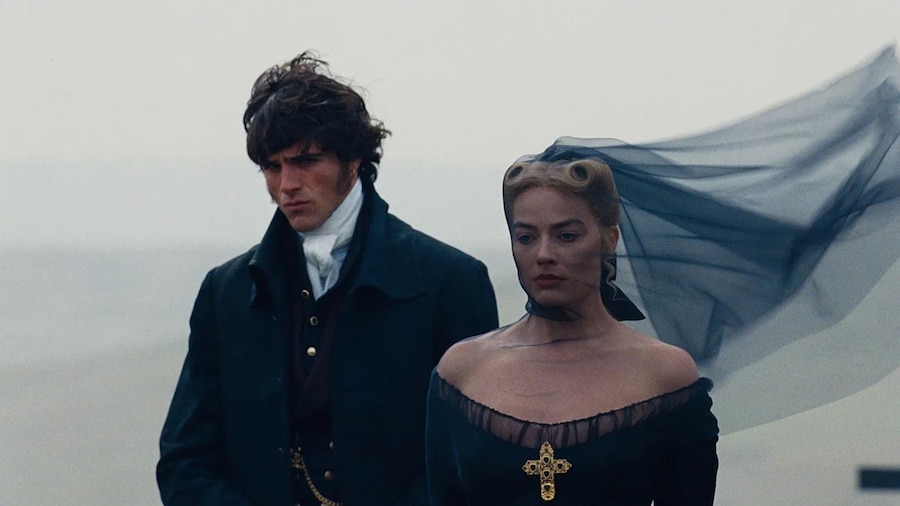
As Emerald Fennell’s controversial adaptation is released, we take a closer look at Emily Brontë’s haunting original, from its depictions of sensuality to its lack of morality
Wuthering Heights author Emily Brontë remains one of English literature’s most enigmatic figures. A reclusive vicar’s daughter who was fiercely attached to the wild landscape of the Yorkshire moors, by the time she died at just 30, she’d produced one of the most singularly amoral and obsessional novels ever written – a totally different species of romantic fiction from the quaint chivalry of her predecessor Jane Austen or the heavy-handed morality of her contemporary Charles Dickens.
The story revolves around the families of two houses – Wuthering Heights, a rugged farmhouse situated on an exposed hillside, and Thrushcross Grange, a grander house nestled in a sheltered vale. Both families become fatally embroiled in the destructive passion of Catherine (Cathy) Earnshaw and Heathcliff, a foundling brought to live at Wuthering Heights by Cathy’s father. Their love is the extraordinary and terrible heart of the novel, the repercussions of which play out for generations.
This Gothic romance has haunted multiple generations of readers around the world, with Cathy and Heathcliff immortalised in the cultural imagination as avatars for dramatic, windswept love. From Sylvia Plath to Muriel Spark, Daphne du Maurier and Patricia Lockwood, Brontë’s brutal love story continues to fascinate writers. Cathy’s lament, “Let me in your window”, is the ghostly refrain from Kate Bush’s famous song, while Simone Rocha has cited Emily Brontë as an influence for her romantic designs. Emerald Fennell’s new film is just the latest in numerous screen adaptations, including the Bollywood remake, Dil Diya Dard Liya (1966), and a 1988 Japanese adaptation that reimagines the story with samurai in feudal Japan. The influence of Wuthering Heights is profound; it has permeated and altered popular culture, in the words of Cathy herself, “like wine through water”.
Read on to discover more about Wuthering Heights, from the tragic but extraordinary life of its author Emily Brontë to its haunting depictions of nature born from lived experience.

1. The landscape is integral
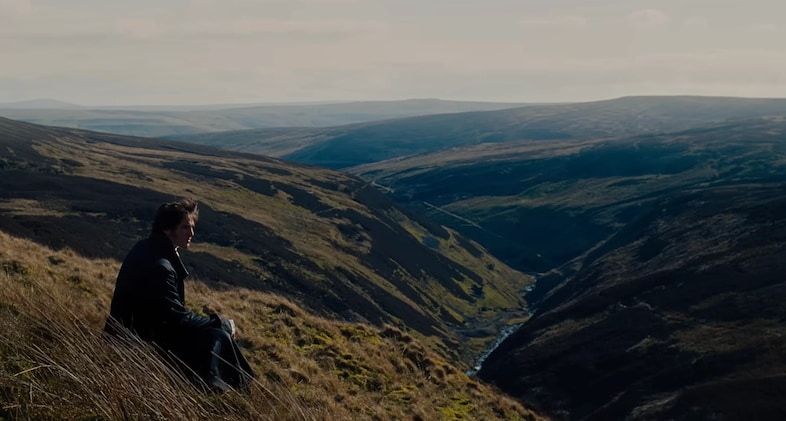
While Wuthering Heights is steeped in the supernatural – ghosts, mysteries, beyond-the-grave love – it’s anchored in a real and tangible landscape. The bleak vastness of the Yorkshire moorland, with its rolling heather and leaden skies, is integral to Cathy and Heathcliff’s tale. More than a passive backdrop, it’s an active element in the story – heightening and articulating the moods of the turbulent lovers as well as isolating and menacing its inhabitants with violently mercurial weather.
Emily lived in the Haworth Parsonage, overlooking the graveyard on the edge of the moors, with her surviving siblings, Charlotte, Anne and Branwell, and their vicar father, Patrick. The young Brontës spent hours roaming the rugged landscape, particularly Emily, whom Charlotte described as a “nursling of the moor”. This image of Emily as a lone figure on the wild moors, accompanied only by her dog, Keeper, has become an abiding point of Brontë lore.
2. There’s no moral compass
One of the many myths surrounding Emily is that she had been working on another novel at the time of her death in 1848 (she is thought to have died from tuberculosis, exacerbated by a cold caught at her brother’s funeral – the Brontë biography is littered with harrowing footnotes). Nothing remains of this would-be second book because, rumour has it, the manuscript was burned by her sister Charlotte, who decided it was too scandalous to see the light of day. Which begs the question, what could have been in that next book that was more shocking than Wuthering Heights?
When it was first published in 1847, under the androgynous pseudonym Ellis Bell, Wuthering Heights was condemned violently by Victorian critics. “Young lady readers” were advised to burn it. Even now, Wuthering Heights retains the power to shock. There are very few lessons to be drawn from its pages; cruelty is inflicted for cruelty’s sake. There’s sadomasochism, alcoholism, brutality and, arguably, necrophilia. Infants are tossed over balconies, puppies are hung, nests of newly hatched chicks are starved, people are beaten and the moors are unforgiving. Love, like life, is brutal and could be viciously extinguished at any moment. And perhaps most shockingly, the story is presented with an implacable absence of judgment or moral justice.


3. Cathy and Heathcliff’s relationship goes beyond sex
In the Brontë Parsonage Museum’s library (a resource centre for visiting academics and writers), there’s a sign pinned to a filing cabinet that reads: “In Austen, sex is just a kiss on the hand. In the Brontës, everything happens.” Darcy and Elizabeth’s courtship in Pride and Prejudice is coolly mannered and bound by social conventions so rigid that turning up with mud on her petticoat is enough to cause a stir amid the polite company. In Wuthering Heights, however, Cathy and Heathcliff run wild.
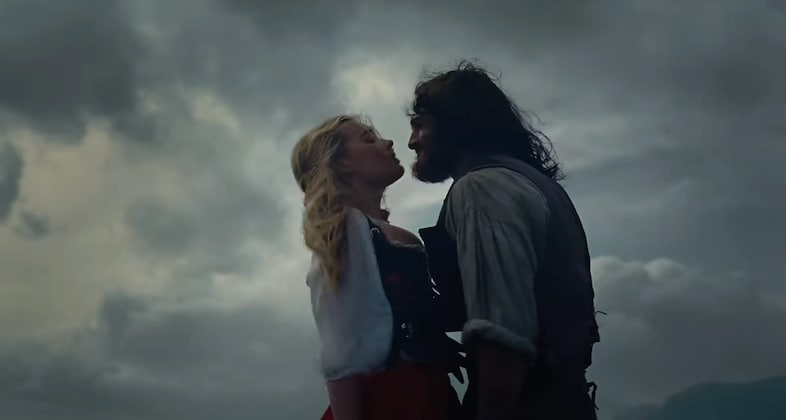
Margot Robbie has recently been quoted as saying, “There is actually not much kissing in the book, but we kiss a lot in the movie. We kiss everywhere.” But Emily Brontë conjures a sensuality so much more elemental and inexplicable than anything as earthbound or feeble as sexual pleasure. Cathy and Heathcliff are more than lovers; their passion runs deeper than mere sex. In one of literature’s most impassioned speeches, Cathy declares, “I don’t just love Heathcliff, I am Heathcliff.” Heathcliff bribes the sexton to place his future coffin close to Cathy’s and break the sides of each so their decomposing mortal remains will leak into the earth and mingle.
4. Heathcliff isn’t your typical brooding anti-hero
Depictions of Heathcliff may bear a likeness to a classically Byronic anti-hero, but Emily Brontë’s protagonist is not your average period-drama stereotype striding around in a frock coat. An interloper and an outsider, it’s his appearance in the story that essentially sets in motion the undoing of both families.
His otherness is emphasised in the book by his unknown origins and his ethnicity – he‘s described as “castaway”, a “gypsy”, and a “Lascar” (a South Asian sailor). His looks are central to his status as an outsider, but it’s the animal nature of Heathcliff that really distinguishes him from the loveable rogues of other romantic fiction. He is continually described in feral terms – a “mad dog”, an “unreclaimed creature”, a “savage beast”. He is a merciless, violent abuser, acquisitive and vengeful, implacably resentful and obsessive. On two occasions, he has Cathy’s body exhumed because he needs to see her face. His love for Cathy is his redeeming feature, but it’s also the force that compels him to extremes of inhumanity.

5. Did Emily Brontë ever have a lover?
There has been a lot of speculation over the years as to whether there’s a real-life template for Heathcliff in Emily’s life. There’s a persistent idea that no unmarried young woman in a Yorkshire village could have possibly possessed the scope of imagination to create such a love affair without translating the passion of Cathy and Heathcliff from lived experience.
The 2022 film Emily, starring Emma Mackey, focused on Brontë’s fictional romance with a real figure and friend of the family. But there’s no credible evidence to suggest she had a lover of any kind. Studying the adolescent writing of Emily Brontë – the melodramatic tales set in a fictional kingdom, inspired by Byron, Walter Scott and Gothic literature – it’s totally feasible that the romance of Cathy and Heathcliff sprang entirely from her imagination. If anything, theirs is the kind of passion that thrives in the imagination more than it ever could in real life.
Wuthering Heights is out in UK cinemas on February 13.
