
Curated by the team behind Émergent Magazine, this ambitious London group show looks at “what feels relevant right now”
Staged across three levels of a former club and sex shop, and spilling into an outdoor courtyard is the first iteration of Clarissa, a new curatorial platform from Émergent Magazine, on Caledonian Road in King’s Cross. Once a London district made up of neon-lit sex shops and late-night clubs, King’s Cross has been polished by regeneration, yet here, the curators draw on the history of the space to choreograph a dialogue between art, architecture, and the city, attempting to explore how contemporary artistic practices might inhabit, and even provoke, the residues of urban change and regeneration. In collaboration with the nomadic curatorial collective Soft Commodity and coinciding with Frieze London, Clarissa sets the tone for a roving series that will travel between cities, aligning exhibitions with key moments on the international art calendar.
“We’ve always seen the magazine as a kind of curatorial project,” explain Reuben Beren James and Albert Riera Galceran, co-founders and editors of Émergent. “We used to describe it as an exhibition in print, and a space to bring artists into dialogue, to think about relationships between practices, and to collect those connections in a tangible way.” Clarissa is not just a curatorial project, but a way of working in line with the magazine’s ethos. “From a curatorial standpoint, the most important thing for us is to ignore all the established hierarchies from blue-chip, emerging, mid-tier,” Reuben explains. “We’re interested in the conversation between artists, not how they are categorised. It’s about looking at what feels relevant right now.”
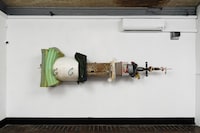
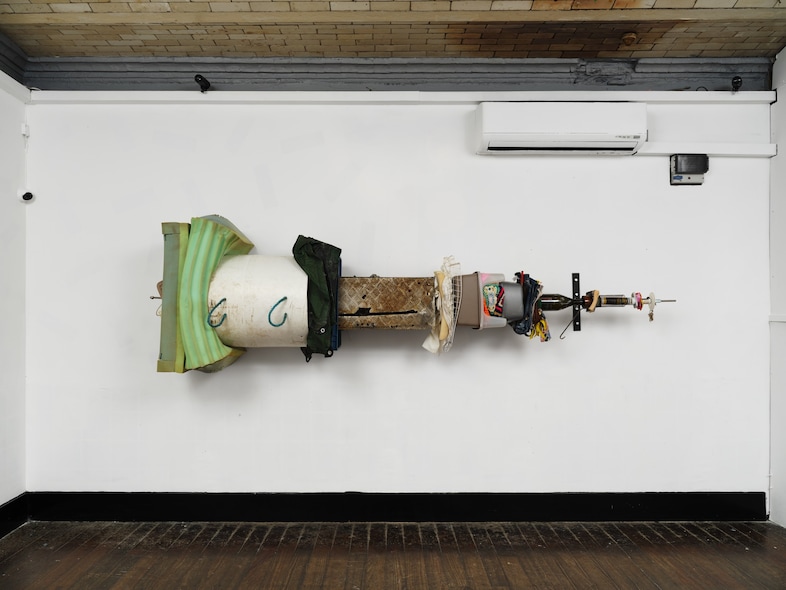
That philosophy is reflected in the ambitious lineup of artists, a mix of generations, materials and geographies, from Michael Dean, Hilary Lloyd, and Tobias Spichtig, to more emerging artists including Joel Wycherley, Remi Ajani, and Tiago Francez (the show is supported by galleries Arcadia Missa, Brunette Coleman, Carlos/Ishikawa, Emalin, Ginny on Frederick and more). The juxtapositions here are intuitive rather than chronological; works are brought together through shared material sensibilities and formal composition. Upon entering the space, visitors are met by a large-scale, freestanding kayak positioned vertically like a totem by artist Joel Wycherley. Behind it, a fragment of a lorry and a greenhouse structure enclose a single goose egg, an unexpected containment of fragility amid the industrial. Nearby, Patricia L Boyd’s photogravure on paper depicts a cluster of eggs balanced on the artist’s crotch, extending the motif of containment and exposure in a more intimate gesture. “There are artists in their twenties alongside Turner Prize nominees,” the editors note. “Not because of contrast, but because of a lineage of shared values and shared approaches to form. The relationships reveal themselves if you spend time with the works.”
 (2017))
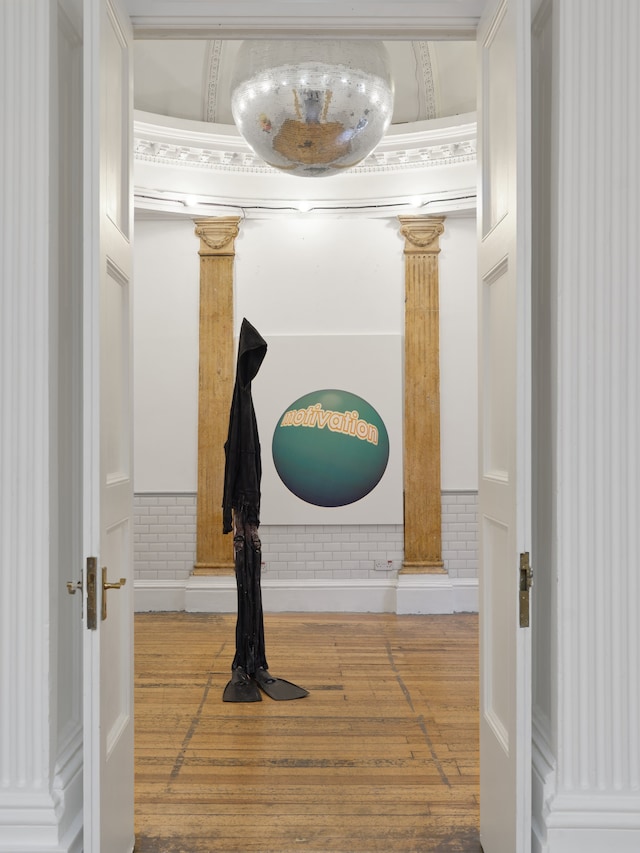
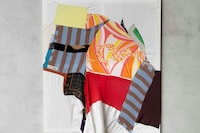
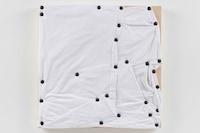
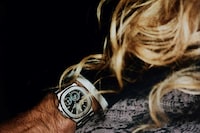
On the first floor, visitors encounter Oscar Enberg’s Abstraktes Bild mit Vatersprache (2025), an intricate assemblage of oil and flocked birch with silkscreened acrylic, shellac and graphite, accented by copper tacks. Nearby, Hamish Pearch presents a delicately constructed collage featuring a cast bronze raspberry set against fragments of collaged paper depicting wicker and woven hair. By the entrance, Graham Wiebe’s cut-up collages of self-help book titles, Ser Serpas’s porous ink-on-paper works that allow colour to bleed and spread, Jan Voresik’s mixed-media compositions, and Kembra Pfahler photographed by Rick Owens on a winding staircase, dressed in black and wearing her characteristically dark and contrasting make-up. Upstairs, beneath a large disco ball and curved dome, a canvas stitched together from a Pucci jumper, Missoni knit, Stephen Burrows scarf, and silk by Eric N Mack hangs alongside Tobias Spichtig’s tall, hollowed, ghostly figures, both works invoking a tension between fashion, form and absence. In the exterior courtyard, Michael Dean’s sculptural installation titled Unfucking Titled (2018), a corrugated-metal tunnel shaped like the Playboy bunny logo and filled with heart-shaped balloons, playfully reanimates the site’s past. Below ground, Hilary Lloyd’s videos flicker across the marble surfaces of a disused pool, a lingering trace of the building’s former past.
As practising artists themselves, Reuben and Albert founded Émergent while studying at Central Saint Martins, wanting to create a magazine that they wished they had been able to buy and consume when they were at art school. The magazine has grown into an internationally recognised publication, with the release of its latest issue coinciding with the opening of Clarissa, including interviews and features on Ebun Sodipo, Sylvie Fleury, Wolfgang Tillmans and more. The exhibition’s name, Clarissa, has its roots deep within the magazine’s history. “Clarissa started as a fake editor,” Reuben laughs. “When it was just Albert and me, we made up a few names of people who supposedly worked for the magazine.” Over time, Clarissa became more than an in-joke; she became an idea and a stand-in for anonymity. “She’s the embodiment of everything we’ve built together,” says Albert. “A writer, an artist, a curator. A kind of alter ego for the magazine itself.”
 (2025))
Clarissa brings together an ensemble of some of the most compelling artists working today. Does it always make sense? Perhaps not – but that may well be the point, and like the magazine, the exhibition unfolds as a kind of physical format: a space where distinct, cross-generational practices are placed in proximity, inviting unexpected correspondences. In its deliberate eclecticism, Clarissa resists a single, linear narrative, favouring instead a dialogue between artists, materials and generations.
Clarissa is on show at 9 Caledonian Road in London until October 19.
