
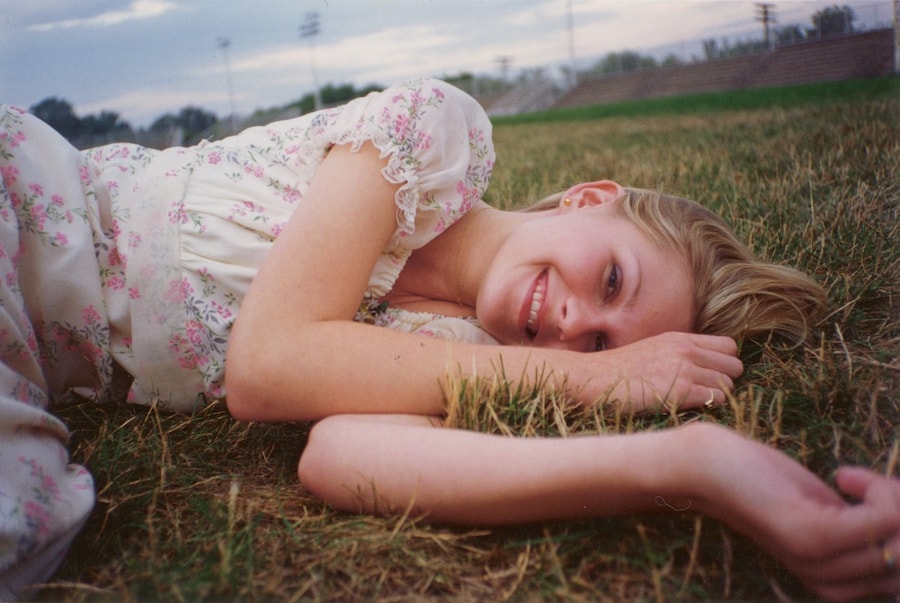
With work by Sofia Coppola, Simone Rocha and Louise Bourgeois, a new exhibition in Antwerp looks at female adolescence in all its contradictions, innocence and complexity
Beyond the surface deluge of trend aesthetics – cottagecore, fairy core, ballet core – the serious recognition of girlhood is surprisingly recent. Until the early 20th century, children were dressed alike; only in the 1950s did the ‘teenager’ emerge as a distinct category, largely manufactured by clothing companies who spotted its commercial potential. Before then, adolescents slipped awkwardly between large children’s clothes or small adult garments, and the expectations that came with them. But girlhood is far more than a marketable niche: MoMu Antwerp’s latest exhibition Girls: Boredom, Rebellion and Being In-Between reclaims the word from nullifying cliché, framing adolescence not just as a catalogue of struggles, but as a crucible of strength, self-invention and agency.






Through her sensitive vision, curator Elisa de Wyngaert expands adolescence beyond a mere threshold into a terrain of becoming. “Adolescents are always skipped over, yet they’re the most struggling group,” she explains. “Their memories cut sharp because they’re hyper-aware of how they come across to others.” The exhibition opens with a recreated bedroom from Sofia Coppola’s The Virgin Suicides, complete with the Lisbon sisters’ original dresses. Bedrooms recur throughout – in the imagined spaces of designers Jenny Fax and Chopova Lowena – as landscapes of expression and depression, comfort and constraint. Few artists captured this tension more acutely than Louise Bourgeois, whose embroidered apron, reading “I had to make myself forgiven for being a girl,“ cuts to the heart of adolescent shame and expectation.
As De Wyngaert notes, “Archetypes like tutus, uniforms, white socks, Mary Jane shoes – when used interestingly, question presumptions about obedience and meekness, and propose new, more inclusive identities.” Several works in the exhibition revisit these symbols of girlhood as a sense of longing for what it could have been. Over a painted self-portrait, artist Arisa Yoshioka pins a vintage linen dress, turning memory into fantasy and fantasy into a strategy for survival. Elsewhere, these familiar emblems shift from markers of neatness and submission into props for resistance and play.

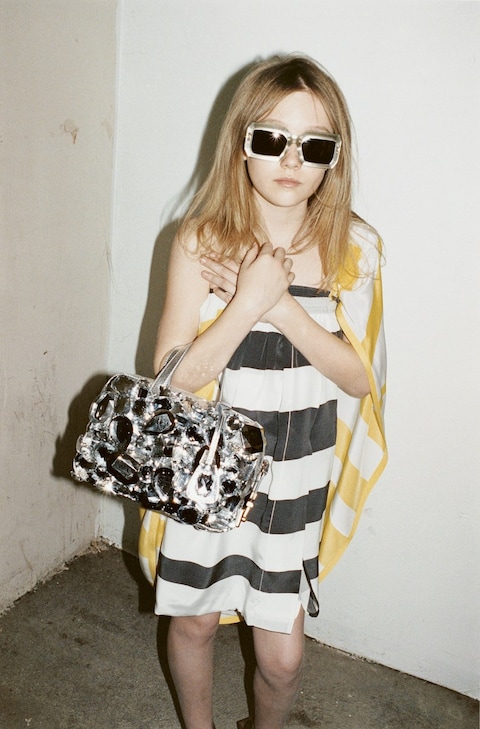
Nowhere is this clearer than in the exhibited communion dresses – white, laced, eerily bridal – linking girlhood to docility rather than independence, and notably revisited by Simone Rocha. Growing up in Ireland, she envied the girls around her who took part in the ritual, and her collections have repeatedly returned to this silhouette, only to distort it with defiant proportions, unsettling the obedience the dresses once enforced into empowerment.
Throughout the exhibition, fashion more broadly circles back on its own refrains of girlhood. A silver sequined wand from Margiela’s A/W02 collection, which he has preciously kept, sits alongside undergarments from Miu Miu’s collaboration with Petit Bateau. Molly Goddard’s oversized tulle dresses recall the protective comfort of childhood garments. Guest film editor (and author of AnOther column Girlhood Studies) Claire Marie Healy assembles a montage tracing how girlhood has been fashioned on screen – from Jean Seberg’s dressed-not-dressed ease in Bonjour Tristesse (1958) to the bodycon rituals of Céline Sciamma’s Girlhood (2014). If such designs once signalled infantilisation, they now read as power: playful, colourful dressing claims feminine agency in a language once used to diminish it.

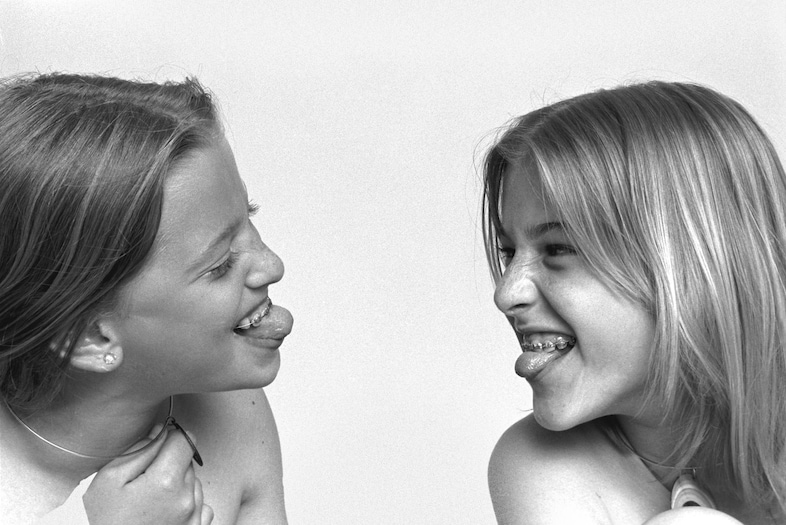
If nostalgia softens girlhood, the present, sadly, hardens it. Social media has accelerated adolescent vulnerability – body-image crises, eating disorders, the spectre of deepfakes – while erasing the fertile boredom that once bred creativity and private becoming. In this unsettling contemporary light, Girls reads less as nostalgia than as insistence: to look at adolescence in its contradictions, its innocence and volatility, its complexity. Bourgeois captured this tension in a 1947 text – later performed in her eighties and now featured in the exhibition – which imagines a woman who waits and waits until she grows smaller and smaller, an allegory for how girls are encouraged not to grow up, but to shrink.
Yet the exhibition closes with a film by Leonardo Van Dijl, shaped from focus groups with girls aged nine to 19 held in 2024–2025, in which they speak about what girlhood means to them. It is a soul-affirming projection of strength: of women now, and of the generations of girls to come. And as De Wyngaert reminds us, this is only one strand of a much larger story. “I had to make choices about which tales of girlhood to tell,” she reflects, “and those questions sometimes kept me up at night – am I doing it right? Because one exhibition can’t solve it. It will take documentaries, books, stories, coming-of-age novels, all stacked together, to even begin to tell an appropriate story.” Girls offers a reminder to all of us – even as grown women – of the importance of reaching inward to touch again the wonder and intensity of girlhood.
Girls: Boredom, Rebellion and Being In-Between is on show at MoMu in Antwerp until 1 February 2026.
