
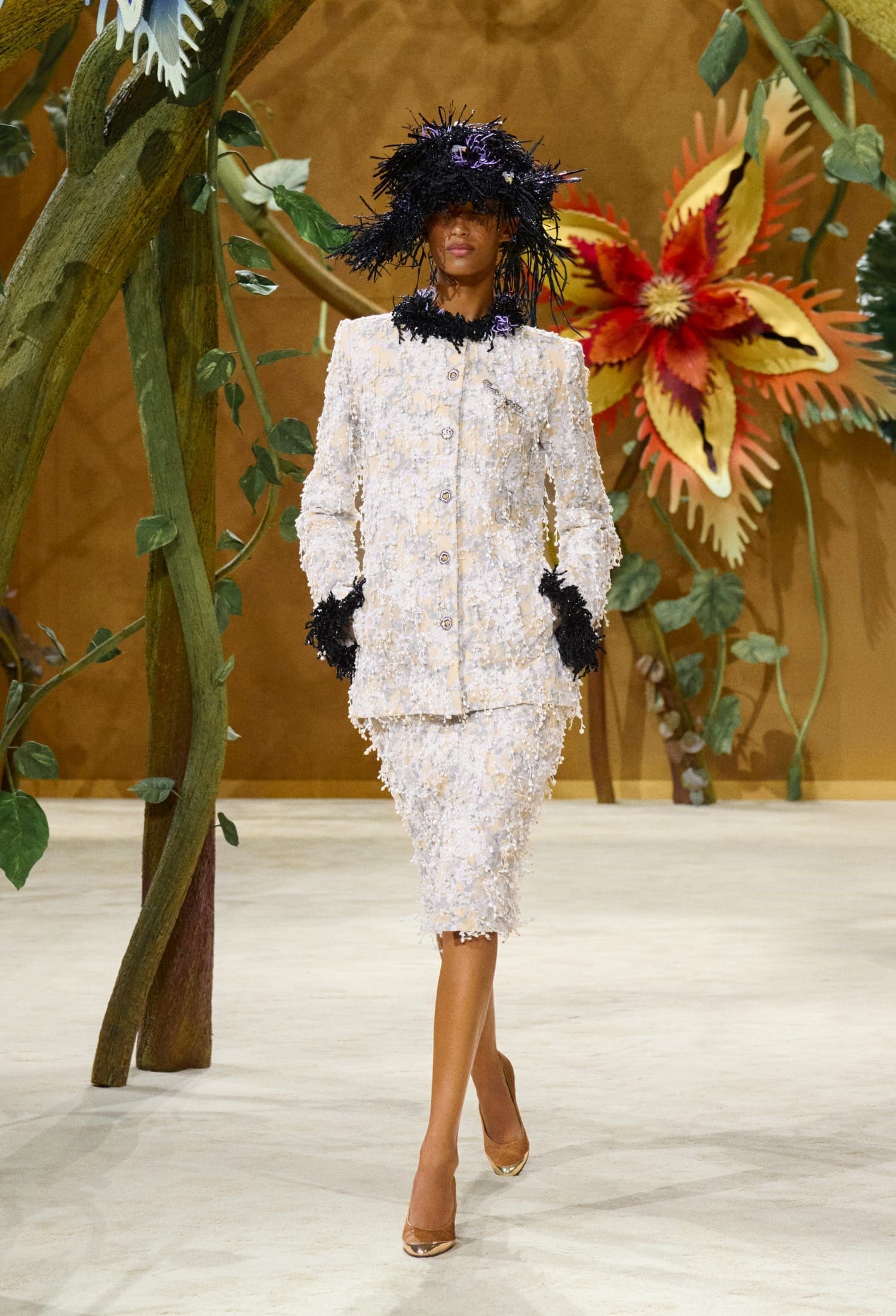
Matthieu Blazy presented his latest Chanel haute couture collection up close. It made it more personal. Rather than the glassed-in, football-field sized central nave, it was held in a space up in the rafters decked out like Gabrielle Chanel’s wheat coloured apartment, strewn with gilt chairs. “If people think couture is a big painting, at Chanel it’s maybe a miniature,” Blazy said backstage after. And these are clothes you want to bury your face inside, to figure out how they’re made, how they work.




But that salon wasn’t a simple sham. Clambering over the walls, curling around some salon chairs and hauling them aloft were cartoonish toxic vines, nature overwhelming. It felt appropriate, given how the hot weather had overpowered human endeavour in Europe across the past few sweltering weeks. Those twisted plants also made you think about the nature of Chanel, how overwhelming that could be for any designer seeking to cultivate their own genus within the hot house habitat.
Blazy, however, wasn’t thinking about any of that, at least not explicitly. Blazy likes to keep his collection themes strong, simple. He’d thought about fairy tales, found a leather-bound antique book of contes de fées, as they’re known in France, in Gabrielle Chanel’s personal library, planted some beans that he and his team watched grow into stalks. And then he decided to make a collection that captured their magical and transformative quality, reframed through the magical and transformative qualities of haute couture. Because that’s what everyone always goes on about, when they’re talking about couture – myself included. The impossibility of the art form, of elf-like little hands sewing together gossamer dresses where the stitches themselves are ostrich feathers, Rumplestiltskins at Lesage weaving tweeds from solid gold, and hand-cobbled transformative slippers for princesses, although not usually glass. It’s a métier with its own myth and legend. Indeed, if you’re looking to typecast a grumpy old witch who’s likely to broil you alive for chewing up her house, Gabrielle Chanel is a great candidate.

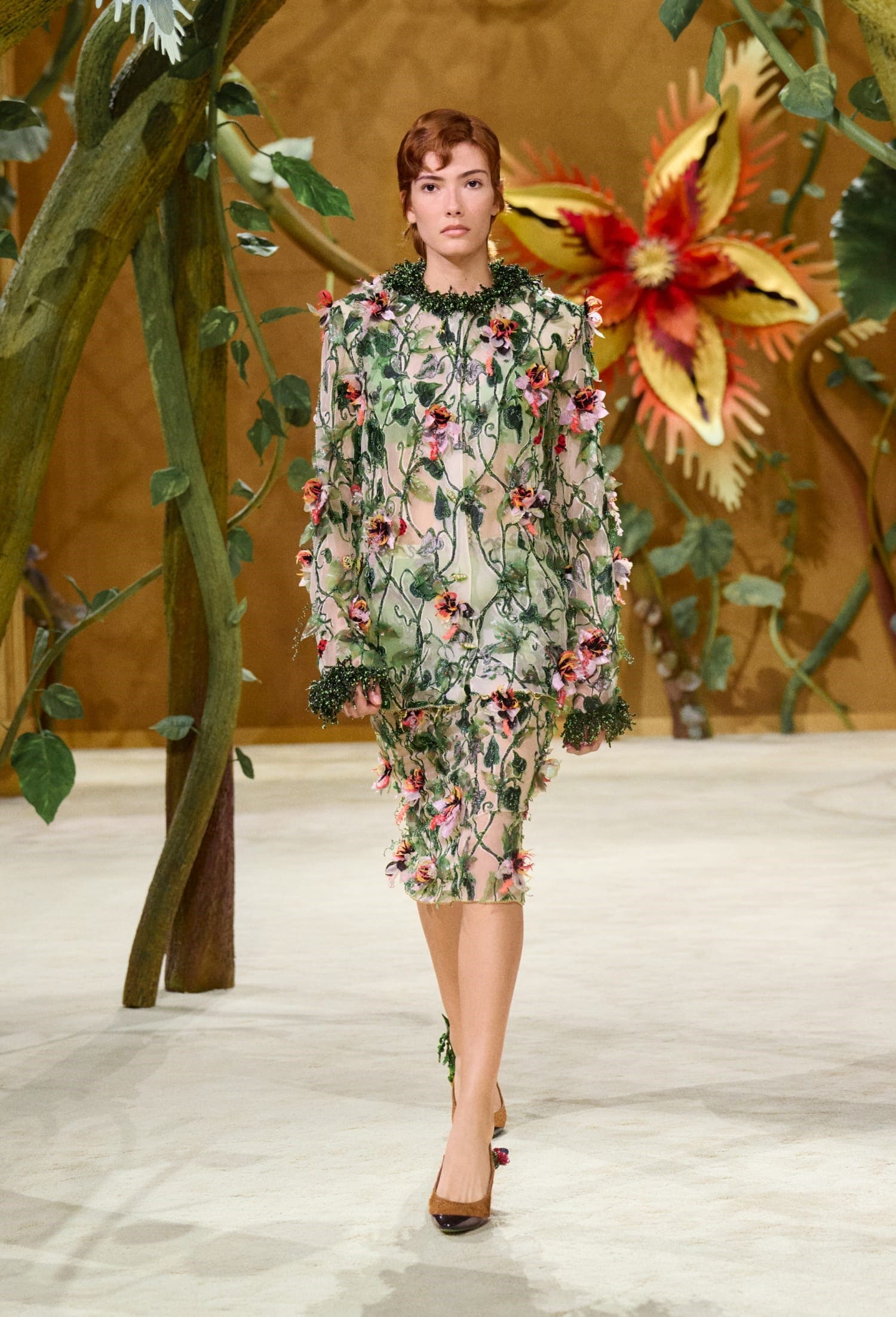

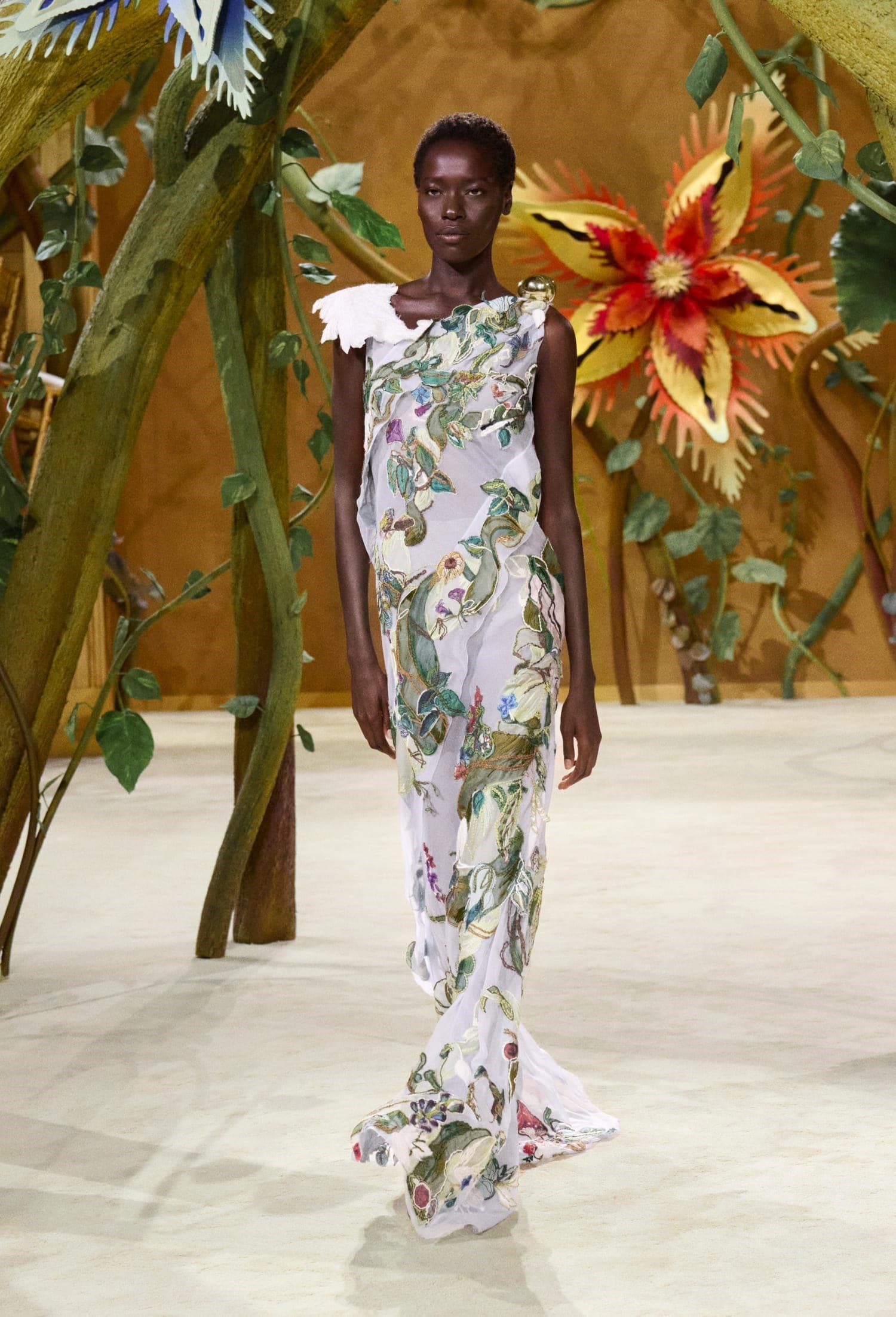
“Can I make a link with Gabrielle’s life?” was the question Blazy posited, though he probably wasn’t thinking of that. Rather, the idea of an orphan girl becoming queen of fashion, her own Cinderella-ish transformation. Backstage, he had pinned up lavishly illustrated parables, which were printed on silk to line the clothes, their details worked into designs, fashioning buttons – one a boot, another a puss, alongside good luck charms and lots of bean counting, although that isn’t something Chanel does. The couture turns a profit, but rather it’s about a wealth of legacy. Here, it was expounded and expanded, an explosion of creativity, a few riffs on ideas Blazy introduced last season (his exceptional chiffon suits got another workout), but also an expansive expansion, truly.
Earlier this week, Schiaparelli’s designer Daniel Roseberry wrote something that keeps echoing. “Formulas are antithetical to the magic of creation.” He’s right. The best collections, the ones that get stuck in your teeth, are those that break with designers’ formulas and the expectations of their respective fashion houses, proposing something not necessarily new, but at least different. It’s the same at Blazy’s Chanel – which is odd, because on the surface, Chanel is the most formulaic of couture houses. Gabrielle Chanel, after all, spent her final 17 years essentially refining her great late contribution to fashion, the Chanel suit, as well as introducing an eternal vocabulary of clothes, her two-tone shoes, her chain-strapped bag. Those were present, as well as the twists Blazy has established, like weird artsy heels clambering up those colour-dipped slingbacks (this time, proverbial chickens and eggs, and more beanstalk vines), and Chanel’s chain hems stitched on the very edge of gossamer-fine suits and dangling with little charms, like pieces of jewellery in themselves.

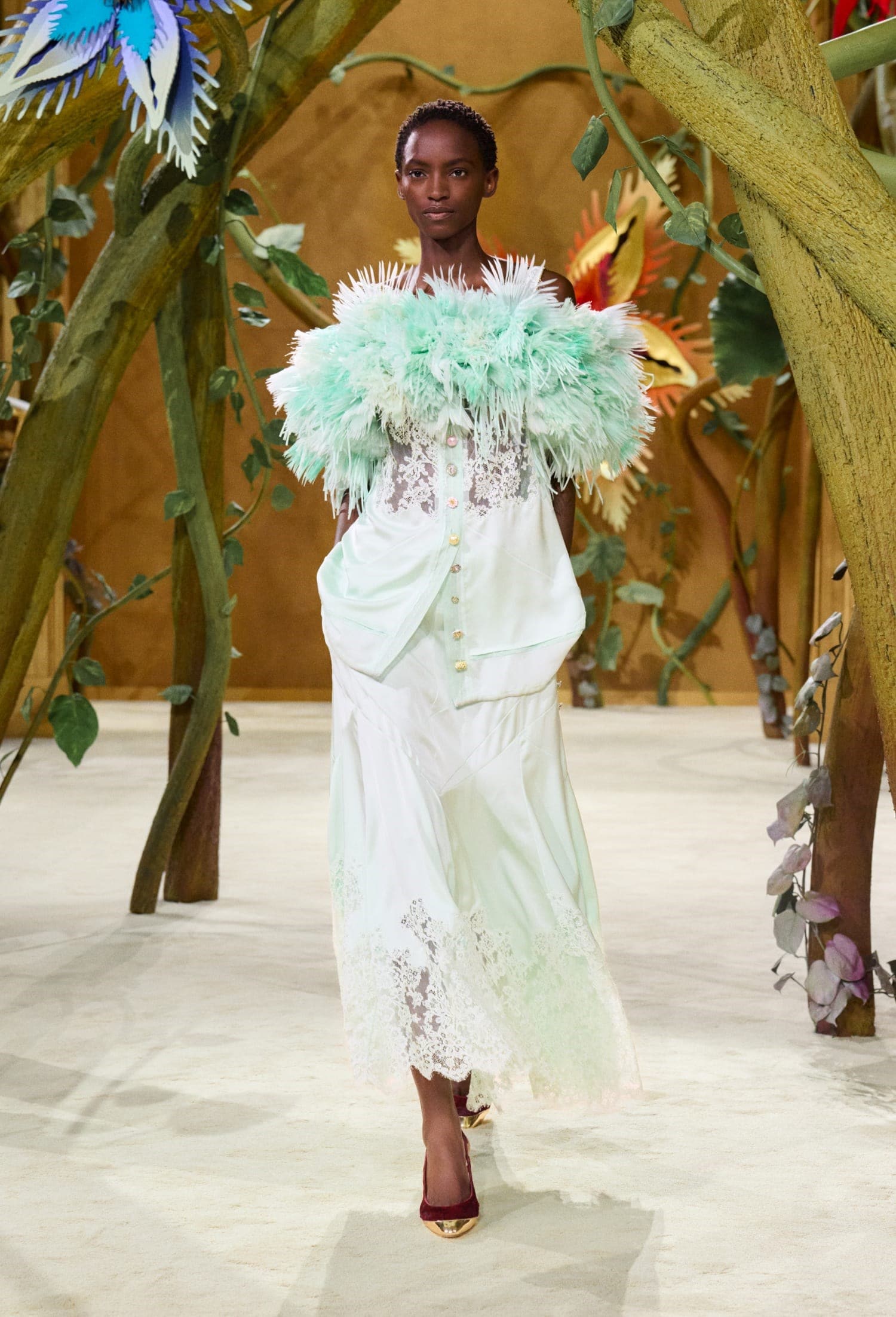

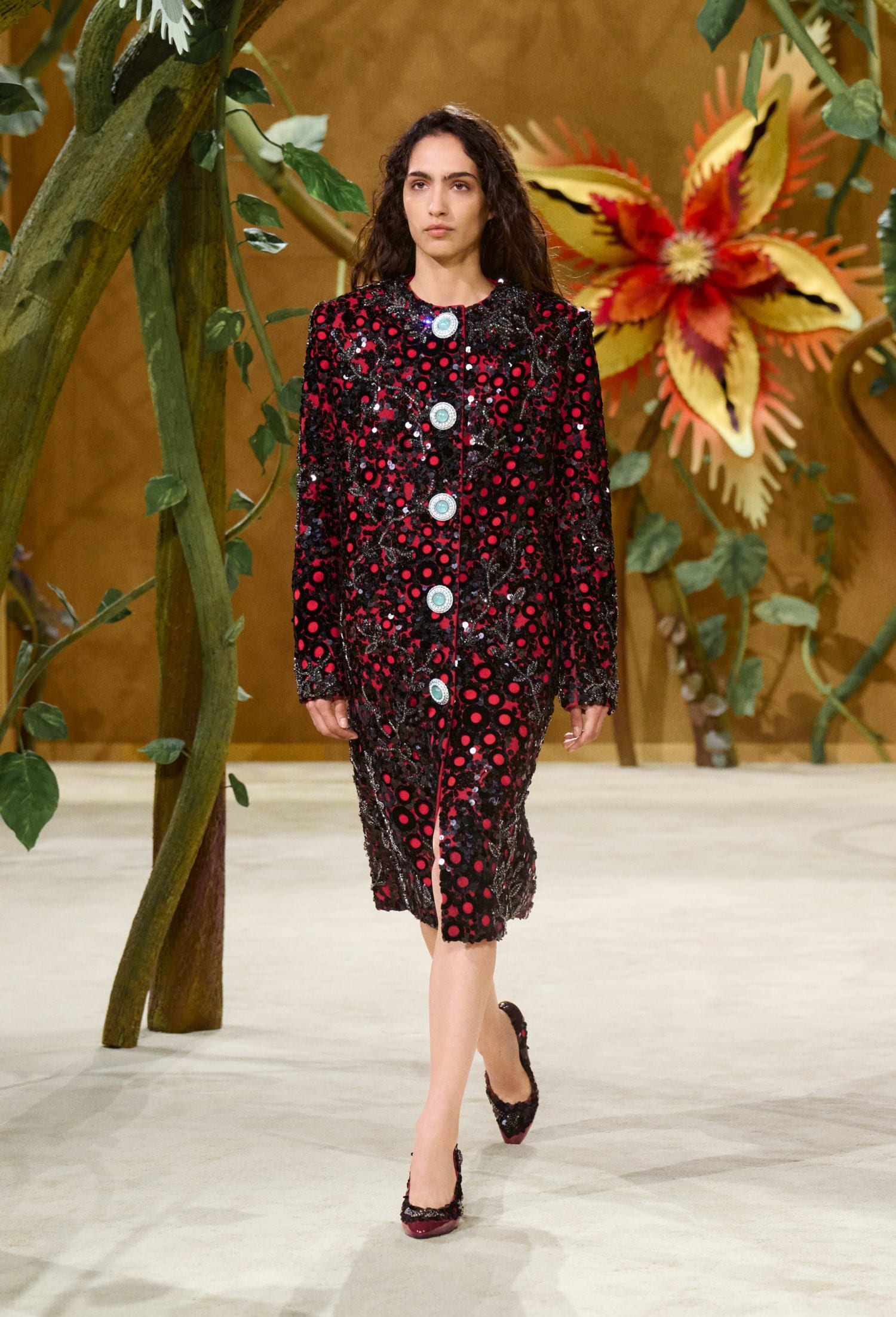
No one needs to be reminded of the riotous succès fou of Blazy’s Chanel revitalisation. And it would be easy – expected, even – for him to stick to his formula. He’s a great designer, so he didn’t. Here, it was the new stuff that blew your mind. Of course, at Chanel, new is rooted in old. “There are pictures of Gabrielle – she’s not pinning, she’s attacking the fabric,” Blazy said. “Ripping the sleeve.” Indeed, she used nail scissors to hack at her models – models meaning both clothes, and the long-suffering women who wore them in-house. Chanel literally let blood. Here, there were dresses with shredded surfaces of tweed blossoming into flowers, coats hacked apart at the midriff, their raw edges embroidered with frays of filigree gold chains and tiny beads like couture kintsugi.
For Blazy, that also connected to his own past – working with Raf Simons, working with Margiela. “The function and friction of the clothes,” is how he connects those places to Chanel. And essentially, that’s breaking the ivory tower fairytale of 21st-century Chanel a little bit, because back in the day Chanel was rough and ready and radical, a fashion reverse Robin Hood stealing clothes from the poor to sell to the rich. “Mocking luxury” was how Blazy put her approach, best summed up in a magpie finale of filched jewels applied to little black dresses and suits.
Couture as a fairytale is hackneyed. What felt surprising – interesting – here is that Blazy wasn’t dressing princesses who couldn’t sleep on peas, but a heightened version of real women. “Fashion is always about representation, an idea of what women stand for,” he said. “But the reality should be part of that. It’s not one side of the coin.” Neither is his Chanel, a fairytale he’s only just started to write.
