
As Comme des Garçons Parfums launches To Vetiver, we speak to the nose behind its creation, Antoine Maisondieu, and president Adrian Joffe about scent sensitivity and creativity
Vetiver is perhaps perfumery’s most primordial material: its name etched into the Bhagavad Gita, its roots carried forward across millennia of human devotion – to work with it borders on the numinous. For Antoine Maisondieu, the nose behind To Vetiver, Comme des Garçons Parfums’ latest ‘pebble’ fragrance, the weight was doubled – this was the last completed perfume of Christian Astuguevieille, CDG Parfums’ pioneering creative director of three decades, composed in devotion to the material he loved above all others.
Maisondieu had worked alongside Astuguevieille on 17 Comme des Garçons Parfums fragrances over some 20 years – a creative partnership he describes as the greatest pleasure of his career. “You cannot hide yourself with Christian,” he says of working with someone sensitive to scent. What Astuguevieille demanded was a kind of creative annihilation: to unlearn the classical compositions of their training and approach each material as if for the first time. “A perfumer is like a musician,” Maisondieu reflects, “he has old melodies in his mind always. Christian undid that completely.” He was, in Maisondieu’s formulation, “classical and punk at the same time” – someone who could hear beauty in a composition and then insist it needed “a splash of soy sauce” so that it was never “too beautiful.”
For To Vetiver, Maisondieu found his way in through saltiness – a mineral, aquatic quality latent within vetiver that he drew out by loading the top notes with black pepper, dosing more of it than in CDG’s Black Pepper fragrance, which he also worked on as the nose. “The pepper gives a saltiness in the smell,” he explains. It is this push and pull – between the pious and the unexpected, the ancestral and the modern – that gives the perfume its secular mysticism. Where the ancient materials pull the senses towards the devotional, Maisondieu’s hand intervenes, jolting you back into the present. The result builds from a sharp, ozone-like opening through the woody sensuousness of vetiver oil, settling into a deep bed of myrrh, opoponax and musk. “It heart-grounds,” says Adrian Joffe, president of CDG International and CDG Parfums – a compound verb of his own invention, which takes the earthbound quality of vetiver and relocates it from the physical into a felt interior.

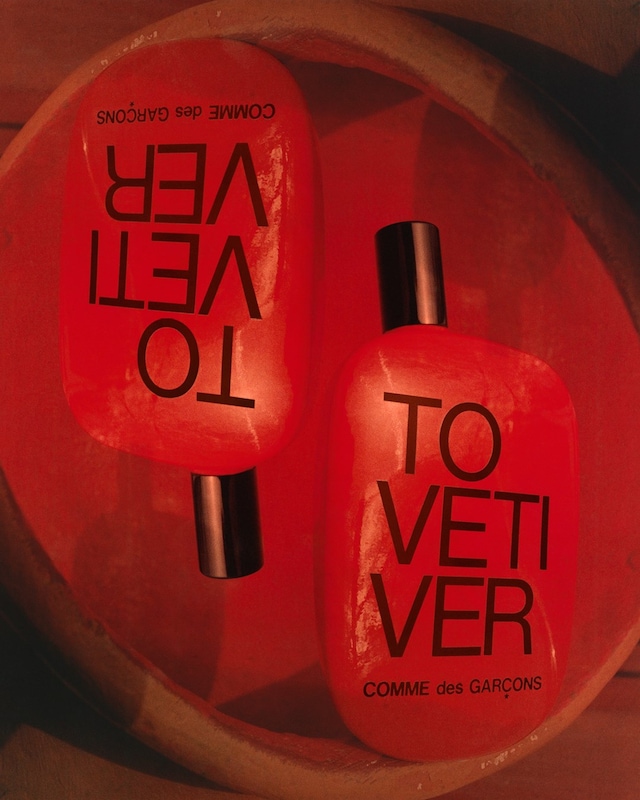
The perfume is contained in CDG’s iconic pebble – the bottle Rei Kawakubo designed for the house’s very first fragrance, the form Astuguevieille made his own across three decades of creation, and To Vetiver now completes the arc within. For this release, she chose red. “I expected a brown or green one,” Joffe admits. “But Rei always likes to do something unexpected. Red is one of her favourite colours – red is the new black, or the old black.” Without assigned meaning, it nonetheless mirrors the sacred and the ceremonial.
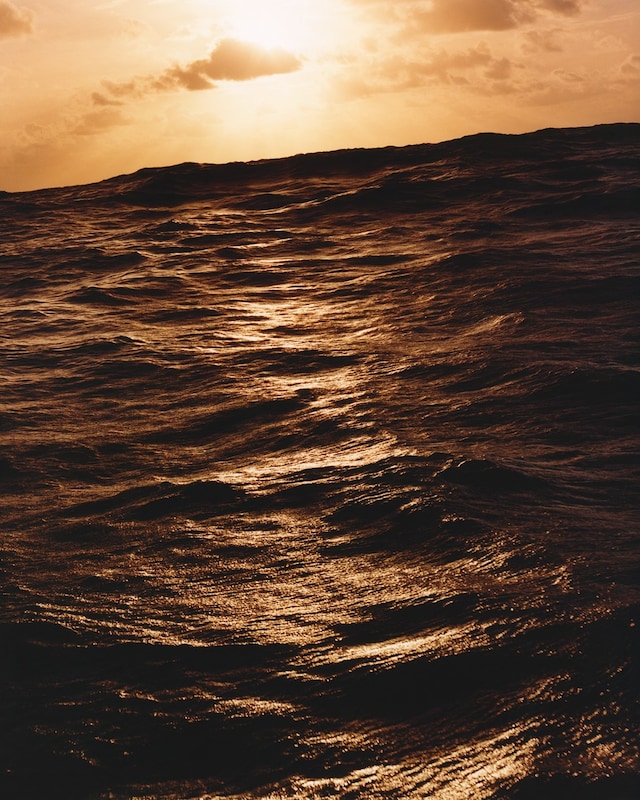
For the campaign imagery, CDG turned to Jamie Hawkesworth, who happened to be embarking on a three-week sailing voyage from North Africa across the Atlantic to Rio de Janeiro – no internet, no contact, just open water and time. Joffe gave him a bottle and sent him on his way, uncertain whether it would work. “Vetiver is very earthbound,” he reflects. “It’s a plant, it’s a root.” But the ocean, he reasoned, is perhaps the oldest thing of all – and what is antiquity if not this: always there, from the beginning. A couple of bottles were lost overboard along the way. “And well, they’re gone to them now,” he says, laughingly – swallowed by the Atlantic, destination irrelevant.
“Journeys don’t start when they start and when they end,” Joffe says of Astuguevieille’s work – and the lemniscate logic holds: a loop with no fixed point of origin or return, moving through ancient materials and a great perfumer’s last act of devotion, through an ocean crossing and a red bottle lost to open waters, into the hands and onto the skin of whoever wears it next. Maisondieu carries this spirit in his blood – his grandfather was Albert Camus, and there is in his work perhaps the same refusal of easy consolation, the same insistence on creation as a form of resistance. “It’s a challenge,” he says of what comes next, “but a challenge to do with a lot of heart.”
To Vetiver launched exclusively on May 6 in Venice at the Fondazione Dries van Noten, in conjunction with the exhibition The Only True Protest is Beauty, before rolling out from May 7 at Dover Street Market and Comme des Garçons Parfums stores globally.
