

Folklore is 180 years old. Obviously, I mean that’s when the phrase itself was invented, given that the whole point of the actual thing is that that’s ancient, passed between generations, adapting and mutating, stories twisted. That’s kind of the same as a fashion house, whose meaning rarely deviates from its natural order but whose re-telling can be elaborated, extrapolated and shifted.


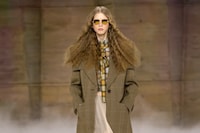


It’s certainly the case with Chloé, a house of exceptional malleability whose successive creative directors have navigated the label across diverse territories, from pastoral bohemia to good-time glittered denim to sleek, well-meaning minimalism. Some of that was good, and meaningful. Some, not so much. Chemena Kamali’s interpretation, however, is sticking. It’s knowledgeable, well-rounded, yet fundamentally based on feeling and doing, rather than over-thinking. She isn’t really mulling over the philosophy or identity of the Chloé woman – and at 74 years old, can we call her a woman now, rather than a girl? Rather, she’s going with her instincts. They’re bang on.
If Chloé is the character, this Autumn/Winter 2026 season she had something a bit folkloric about her dress, with vaguely Tyrolean knits, pretty prairie blouses and, of course, whirling diaphanous ruffled gypsy skirts, boho-a-go-go. Folk in frocks is a cliché, and folk frocks at Chloé are arguably a cliché on a cliché. Yet it’s also a truism: they’re how Karl Lagerfeld (him again) first rocketed the label to prominence. His lingerie-look tea dresses were drifting distractions to grim realities during the Yom Kippur war and 1973 oil crisis, incidentally, which find uncomfortably distinct parallels today.


Kamali, however, isn’t about distractions. Rather, she’s addressing what women want to wear, how they look good, what Chloé should stand for. She isn’t making a huge geopolitical statement with her clothes – her vast, ruffled, high-necked Mennonite-lite dresses have no hidden meanings about sister wives or femininity right now. They just look good, as do her fold-over cavalier boots and sharp blazers and skinny leather trousers and layered chain-belts, maybe dangling a bunch of charms that spell out ‘Chloé’.
You didn’t need those to identify the brand. Which is an achievement both in a general fashion climate, and at Chloé more specifically. What Kamali has done, and is doing, is nailing Chloé with an exceptional nous. She said she was drawn to folkloric dress because she was interested in “how clothing can both hold emotion, and carry memory.” The emotion here was want-it, need-it, and the memory they carry is of Chloé, for sure. She’s done that from her very first collection, shows filled with Chloé tropes of those floaty dresses and tight T-shirts and high-waist jeans that tick boxes for identity, but also chime with what people want to wear. That also means Kamali can push a little, reviving some unexpected stuff, like Lagerfeld’s swashbuckling coats and those high boots (they looked great), as well as a forceful line in late-1970s early-80s tailoring that feels as if it’s where fashion is shifting right now (see Saint Laurent, even a bit of Mugler). It all prevents Chloé from getting either staid, or saccharine. And means that Kamali isn’t just showing us what Chloé was, or is, but what it could be.
