

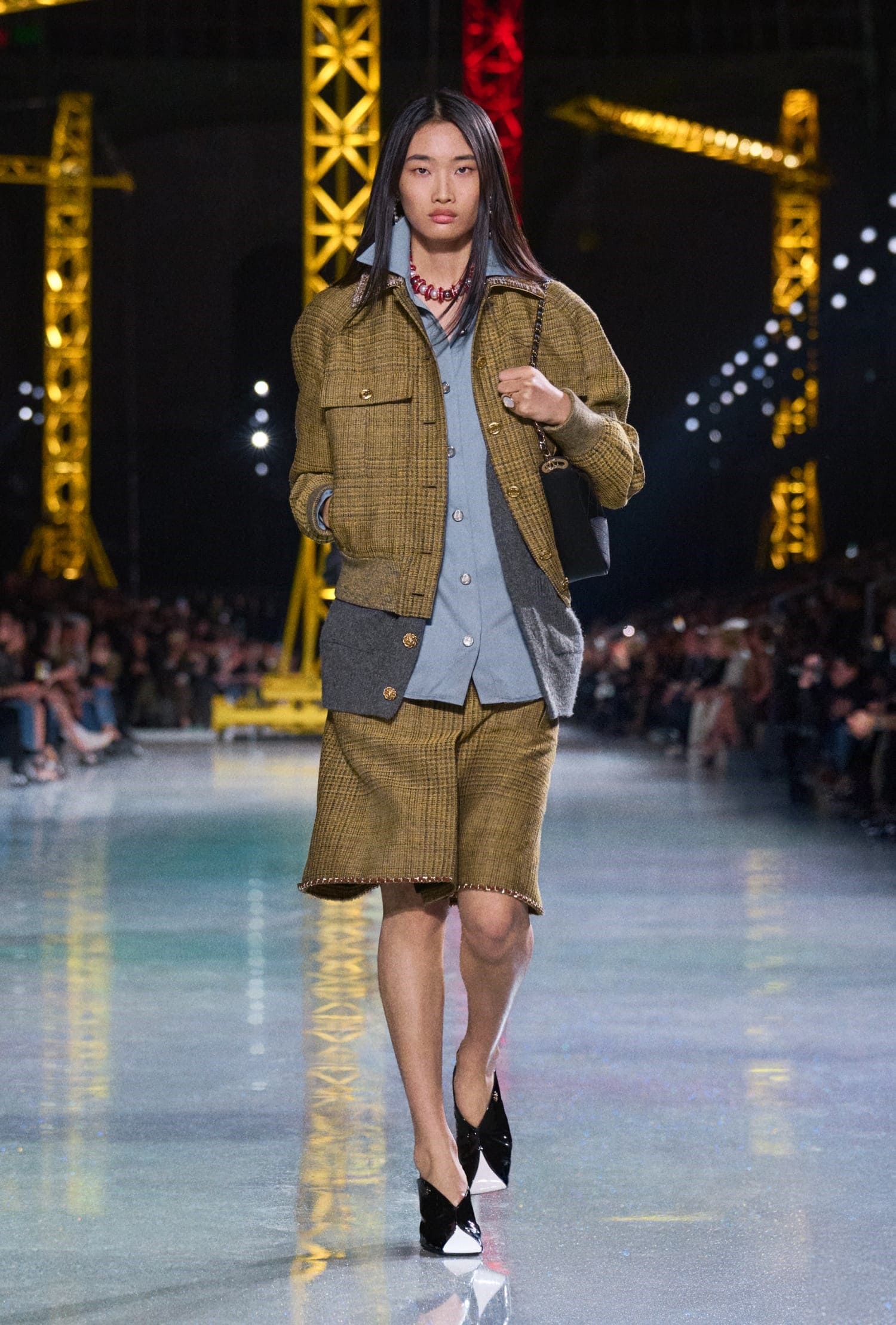
Matthieu Blazy sees his Chanel as a work in progress. He’s probably the only one that does. A season in, his recalibration of that name has been deep and trenchant. It’s emblematised by a passage of Chanel suits in this latest show that were literally ripped apart to their tweedy bones – deconstructed, yet still identifiably, unmistakably Chanel. It’s exactly what he’s doing, in a wider sense, literally taking the stuffing out of the suits as well as loosening up the company as a whole. Evidence of the former began to filter into stores this Paris Fashion Week: you’ve never felt a Chanel jacket so light, hems raw-cut, their decorative chains actually serving their original job, anchoring a flyaway garment to the body. Chanel’s happy, smiling advertising campaigns are an exemplar of the latter.


That is all very much from the Chanel playbook, if you’re tracing it back to Gabrielle Chanel herself, a woman who equally tore the structure out of clothes, hacked open sleeves, wore men’s blazers and sported underwear as outerwear before anyone had thought of such pithy terminology. It was subconscious, instinctive. Blazy is doing all that, although he does consider everything far more – as fashion demands, these days. Yet he is, truly, a natural successor. There was even a dress in his Autumn/Winter 2026 show that he cited, backstage, as his “wedding dress”, celebrating his union with Gabrielle. It was a drop-waisted 1920s thing with trailing ribbon streamers, so good he showed it thrice. “Taking something from the past – something borrowed, something blue.” Only one was that hue, though. “Honestly, I don’t find them un-modern at all. It’s how we look at them.”
That seems to be Blazy’s approach, in a nutshell – looking at Chanel, seeing something new. He’s also lucky that he’s working at Chanel, or rather with Chanel, as his work does come across as a dialogue with her legacy. Rather than exhuming dusty relics from a forgotten dressing-up box of history, as at some other houses, Chanel has a vibrant contemporaneity. You can imagine plenty of women wearing Chanel’s original clothes on the street – a lucky few women do still sport vintage examples of her suits. Which is why it works to quote liberally from her back-catalogue, to glance back at her rambunctious cloqué suits from the 1960s, her weird fake tweed prints of the 30s, her lion’s head buttons (she was a Leo). There were even buttons that resembled cocoa beans – cocoa, for Coco – a visual gag worthy of Blazy’s punny predecessor, Karl Lagerfeld.


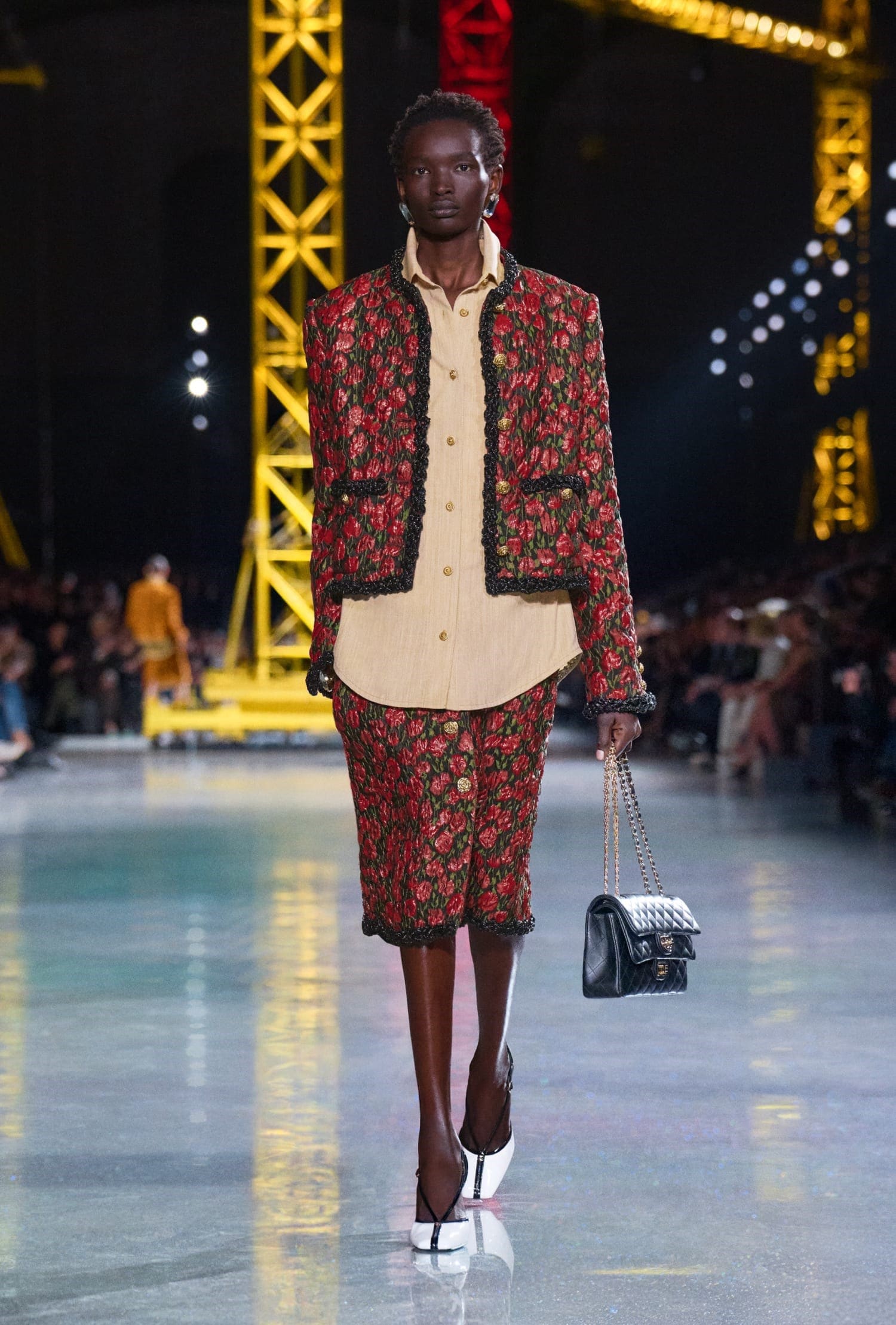
“Tac, tac, tac,” Blazy said, tapping on photographs of looks backstage as he talked through his ideas at breakneck speed. There was a 1957-ish interview with Chanel, he said, where (as we’ve already read everywhere since) she compared her fashion to a caterpillar by day and a butterfly by night. Namely, that during daylight hours you could be dowdy and brown, low-key, a bit fuzzy (hey, she loved hairy tweed), crawling about, unseen and unspectacular. But, at night, a woman wanted to metamorphose, to transmogrify and spread fabulously decorated wings, if only for a short while.
“Et voila.” From caterpillar, to cynosure – double-C. There were other obscure Chanel anecdotes here too: that she once replied that her favourite colour was iridescent, that the first ever Chanel handbag was actually little chainmail clutch for evening, and that her apartment is papered, in part, with cotton gauze painted gold. Tac, tac, tac. Some other stuff was more direct and readily identifiable – the drop-waisted twenties dresses in tweeds or knits, what Blazy called, last time, Le Jour, and continued with this time, were quintessentially Coco. “I really wanted to redo as a second part of the first show, like a conversation,” Blazy said backstage. Then, instead of butterflies, he did moths, in soft, fluttery, feathery colours, the critters you usually try desperately to keep out of your clothes suddenly looking great embedded in them.



The most unexpected part was a sequence of shimmering evening looks, lifting that chainmail and cutting it into narrow jackets and coats overprinted with impressions of tweed, Coco meets Claude Monet, a riff on the trompe l’oeil looks Chanel didn’t do that famously. They also reminded me of a little-known, little-loved Lagerfeld collection of metallic tweeds and caked-on make-up inspired by the ganguro girls of the Shibuya and Ikebukuro districts of Tokyo. Blazy’s closers had a shimmering anime feeling too, models with shimmering pastel coloured hair streaming or plastered with paint by Duffy.
“It’s very Chanel,” Lagerfeld said of that millennial show. “But she would never have done a dress like this. That’s my job, no?” It’s Blazy’s job too, to propose his fictional Chanel-ism that seems truer than fact, updating her spirit, evolving her ideals. This time, the chain-weighted shirts he introduced in his debut were made in cotton, fully lined with braid-trimmed pockets. For Blazy, it was a new Chanel suit – not spectacular, caterpillar for sure, but you wanted to fall into them, just as women fell into Chanel’s suits as a uniform in the 60s, and Lagerfeld’s redux in the 80s. Who said if something was broke, you shouldn’t fix it? They looked fantastic – and, contrary to Blazy’s mining of the Chanel we’ve never seen, the collection closed with another of her enduring, still-relevant clichés, the little black dress. This was in sinuous jersey, rucking and tucking around the body, a feathery flower pinned between the shoulder blades. Those butterflies going right back to chrysalis. Blazy said the idea was that she could loop the whole show right back to the start, an ever-continuing circle and cycle. Eternal style. How very, very Chanel.
