
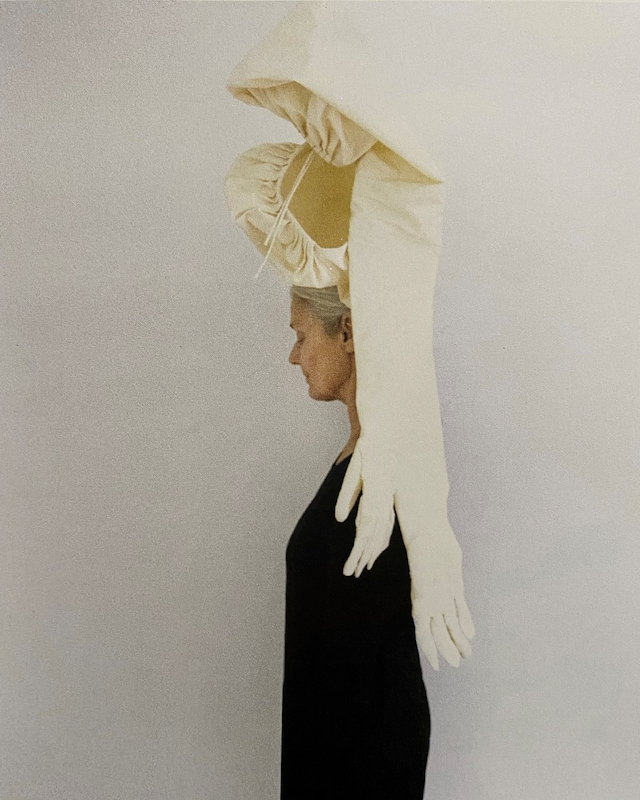
Designed and imagined for Fondation Cartier, the French historian and curator focuses on everyday clothing, mended and overlooked by official museums
The question of how fashion is archived – what enters the museum; what is deemed worthy of preservation; whose clothes are considered culturally significant enough to outlast the bodies that wore them – has long sat uneasily at the centre of fashion history itself. Institutions have tended to answer it, or ignore it, in much the same way: couture gowns under glass, luxury garments mounted on conservation-grade mannequins in blockbuster exhibitions – an implicit hierarchy of the designed over the worn, the authored over the anonymous. It is precisely this system that the French fashion historian Olivier Saillard – formerly director of the Palais Galliera, and now of the Fondation Alaïa – sets out to provoke and cleverly dismantle with Le Musée Vivant de la Mode, staged nightly at Paris’ Fondation Cartier until late March.
The animating idea arrived during a visit to a music museum in Bologna, lined with halls of inert instruments arranged neatly behind glass. Stepping outside, Saillard heard students practising through the open windows of a nearby conservatoire, the sound drifting through the streets. The contrast between the archived and the alive struck him as a perfect analogy of fashion’s institutional problem. And it is worth sitting with, because the issue is not merely curatorial – it is a matter of judgement: who decides which lives, and which garments, are worth remembering. Museums tend to preserve couture, the clothes of the privileged, garments carrying a designer’s name and valued as a collector’s investment. The work-worn, the mended, the anonymously beautiful – these are allowed to disappear; their disappearance treated as natural, inevitable, when in truth it is neither.
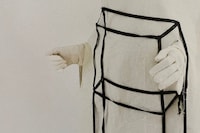
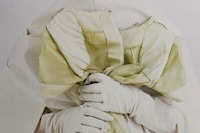
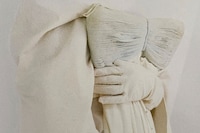
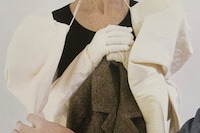
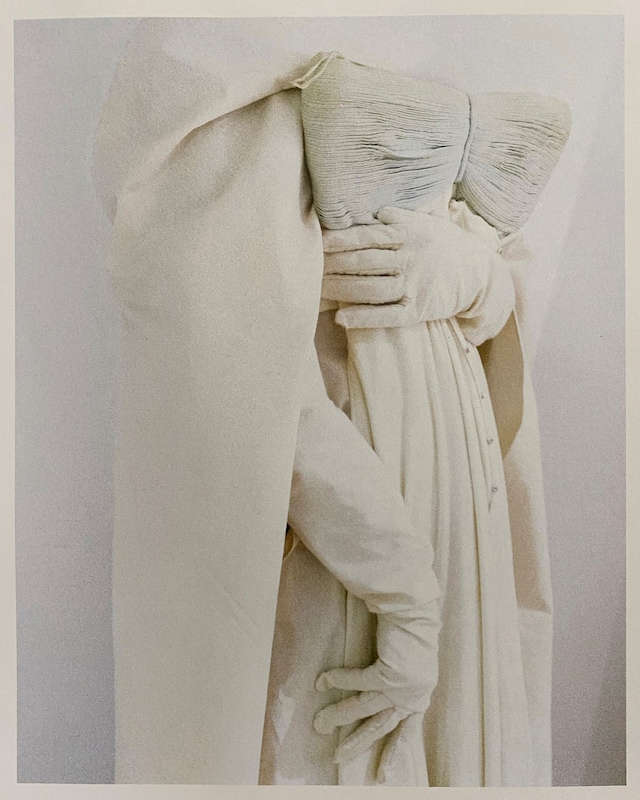
Le Musée Vivant de la Mode proposes another kind of institution. Models move slowly through the auditorium in plain beige toiles, the canvas dresses functioning as mobile display panels, “cimaises vivantes”, onto which the evening’s collection is pinned. The audience watches in near silence as garments appear, disappear, and give way to the next. A Madame Grès dress too damaged for any institutional collection; a pair of mechanic’s trousers worn thin through years of labour and carefully patched by their owners’ wives, later sent to Alaïa’s master tailor Erdal Pinarci, who transformed the repairs into something resembling a Bar jacket (Saillard refers to it, wryly, as “le tailleur bar du coin”); florists’ aprons; handkerchiefs embroidered with women’s initials; a white T-shirt from Helmut Lang’s personal wardrobe, 25 years old, worn almost to nothing.

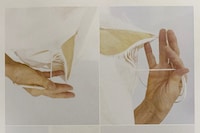
Saillard moves among them throughout the performance, offering commentary in French that sits somewhere between a pithy wall label and plaintive prose – precise, occasionally funny, yet always attentive to the biography of each piece. A dress arrives destroyed; he names what destroyed it – the repair becomes the record.
Saillard has recalled being asked, during his years at the Palais Galliera, what he might say to an alien curious to understand fashion on Earth – and realising, surrounded by designer couture gowns, that he was describing a world that scarcely resembled the one people actually dress in. Nothing of the white T-shirt or the jean, the work coat, the uniform – the clothes that both are fashion and make it possible. Le Musée Vivant de la Mode is, in part, his extended answer to that question. And if its form – the toiles, the pinned garments, the spoken commentary threading piece to piece – still echoes the conventions of the exhibition it seeks to move beyond, perhaps this is not a failure of imagination so much as an honest acknowledgement: that institutional grammars are difficult to escape entirely, and that the more urgent work, in the meantime, is to change what they are used to say.
Le Musée Vivant de la Mode is staged nightly at 5pm, Wednesday to Sunday, at Le Musée Vivant de la Mode in Paris until 21 March.
