
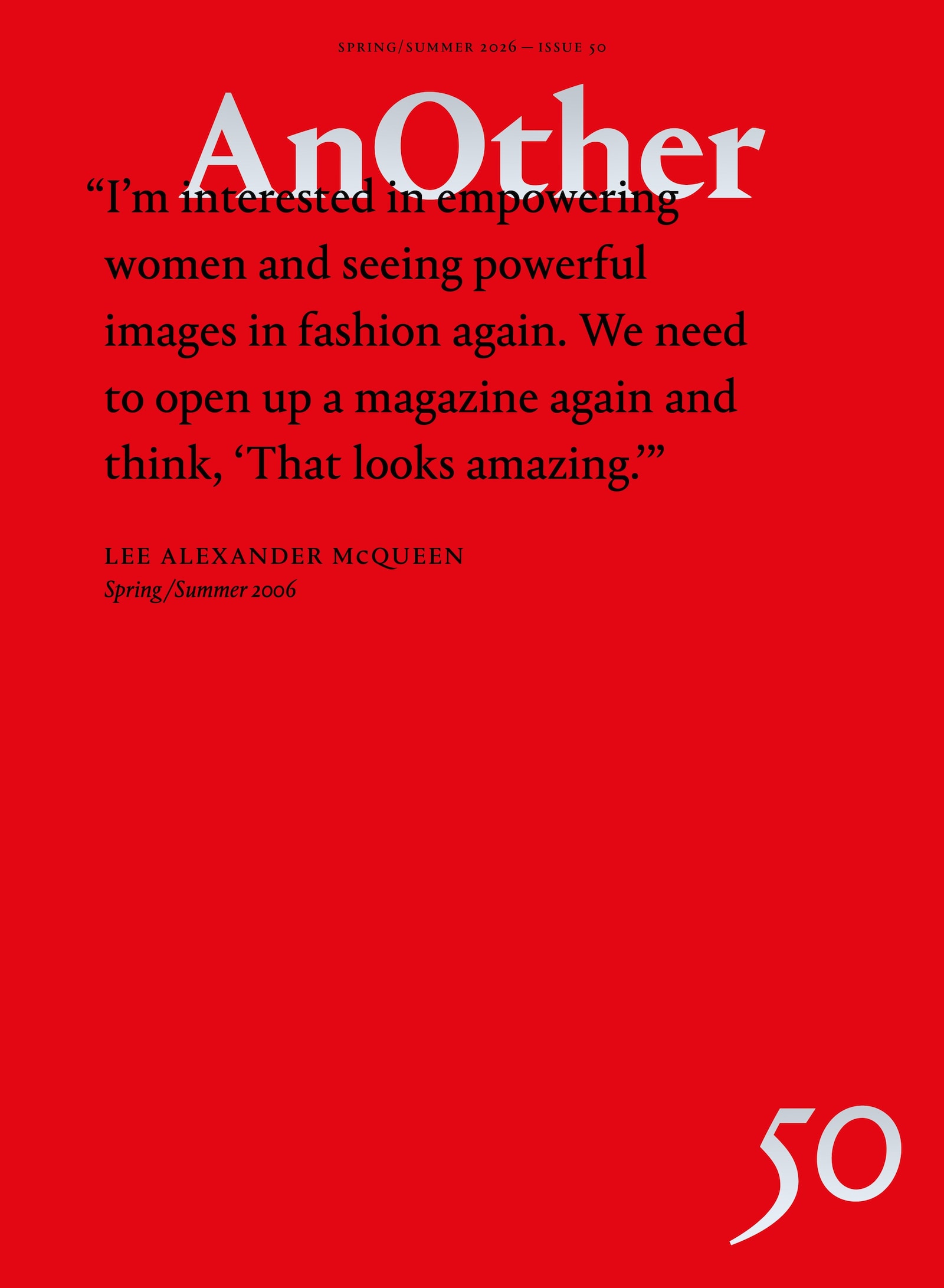
This story is taken from the Spring/Summer 2026 issue of AnOther Magazine:
Each issue we invite a cultural luminary to guest-edit Document, our literary section – past editors include Wim Wenders, Luca Guadagnino, Bjork, Ocean Vuong, Kim Gordon and Tilda Swinton, to name but an illustrious few. To mark our anniversary issue, we have done something different, turning to the words of the world’s greatest designers, people who we have been lucky enough to talk to throughout the past 50 issues, and whose thoughts and observations have filled our pages. Their voices, like their chosen metier, are a vital cultural and social barometer of the times. Taken from their expansive interviews over the past 25 years, and incorporating names from Alexander McQueen to Yohji Yamamoto, here are 50 of our favourite extracts. The edit appears in full, across 32 pages, in the Spring/Summer 2026 issue.
Fashion is more than a visual medium. The thoughts, ideas and voices of designers drive our industry also. For the past quarter-century, we have been fortunate enough to speak to its greatest names, those who have defined and redefined their metier in the 21st century. To say that fashion is a mirror of its time – as stated by Louis XIV, if you please – is a cliché but, as Marc Jacobs implies in these very pages, a cliché is a cliché for a reason. Fashion is an intrinsic part of culture, of a dynamic exchange that delineates an era, and one that we have always sought to present in that context.
At AnOther Magazine we take care of the words that run alongside any imagery. Our fashion stories are prized but the unprecedented access we have enjoyed to designers from Alexander McQueen to Yohji Yamamoto – that’s alphabetical, so imagine everyone in between – affords those stories further meaning, fixes them in time. Since the magazine’s inception, we have invited different luminaries, spanning different creative practices, to guest-edit a 32-page literary section of favourite writing. Past talents include Björk, Sofia Coppola, Luca Guadagnino, Hilton Als, Chris Kraus, Tilda Swinton, Ocean Vuong and Wim Wenders. It serves quite literally as a document of the past, an indication of a future and, perhaps most evocatively, a definition of our present.
To celebrate the designers who have taken the time to talk with us about their work, for this anniversary we give this space to them. Over the following pages, we have excerpted the words of those who have been central to the making of this title. They touch on everything that has changed our world since 2001, beginning, of course, with 9/11, moving through the boom of the first decade of the century, to the 2008 crash and, more recently, the Covid-19 pandemic and the Black Lives Matter movement. All are representative of seismic shifts in thinking and feeling.
Some of the stories told in these designers’ words are sad, at times they are angry, at others uplifting. Some are conversational, others short and sharp. They are all illuminating, encompassing the state of our world and of humanity at the time in which they were spoken. They express the indefatigable power of creativity. For all their wise and immensely generous words, we thank every one of them. It is their input that drives our vision – is its lifeblood.
Words by
Virgil Abloh, Haider Ackermann, Miguel Adrover, Azzedine Alaïa, Jonathan Anderson, Giorgio Armani, Christopher Bailey, Manolo Blahnik, Sarah Burton, Hussein Chalayan, Willy Chavarria, Maria Grazia Chiuri, Telfar Clemens, Demna, Julien Dossena, Alber Elbaz, Silvia Venturini Fendi, Tom Ford, John Galliano, Jean Paul Gaultier, Nicolas Ghesquière, Lazaro Hernandez, Viktor Horsting, Marc Jacobs, Kim Jones, Stephen Jones, Rei Kawakubo, Andreas Kronthaler, Christian Lacroix, Karl Lagerfeld, Helmut Lang, Daniel Lee, Raul Lopez, Christian Louboutin, Maison Martin Margiela, Glenn Martens, Jack McCollough, Lee Alexander McQueen, Alessandro Michele, Pieter Mulier, Kei Ninomiya, Shayne Oliver, Rick Owens, Phoebe Philo, Pierpaolo Piccioli, Stefano Pilati, Miuccia Prada, Gareth Pugh, Simone Rocha, Martine Rose, Daniel Roseberry, Jil Sander, Raf Simons, Martine Sitbon, Hedi Slimane, Rolf Snoeren, Jun Takahashi, Riccardo Tisci, Dries Van Noten, Vaquera, Donatella Versace, Grace Wales Bonner, Andre Walker, Junya Watanabe, Vivienne Westwood, Pharrell Williams, Yohji Yamamoto
2000s
1. “Let’s face it, when people look back to September 11 in 50 years’ time, they’re not going to wonder what sort of fashion people were designing.” – Lee Alexander McQueen, Spring/Summer 2002
2. “Fashion is for everyone.” – John Galliano, Autumn/Winter 2002
3. “It is our view that it is not impossible for independence to prevail even though the overall economic climate within which our industry continues at the moment is a bit dark. This is certainly not the first time that the economic climate is depressed and, after all, ‘necessity is often the mother of invention’. An example of this is a skirt that is constructed and worn like any other yet a slit has been cut into the middle of its front panel. This slit allows for the fact that, once the front panel is lifted up and the head of the wearer passed through it, the skirt becomes a backless halter top. Pleated skirts and lined dresses have their hemlines lifted and fixed in place at the waist or the shoulder, other skirts are entirely lifted up so that the front hemline finds itself across the collarbone, the back hemline draping low, revealing the back of the wearer.” – Maison Martin Margiela, Spring/Summer 2003
To conserve the idea of anonymity and community central to the creative representation of the designer Martin Margiela, the house issued quotes written in the plural and credited to the Maison rather than its namesake. This continued after Margiela’s departure in 2008, until the appointment of John Galliano as creative director in October 2014.
4. “Without fantasy, life is too real.” – Lee Alexander McQueen, Spring/Summer 2003
5. “What’s the point in hiring someone for their creative vision if they don’t trust that person’s creative instincts and go with it? It seems ridiculous to me.” – Pharrell Williams, Spring/Summer 2003
Interviewed here before he began his career as a designer, Pharrell Williams had already achieved global fame as an award-winning musician and record producer. In 2005, he co-founded the fashion label Billionaire Boys Club with Nigo; a year before, the duo had co-designed eyewear styles with Marc Jacobs for Louis Vuitton (that designer was creative director at Vuitton from 1997 to 2013). In a full-circle moment, in February 2023 Williams was appointed creative director of that house’s menswear.
“Fashion at the moment has a responsibility to commit, to understand or feel the time, even if it feels uncomfortable” – Hedi Slimane
6. “Fashion has the incredible chance right now to respond and develop a new code, which is only possible when society is shifting.” – Helmut Lang, Autumn/Winter 2003
7. “We all want to be attached to something.” – Miuccia Prada, Autumn/Winter 2003
8. “There’s absolutely no reason to apologise for wanting to look beautiful, sexy and young.” – Marc Jacobs, Spring/Summer 2004
9. “For the last couple of seasons what I have been working on is the idea of modern glamour, modern elegance. I had to really think this season, ‘Why did I get into the business? Why did I become a fashion designer?’, and it was because I wanted to make women beautiful, because I wanted to make beautiful things. I think that that’s really what we need at this particular moment. I love the idea of eye candy – eye candy as a sort of modern beauty.” – Tom Ford, Spring/Summer 2004
10. “What I try to bring back to fashion is beauty. People are looking for real things just now, not façade. I love simple things. That doesn’t mean boring, just not manipulative.” – Alber Elbaz, Spring/Summer 2004
11. “We live in a very interesting time, and I don’t understand those who think the contrary. There are many new situations coming about in all fields; we need to invent a new world, a new way for us all to live together. To me this seems a fascinating project and I do not understand how people can be pessimistic.” – Miuccia Prada, Autumn/Winter 2004
12. “I have no problem with the word cliché.” – Marc Jacobs, Spring/Summer 2005
13. “Escapism is a temptation that I refuse. I want to find it in the here and now.” – Miuccia Prada, Spring/Summer 2005
14. “Fashion at the moment has a responsibility to commit, to understand or feel the time, even if it feels uncomfortable. There’s a vital need to live it fully. It is the time for change, but strangely it feels like people are attached to their current fantasy world. I don’t see much curiosity or even hope. It drives me mad. I’d like to think we are living these fantastic creative years. The world may be warmer, a bit run-down – it is certainly not a cold, perfect machine – but it is truly the beginning of something. A new romantic world.” – Hedi Slimane, Spring/Summer 2005
15. “I never take a collection to its logical conclusion. It is always more interesting to stop just before.” – Rei Kawakubo, Autumn/Winter 2005
“The future is now” – Hussein Chalayan
16. “In theory, it’s completely wrong that if one thinks of dressing beautifully, one always thinks back. Why shouldn’t there be a form of beauty that is for now? I think we have to redefine beauty that is for our time, and that time is more complicated, of course. It was very easy to find a beauty and to dress people in a society that was small and enclosed – if you were living in Paris, say, and the women were very rich. But now we have to face a far more complicated world, a far more complicated mentality, with different concepts and different religions. So, for me, the problem is still how to create something beautiful, something beautiful but right for today.” – Miuccia Prada, Spring/Summer 2006
17. “I am also obsessed with the thinking process of a futurist. For many years people have been looking inside the lines and not at the lines themselves ... It’s the future to think about the future. The new century didn’t start four, five or six years ago. It’s starting right now.” – Raf Simons, Autumn/Winter 2006
18. “I am reacting against boredom, against always having to behave and be nice.” – Miuccia Prada, Autumn/Winter 2006
19. “When I was very young, my grandmother took me to see an operetta at the Châtelet theatre in Paris. I can still remember my excitement at seeing dancers on stage – I was bewitched. Collaborating with [the renowned choreographer] Régine Chopinot on Délices in 1983 opened my eyes to contemporary dance. For Défilé [1985] ... I decided my purpose was to hinder movement. In platform shoes that were ten inches on one foot and three on the other, the dancers had no choice but to move differently. Whereas models are a bit like mannequins – passive – dancers’ movements give life to the costumes. For me, dance is an expression of art, while fashion is an expression of craftsmanship. When I include dance in my own shows, I find those moments so important that l include them at the beginning and the end. The middle is reserved for me. Dance is my ‘sauce’.” – Jean Paul Gaultier, Spring/Summer 2009
20. “The future is now. Every second you live is the future. I have never seen the future as this removed thing.” – Hussein Chalayan, Spring/Summer 2009
21. “Fashion doesn’t need to be about this small clique of people who are the only ones who understand it. This is a democratic industry as well and I love that.” – Christopher Bailey, Autumn/Winter 2009
2010s
22. “I remember going to the Brook Street store years ago now. You felt so unwanted that you wanted to be wanted. I bought a Comme des Garçons striped shirt for £129. Why was it special? It had Comme des Garçons on the label. I think that every designer you ask will be influenced by Rei in one way or another, but what makes them a good designer is them moving the Rei concept on for their own label — the tulle over a suit, masking a jacket over a coat, pearls trapped inside layers of fabric — moving it forward, not just taking it, digesting it and regurgitating it the same way. What’s really impressive about her is that she’s never backed down. I believe everyone should be like that, but it’s hard. I’ve been in this business for 20 years now and I know how tough it is to do the things you want to do. Rei doesn’t compromise, nor should she. No one should compromise. Compromise makes people dull.” – Lee Alexander McQueen, Spring/Summer 2010
The Spring/Summer 2010 issue of AnOther Magazine featured a series of quotes from key fashion figures celebrating the groundbreaking work and influence of Rei Kawakubo, including her fellow designer Lee Alexander McQueen. This interview was completed shortly before his death in February 2010.
“No one should compromise. Compromise makes people dull” – Lee Alexander McQueen
23. “The main pillar of my activity is making clothes, but this can never be the perfect and only vehicle of expression. I am always thinking of the total idea, and the context of everything. Fashion alone is so far from being the whole story. It seems that with fashion, as with art, things are getting easier in one sense but at the same time it is getting harder to be stimulated about things or to excite people. Without that impetus of creation, progress is not possible. All kinds of ways of expression are spreading out all over the place, information is overflowing, and it’s harder and harder to be excited about anything. In order to be stimulated or moved in the future, we probably have to go into space and look at our world from there. What do I think is an unyielding spirit? It would be wonderful if everyone had it in equal measure. But it’s impossible. This defiant mentality can also be called the fight against absurdity and injustice and the power (authority) that thrives around it (that is rampant). One cannot fight the battle without freedom. I think the best way to fight that battle, which equals the unyielding spirit, is in the realm of creation. That’s exactly why freedom and the spirit of defiance is the source (fountainhead) of my energy.” – Rei Kawakubo, Spring/Summer 2010
24. “There is one moment that remains with me – selling my very first car, a white Volkswagen Beetle. It was beautiful, although rigid and spartan, with seats in faux leather, and I loved driving it, often on short trips throughout Italy. But the moment arrived to make a major decision in order to start my business, and I had to sell the car. The money I got for it helped found and launch, in 1975, Giorgio Armani. It was very hard for me to sell that car, and at the time I had no idea what the future had in store for me. On the other hand, there is always a critical moment at which one is forced to make certain decisions, and once the decision is made, that moment remains forever in one’s memory. That little Beetle, however, always remained dear to my heart, and as soon as I could, I bought it back.” – Giorgio Armani, Spring/Summer 2014
25. “My business plan was to be Charles James. I was going to make beautiful things and live in glamorous squalor on Hollywood Boulevard and die the hero for having stuck to my vision and not compromised ...
“I’ve always loved a bit of sleaze. That used to be our life and I miss that. I enjoy the romance, the poignant element of that attraction to self-destruction and decay, to imperilled beauty ...
“I hate mood boards. In fact, I condemn mood boards. They’re just so corny – my inspirations are private. I use biblical references a lot ... I love Madame Grès. And when I mix that with skateboarder shorts and a big bomber, it crosses the entire spectrum of history ...
“I hate miniskirts, that thing where you have to cross your legs wherever you are when you wear them. You’re in this super-high miniskirt and high, high heels and you’re tottering along on cobblestones in Paris ... I mean, why not just put restraints on the girls and then blindfold them?” – Rick Owens, Spring/Summer 2014
“I live with the climate. I am like the fruit. When I’m ready, I’m ready. There are no rules, it’s a way of life” – Azzedine Alaïa
26. “One has to maintain a vague mystère ... I personally have nothing to say, nothing to explain. I make such big efforts to forget things and I can’t tell the story of my life because, thank God, I’m still living it. Non, non, non, I couldn’t tell the truth ...
“I’m not a very sociable person. I’m very at ease and good at small talk, but I don’t have much time. And social life bores me. People don’t bore me, social life bores me. But I’m perfectly happy. I adapt very well to our times. Better than many people. I have the opportunity to do a job that I love in the best conditions, because better conditions than this you cannot have.
“We lived on the Danish border and they were not like me, so I thought I was the king of kings. But I had to make an effort to get my mother’s attention. She spent her life reading on a couch during the day. She never lifted a finger but she knew how other people should lift their fingers. For some people that could have been frustrating, but she wasn’t being unkind. She was always right. I think that’s génial ...
“As a child, I never had a meal where I was not properly dressed. I wore what other people did not – Tyrolean outfits – and I loved that …
“There are photos people have sent me, because I kept nothing. You see all these schoolboys with little shirts and little knits made by their mothers, with short blond hair, and in the middle is a creature with long hair, a big bow and a black jacket. That’s me. Ten years old ...
“I remember in the little village – it’s not so little now, it’s a town – one day we came upon a teacher who always told me, ‘Cut your hair!’ And he said to my mother, ‘Oh, Madame, could you tell your son to cut his hair?’ And you know what she did? She approached the man, took his tie, threw it in his face and said, ‘Why, are you a still a Nazi?’ I will never forget that, this woman who for the village was beyond exotic. She had a perfect nose and was a size 38 even when she was 80. She used to say, ‘You look like me, but not as good’ …” – Karl Lagerfeld, Spring/Summer 2015
“I was just horrified by the way the world is run by such terrible people, people who torture other people, people who create wars” – Vivienne Westwood
27. “I live with the climate. I am like the fruit. When I’m ready, I’m ready. There are no rules, it’s a way of life ...
“I’m always curious. When I wake up in the morning, I brush my teeth and then I think, ‘Who am I going to meet today, which new people, and what am I going to learn?’ Because I’m always an apprentice ...
“Time touches everyone and everything. It interests me because I discover time with all the people I’ve met, they’re all interesting people, important people, people of all ages. And you see everyone is different in the time they live. The street is very interesting for me too. You can stay inside but you have to go outside and look at different generations – the children of my friends, young women – it’s important that you go forward in your work. You can learn from them too. Young people are the future. The past, we know it. We live in the present. The future is obscure. But time is a very important issue. People need to be aware of it because they shouldn’t waste time. If they’re aware of it, they won’t waste it ...
“The basis is always the woman, the body you dress. I’m not thinking about being fashiony or revolutionary. I don’t think about making something that is ‘Alaïa’. I never think about that. I never thought about being a famous designer or a couturier. I admire women because it’s thanks to them that I do what I do. I’m not interested in the noise around fashion. When I make dresses for women, for my friends, and I see that I’m making them feel beautiful, when I see that they’re happy, I’m happy too. I am always happy to see women happy. If she’s getting married, she’s going to wear that dress, she’s going to have memories of it. It’s an important moment, a big thing, so I feel I should do as much as I can to make the clothes perfect. If a woman doesn’t feel good or at ease, it’s a lost evening, a failed evening. Poor girl …” – Azzedine Alaïa, Autumn/Winter 2016
28. “When I was doing punk I was just horrified by the way the world is run by such terrible people, people who torture other people, people who create wars.” – Vivienne Westwood, Spring/Summer 2017
29. “The women of the Fifties are not like the women of now. You can’t speak the same language. I can’t speak like Monsieur Dior – ‘Women are like flowers.’ Honestly, can you imagine me saying that? Please ... ‘Evolution’ is the wrong word. Evolution is something that means the past was less and now is better. I think the word is ‘difference’. It’s a different moment.” – Maria Grazia Chiuri, Autumn/Winter 2017
30. “You can be exactly what you want to be. More than anything, fashion is an expression of a way of life, a point of view. It’s like a universal language. And if you work with empathy towards people, it’s very powerful ...
“I wanted to do something beautiful, that was all. I knew it was inside me. I was surprised when people started talking about genderless fashion. I mean it might seem new now but it wasn’t in the past. We maybe live in an era that’s not so open to everything as we think ...
“We change the brands, we change Gucci and Louis Vuitton, their aesthetic, their creative directors but the expression of their culture is always alive. The idea that, I don’t know where, on the other side of this Earth, someone is appropriating our language is incredible. That’s why I feel free to talk about those people. It’s important to say something real. People really need reality.” – Alessandro Michele, Spring/Summer 2016
“I have to admit that in the last years, with Boris Johnson, Brexit, Trump, everything that was happening, I started to think more of fashion as a kind of escape” – Dries Van Noten
31. “For me, everything is about emotion. Emotion is the only way to connect the path.” – Pierpaolo Piccioli, Spring/Summer 2017
32. “We would have dinner parties, we would have the biggest drama, biggest fights. And the biggest love. And we were like this working together, two different people. Gianni and me – we were totally different people. You know, everything started here …
“I was Gianni’s disturber. I wasn’t a muse. I was the one who made Gianni think. I’d never say I like it right away. ‘We can do better. You can do better. You know you can do better than this. Don’t be afraid’ …
“I remember the last show of Gianni in Paris. We were singing, both of us, we were singing the music of the show – loud – and people were looking at us and saying, ‘They’re crazy, these two.’ We were so happy that day, and I remember it like it was yesterday. I want to remember Gianni like that. The last day we’d be together, doing the show in Paris, that collection. He was killed five days later. It was July, in Paris. I left the Hôtel Ritz and went outside to say goodbye …
“He went the next day, he was taking the Concorde – which was still there! – to go to New York and then to Miami, and said, ‘I’Il see you in three days.’ I was supposed to go there in three or four days.” – Donatella Versace, Spring/Summer 2018
33. “I think perfection is ugly. Somewhere in the things humans make, I want to see the scars, failure, disorder, distortion. If I can feel those things in work by others, then I like them. Perfection is a kind of order, like overall harmony, and so on. These are things someone forces onto something. A free human being doesn’t desire such things ...
“Choosing an outfit is choosing a life.” – Yohji Yamamoto, Autumn/Winter 2018
34. “I like to be real. I’m a realist and I am obsessed by what I do. Ultimately there’s an obsession to be the best. And it just happens to be fashion. In a weird way I fell into it. It always had to be something creative but whatever it would be I had to play at the top of my game. I wanted to be one of the top ten designers in the world because, otherwise, what’s the point? I just feel like I have an addiction to aesthetics – the idea of building aesthetics, people creating things together that are my vision of what a world should look like ...
“I think I’m not all that easy to like. Of course, my father is incredibly competitive and I think there is something in that. But I have taken that something to a different level, because with sport there is a friendliness in the end, whereas in fashion ... In fashion, there’s not so much of a friendliness …” – Jonathan Anderson, Autumn/Winter 2019
2020s
35. “Fashion is about outsiders, and I’ve always been attracted to outsiders, alternative people. It’s definitely where all the freaks end up. But then, within that, it creates its own sort of conformity ... I don’t get offended if it’s not everyone’s thing at all. It’s really not supposed to be ... I think I’m, for lack of a better word, rebellious by nature. Since I was really small, I’ve never really liked the idea of mass anything. If I felt that lots of people were doing one thing, I would absolutely go the other way. I went to see an Ibsen play when I was about 17, An Enemy of the People. It’s basically about the danger of mass – of the mindless mob, that there is no thought and there’s something inherently dangerous about mob mentality – and it really struck a chord with me. I’d always felt like that.” – Martine Rose, Autumn/Winter 2020
36. “I’m interested in beauty and connecting that through time – that’s one guiding principle for me. My work also connects to identity, but it’s more about revealing something that is timeless or something that has always been there but hasn’t always been represented in a nuanced way in fashion. I believe that beauty can seduce you into an ideology.” – Grace Wales Bonner, Autumn/Winter 2020
37. “Fashion is seen as a business, as consumption, but I believe in fashion as part of the social fabric. I grew up with fashion that meant something.” – Stefano Pilati, Autumn/Winter 2020
“During the lockdown period, something drew my mind to the way we felt during the Thatcher years, our backs up against the wall. Nothing can stand in the way of this kind of creativity” – John Galliano
38. “During the lockdown period, something drew my mind to the way we felt during the Thatcher years, our backs up against the wall. Nothing can stand in the way of this kind of creativity … I was hungry for the kind of aspirational beauty that inspires hope. In many ways we were expressing the same sentiment in the Eighties. It was a hankering for beauty, for heroism, hedonism and hope ...
“We may be in a time of limitation, but we still have a human need to dress up, express ourselves and have a good time. Glamour needs an audience. I’ve never referenced a period in my own life before, but the emotional state of lockdown evoked an energy I had felt before ...
“In the beginning, [the Covid-19 pandemic] filled me with anxiety – and like everyone, of course, we had to deal with practical challenges. To me, it became a matter of turning those challenges into a sense of resourcefulness. I applied some of the things I’ve been fortunate to have been taught in the past. It’s like a mourning period – once you accept reality, you are able to embrace the unknown. And so it became a driving force – the feeling that nothing would stand in the way of creativity …
“The idea of fight and flight is another way of expressing resourcefulness and escapism – elements that have been inseparably interlinked through history. The human desire for beauty and seduction is a powerful instinct …
“Believe in yourself. Believe in your dream. Be passionate. You can be whatever you want to be. Don’t listen to anybody who says you can’t.” – John Galliano, Autumn/Winter 2020
The Autumn/Winter 2020 and Spring /Summer 2021 issues of AnOther Magazine were created under the restrictions of the Covid-19 lockdowns affecting countries around the world. Designers were interviewed via Zoom and featured in conversation with other, like-minded creatives, accompanied by self-shot portraiture.
39. “Arthur Jafa broke it down in a very simplistic way. He was like, Black people are born conceptual artists ... pressure creates diamonds, right? When you’re born, you just hop on Earth at a young age and don’t understand, you don’t know, the systemic rules of the world. You only feel those when you go to school and some kid says, ‘You must behave like this, you must talk like this, you’re a different human being.’ And then that pressure, as you grow older, it just keeps crushing down and it creates diamonds. When we output, we conceptually do this calculation that inherently comes through our skin and our perception of our skin. For me, instead of being hardened or pessimistic, driving myself crazy, as a profession like this can make you, that idea just sort of reorganised my operating system ...
“For 2021, the pressure’s off. There’s nothing more satisfying than instead of looking for acceptance, or looking for a fairy-tale existence, all of a sudden realising there’s no gatekeeper. I know what I need to create with my time ...
“What I’m excited about is the nonjudgemental space. I don’t believe in genres, or disciplines of creativity, I like when they blur. I want to see this as a renaissance. I want to see some non-genredefining amazingness, because I believe that our generation has that. I can’t wait to see what the pressure from 2020 built.” – Virgil Abloh, Spring/Summer 2021
The founding designer of the label Pyrex Vision, which later became the brand Off-White, Illinois-born Virgil Abloh was appointed artistic director of menswear at Louis Vuitton in 2018. In 2021 his Vuitton role was expanded to have a wider creative remit across LVMH, with the group acquiring a majority stake in Off-White at the same time. Abloh featured in the Spring /Summer 2021 issue of AnOther Magazine in conversation with his fellow designer and friend Shayne Oliver. Abloh died in November 2021.
“It’s the most exciting thing – people discovering something that can change the way they think” – Kim Jones
40. “Now in fashion, quite often, we are spoiled brats. We can do whatever we want. We have the money to pay for the most amazing fashion shows. If we want to make it rain on a fashion show, we can make it rain. If we want to fake sunshine, we can have fake sunshine. Now, poof! You can’t have contact any more. Now we have to bring emotion by Zoom, by video, by photographs. How can you do that? You can’t see clients any more so you have to reinvent, but with a lot of limitations. And in fact, it’s quite stimulating because you start to see some of the things we’ve lost ... In the end, fashion has to reflect what’s happening in the world and moderate it. Fashion has to be, to use a very fashionable word, relevant, because otherwise it’s an anachronism. But I have to admit that in the last years, with Boris Johnson, Brexit, Trump, everything that was happening, I started to think more of fashion as a kind of escape.” – Dries Van Noten, Spring/Summer 2021
41. “I always have the feeling that clothes should be timeless, and if they’re beautifully made, stripped to the bare bones and essential, that will hopefully be the case. It’s also nice to look at the insides of clothes, which are often as beautiful as the outsides, and at how to make clothes feel relevant for today. How do we make clothes that are more considerate to the wearer, more emotionally resonant? With London feeling completely deserted – bereft – I wanted people to be able to relate to the clothes. I also wanted the collection to be bolder and stronger. I wanted to say, ‘It’s OK – we are carrying on.’ I wanted to be brave, to make things I love and to challenge myself ... As a woman you have to be able to do so many things. I love that and the layers of complexity it involves. I always want to empower women, not in the obvious ways, but in ways that speak to all sides of them.” – Sarah Burton, Spring/Summer 2021
42. “It’s the most exciting thing – people discovering something that can change the way they think.” – Kim Jones, Spring/Summer 2021
43. “Fashion is about life. Fashion is the closest thing to life – because every day, from the first day of our life, we put something on our body. So it’s such a crazy thing to apply boundaries or limits. Because life isn’t about limits.” – Alessandro Michele, Autumn/Winter 2021
44. “We’ve always been very much about the real world. You’re going to see it around you in your day-to-day life before it gets in the magazines. We’re turned on by entertainment, TV and what’s actually going on in the culture sphere globally, on a mass level where every single person sees it, not just a select few who are part of an exclusive group.” – Telfar Clemens, Autumn/Winter 2021
45. “I ask the two heads of the atelier, when we see pieces, ‘Is it Alaïa?’ Always. At the beginning they didn’t answer me. I said, ‘I really respect you, I really want to know. Is it Alaïa?’ In three weeks they started to answer. They’ve been here 25 years, they know. Last week, when we did the selection for the runway and the showroom, they were both crying. That’s even more important than the collection – the ateliers are alive again. It’s a human thing … I hope that comes through, that emotion. And I hope that emotion will be the same in the people who see it. It’s driven by emotion. It needs to make the heart beat … I mean, we’re at Alaïa.” – Pieter Mulier, Spring/Summer 2022
“I’m extremely nostalgic. Things from the past have really made an impact on me” – Raf Simons
46. “I’m extremely nostalgic. Things from the past have really made an impact on me. Things that are daily with me, I think about them all the time, which is in fashion language people like Margiela or Helmut Lang, in music people like David Bowie or Kraftwerk. That is true, for sure ... I always saw the clothes only as one part. For sure, the people we worked with were as important as the clothes, the music was as important as the clothes, the attitude, the places we chose to show in, the relationship between environment and audience, that was all of the same importance for me. It was not, ‘Oh, I make collections, how are we going to present them?’ No way. And still, up until the possible. It’s so connected …” – Raf Simons, Spring/Summer 2023
47. “Just because you’re queer, or Mexican American, or because you’re trans ... or any marginalised person, it’s almost like we’re expected to be full-on activists about it today. Whereas, with my brand, it’s nice to have this moment that is beautiful, real and simply itself without being overtly activist. I think there are so many different approaches to activism and I celebrate all of them. I go to marches and I do things that are typically political, but when it comes to my work I like to take a more elegant approach to how I celebrate humankind.” – Willy Chavarria, Spring/Summer 2023
48. “I grew up at a time when the designers making noise were Alexander McQueen and John Galliano, obviously graduates of Saint Martins. I think that’s how I came to it. I was really thinking, where did they go to school? I saw their work on the internet – it was at the beginning, when there was AOL dial-up – and I guess it was Vogue a little bit too. While at Saint Martins I did an internship at Margiela. That was the first job I had. Martin Margiela was still there. It was good. I arrived speaking no French, so it was challenging at the beginning. But it was a growing experience. And I worked for Nadège [Vanhee-Cybulski, now at Hermès]. After that I went to Balenciaga when it was designed by Nicolas Ghesquière. I worked with a guy who then became my boss at Céline. It was all very connected. At Donna Karan it was Louise [Wilson, then head of the Central Saint Martins fashion MA, who consulted for that brand] ... I love my work, so everything feeds into that, going to an exhibition, to the theatre, a ballet, a concert. Everything feeds in. I really enjoy the physicality of making things and the fact that you don’t have to overthink. It’s more of an instinctive process, more primal. And then I love to give what I make a context and that’s given to you by other people and the contacts you make, the people you put the product on. We’re just at the beginning [at Burberry] and it’s an evolution – we’re becoming more comfortable, building a team, a way of working. As the custodian of a brand that has been around for so long, I feel that every chapter is important.” – Daniel Lee, Autumn/Winter 2023
49. “We designers, when we take over houses, we are the keepers of memories, but we need to take them somewhere else. What I did with Mr Ford’s life and work, over last summer, I took everything in. I saw everything. I saw every one of his interviews. I saw every piece of his work. And then I rejected everything.” – Haider Ackermann, Autumn/Winter 2025
50. “When we start the process of making a collection, we need material to talk about. Not fabrics, creative materials. We need stories. We need to share emotion and something that is quite universal. It’s interesting because it has to be specific but also quite universal. And especially with Vuitton, we know how many people we reach, we know the visibility is enormous. The work is so personal, so emotional, but so collective also …
“I love the idea of everyone having an intimate secret power, of everyone’s small power being a big power. I have always been interested in, I don’t know if we can say empowering women, because I don’t think women need my clothes to empower themselves, but it’s true if I can give women a certain confidence that represents strength, without hiding sensitivity and femininity, it’s not about armour … I’m happy if I can contribute to that. And for sure my references are, and always were, based on the idea of heroines, but heroines of the everyday, heroines of comics, heroines of movies. I mean, I was more attracted to fighters, to women that fight – they can fight against an alien, but they can fight socially too, they can fight in their everyday life even for simple things. I’ve always been interested in that, in this idea of strength, more than in romanticism. I don’t really know why …
“I think we are very serious about what we do but we don’t take ourselves too seriously … ” – Nicolas Ghesquière, Autumn/Winter 2025
Interviews by Emma Hope Allwood, Sophie Bew, Tim Blanks, Emma Davidson, Susannah Frankel, Jo-Ann Furniss, Alexander Fury, Donatien Grau, Hannah Lack, Penny Martin, Callum McGeoch, Sagal Mohammed, Lynette Nylander, Olivia Singer, Jack Sunnucks, Harriet Walker.
This story features in the Spring/Summer 2026 issue, marking 25 years of AnOther Magazine, on sale internationally on 12 March 2026.
